Korean Phrases for Food Allergies and Diet Restrictions

Korean phrases for food allergies combine a clear warning and a specific limit. Say 알레르기가 있어요 (allereugiga isseoyo), "I have an allergy," then name the ingredient with 못 먹어요 (mot meogeoyo), "I can't eat it." Pattern 07 in the SULSUL workbook — 못 (mot) for inability — is the line staff act on fastest.
- Warn the server first: 알레르기가 있어요 (allereugiga isseoyo), "I have an allergy."
- Name what you skip: 해산물 못 먹어요 (haesanmul mot meogeoyo), "I can't eat seafood."
- Ask about an ingredient: 땅콩 들어가요? (ttangkong deureogayo?), "Does it contain peanuts?"
- Request a change: 고기 빼 주세요 (gogi ppae juseyo), "Please leave out the meat."
How do you tell a server before you order?
Restaurants move fast. Lead with the allergy, not the dish name. 알레르기가 있어요 (allereugiga isseoyo) sets the frame; follow immediately with 견과류 못 먹어요 (gyeonggallyu mot meogeoyo), "I can't eat nuts," or whatever applies.
- Catch the server's eye with 실례합니다 (sillyehamnida), "Excuse me."
- State your allergy before pointing at the menu.
- Name the ingredient you must avoid.
- Ask 이거 괜찮아요? (igeo gwaenchanayo?), "Is this okay?" while pointing.
- Close with 감사합니다 (gamsahamnida) once they confirm.
Vegetarian travelers can swap 못 먹어요 for 안 먹어요 (an meogeoyo), "I don't eat it," when the restriction is a choice rather than a medical reaction — both are polite 해요체 (haeyoche).
| Situation | Say this |
|---|---|
| I have an allergy | 알레르기가 있어요 (allereugiga isseoyo) |
| No seafood | 해산물 못 먹어요 (haesanmul mot meogeoyo) |
| No dairy | 우유 못 먹어요 (uyu mot meogeoyo) |
| Leave it out | 빼 주세요 (ppae juseyo) |
| Is it in this dish? | 들어가요? (deureogayo?) |
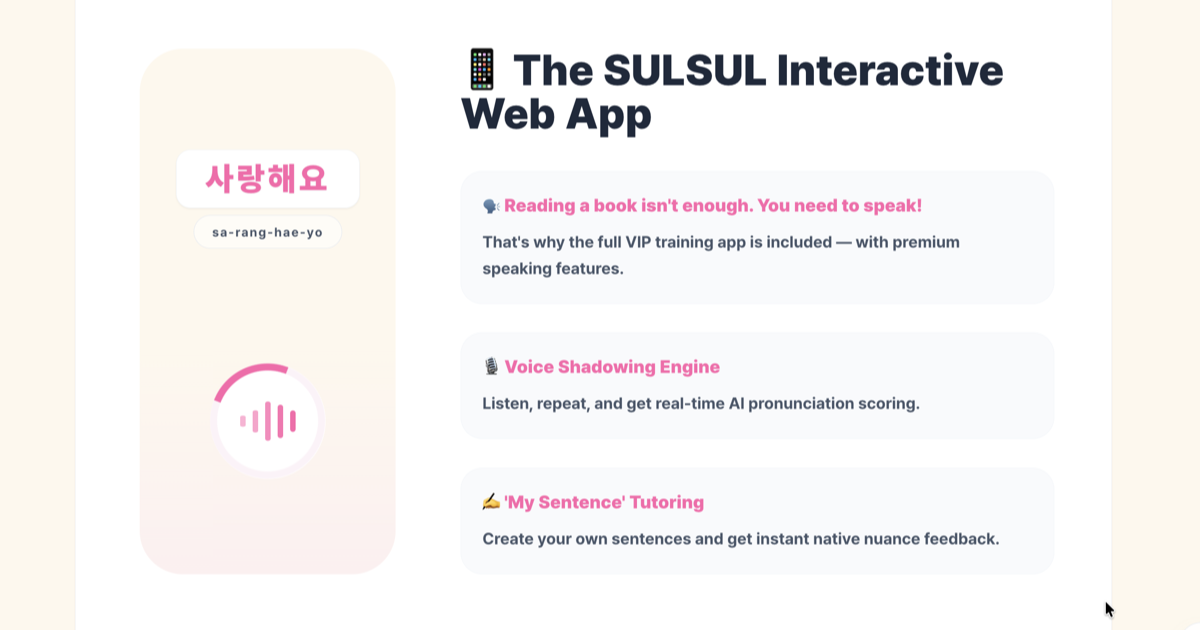
Practice this out loud with SULSUL — the app says it, you repeat it →
What does the staff say back?
Servers often repeat the ingredient to confirm they understood.
You: 알레르기가 있어요. 땅콩 못 먹어요. — allereugiga isseoyo. ttangkong mot meogeoyo. — "I have an allergy. I can't eat peanuts."
Them: 땅콩 빼 드릴게요. — ttangkong ppae deurilgeyo. — "I'll leave out the peanuts."
You: 감사합니다. — gamsahamnida. — "Thank you."
If the kitchen cannot adjust the dish, they may say 어려울 것 같아요 (eoryeoul geot gatayo), "That might be difficult." Ask 다른 메뉴 추천해 주세요 (dareun menyu chucheonhae juseyo), "Please recommend another menu item," instead of guessing from the photo alone.
What if you only realize mid-meal?
Pattern 03 — 있어요? (isseoyo?) — works when you need to check one ingredient on a plate already in front of you. 이 소스에 새우 들어가요? (i soseue saewu deureogayo?), "Does this sauce contain shrimp?" is clearer than describing the allergy in English.
Travelers sometimes whisper 매운 거 못 먹어요 (maeun geo mot meogeoyo) when they mean spice sensitivity — staff hear it as a preference, not an emergency. For a true allergy, always lead with 알레르기 (allereugi). For general ordering lines, see Korean phrases for ordering at a restaurant.
Say it out loud, not just in your head
Reading 해산물 못 먹어요 here is not the same as saying it while a waiter is already writing your order.
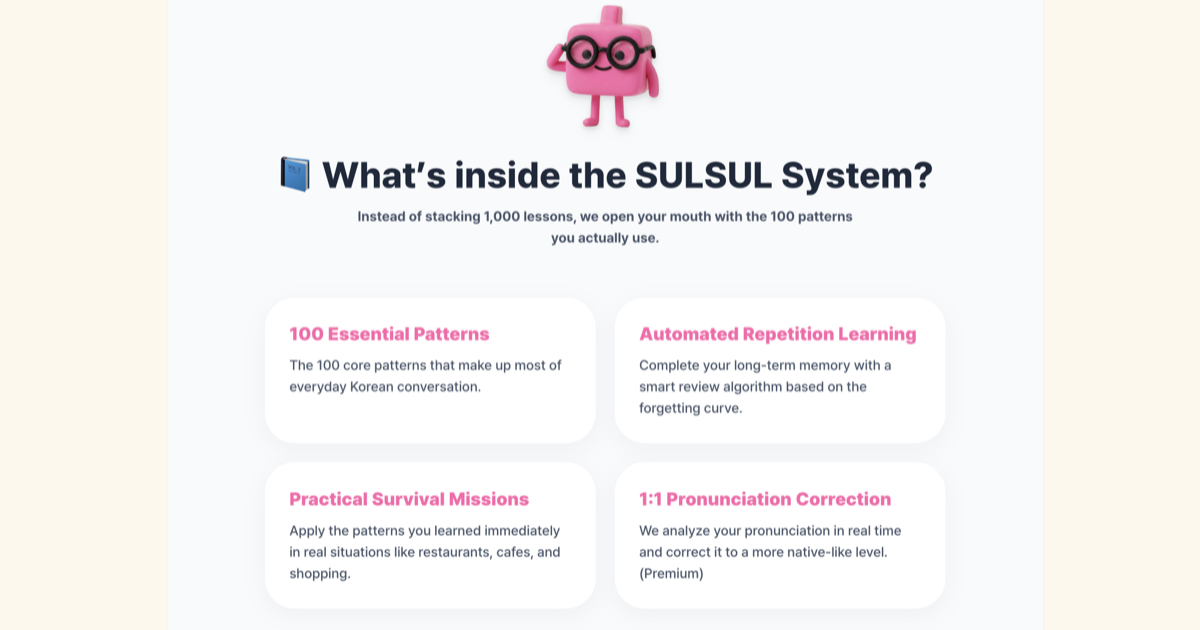
SULSUL is a speaking gym for exactly that moment: pick a survival pattern, say it out loud, get an instant fix from the AI pronunciation coach, then run the real situation as a mission. The 100-pattern PDF workbook comes along as a bonus.