Korean Phrases from Spooky in Love You Can Actually Use


Soompi reported on August 2, 2026 that tvN's Spooky in Love earned its highest ratings yet, making it one of this summer's most-watched dramas. The occult romance between a woman who sees ghosts and a prosecutor who fears them is full of moments where characters check on each other, offer comfort, and struggle to explain the unexplainable. Those moments come with Korean phrases from Spooky in Love that transfer directly into real conversations — 괜찮아요? (gwaenchanayo?), "Are you okay?", works whether you're on a haunted rooftop or just asking a friend who seems off.
- Check on someone who looks upset: 괜찮아요? (gwaenchanayo?), "Are you okay?"
- Offer to stay: 같이 있을게요 (gachi isseulgeyo), "I'll stay with you."
- Express fear honestly: 무서워요 (museowoyo), "I'm scared."
- Reassure someone: 걱정하지 마세요 (geokjeonghaji maseyo), "Don't worry."

Which drama phrases actually carry over to real life?
The lines that survive outside a script are the ones that solve ordinary problems — checking in, reassuring someone, reacting to something hard to believe. Dramatic one-liners written for a ghost plot don't travel well, but these do:
| Scene | Say this |
|---|---|
| Check on a scared friend | 괜찮아요? (gwaenchanayo?) |
| Offer to stay nearby | 같이 있을게요 (gachi isseulgeyo) |
| Admit you're scared | 무서워요 (museowoyo) |
| Doubt something | 진짜예요? (jinjjayeyo?) |
| Tell someone not to worry | 걱정하지 마세요 (geokjeonghaji maseyo) |
진짜예요? (jinjjayeyo?) is worth memorizing on its own. It means "Is that real?" or "Seriously?" and it covers every moment in a conversation where you want to react to surprising news without reaching for a full sentence.
Practice this out loud with SULSUL — the app says it, you repeat it →
How does a comfort exchange actually go?
Understanding the reply is the hard part, not the opener. Here's how the exchange plays out when someone is shaken:
You: 괜찮아요? — gwaenchanayo? — "Are you okay?"
Them: 조금 무서워요. — jogeum museowoyo. — "I'm a little scared."
You: 같이 있을게요. — gachi isseulgeyo. — "I'll stay with you."
조금 (jogeum) means "a little" and softens any admission. You'll hear it in the drama every time a character downplays how they're feeling — and you'll hear it in everyday Korean the same way. Pair it with almost any emotion word and you've described yourself accurately without overstating.

What usually goes wrong when fans borrow a drama scene?
The most common mistake is copying a line without noticing the speech level. When the prosecutor in Spooky in Love speaks casually to the heiress, he's using a register that reflects their growing closeness. Copying that casual form with someone you just met reads as rude, not romantic.
괜찮아요? with the polite -요 (-yo) ending is the safe version — it works with classmates, coworkers, and anyone you've met in the last week. The casual form 괜찮아? (gwaenchana?) belongs only with close friends who have already invited that level of familiarity. If you're still sorting out when to drop the -요, the guide on common K-drama phrases for real conversation explains the boundary in more detail.
I've noticed that the lines viewers quote the most from romantic dramas are usually the ones that are hardest to say in real life — because they require actual emotion behind them, not just a script. Practicing out loud, with someone reacting, is the only way to get past that gap.
Say it out loud, not just in your head
Reading 같이 있을게요 while watching a scene is not the same as saying it when a friend is actually waiting to hear what you say.
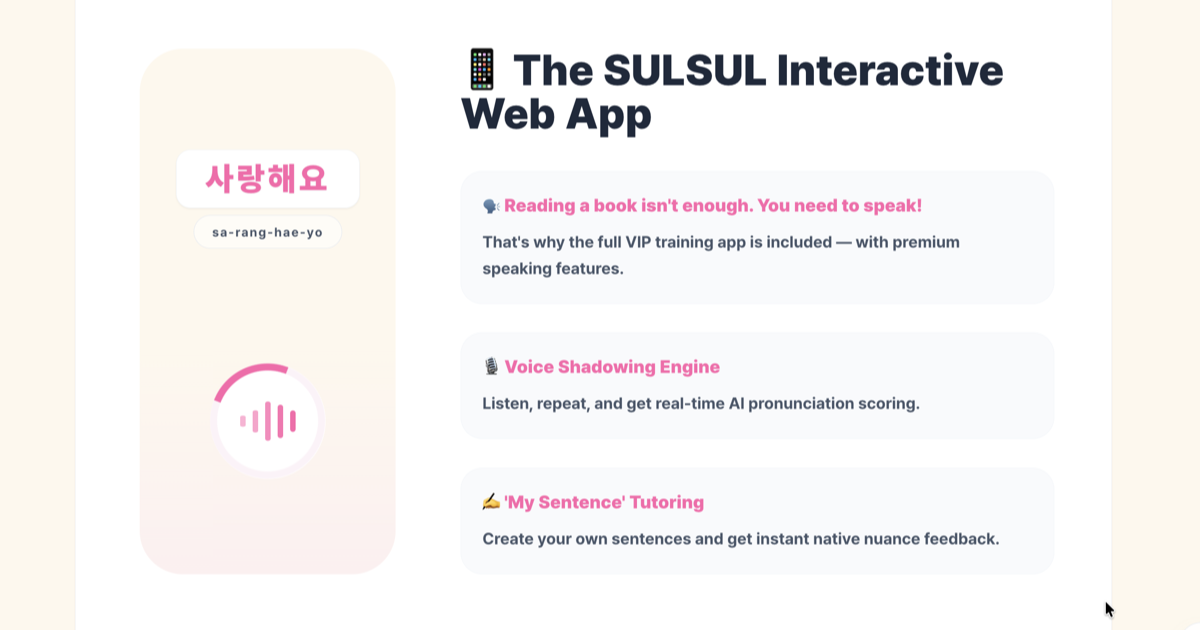
SULSUL is a speaking gym for exactly that moment: pick a survival pattern, say it out loud, get an instant fix from the AI pronunciation coach, then run the real situation as a mission. The 100-pattern PDF workbook comes along as a bonus.