Korean Bio Ideas: Short Korean Lines for Your Instagram Bio, and What Each One Really Says

The best Korean bio lines are short, and most of them aren't full sentences. Korean profile text usually ends in a noun or an adverb, like 천천히, 꾸준히 (cheon-cheon-hi, kku-jun-hi), "slowly, steadily," or 오늘도 행복하게 (o-neul-do haeng-bo-ka-ge), "happily, today too." Leave out the subject and the verb ending, and the line reads like a quiet motto rather than a translated sentence. Koreans call this text 프로필 문구 (peu-ro-pil mun-gu, "profile line") or 소개글 (so-gae-geul, "intro text"), and on KakaoTalk it's the 상태 메시지 (sang-tae me-si-ji, "status message").
- 천천히, 꾸준히 (cheon-cheon-hi, kku-jun-hi) — "Slowly, steadily"
- 오늘도 행복하게 (o-neul-do haeng-bo-ka-ge) — "Happily, today too"
- 나답게 (na-dap-kke) — "Like myself"
- 한국어 공부 중 (han-gu-geo gong-bu jung) — "Studying Korean"
- 꽃길만 걷자 (kkot-kkil-man geot-jja) — "Let's walk only on flower paths"
Why Korean bios drop the sentence ending
In conversation you'd say 저는 한국어를 공부하고 있어요 (jeo-neun han-gu-geo-reul gong-bu-ha-go i-sseo-yo), "I am studying Korean." That's Pattern 10 from the SULSUL workbook, 고 있어요 for something in progress, and it's exactly right when you talk to someone.
A bio isn't talking to anyone in particular, so Koreans strip it down. Three endings do most of the work:
| Ending | What it does | Bio example |
|---|---|---|
| noun + 중 | "in the middle of" | 한국어 공부 중 — "studying Korean" |
| adverb ~게 / ~히 | "in this way" | 오늘도 행복하게 — "happily, today too" |
| bare noun list | a snapshot of you | 커피, 여행, 한국어 — "coffee, travel, Korean" |
Dropping 저는 ("I") is normal everywhere in Korean, not just in bios. The subject is obvious: it's your profile.
Practice this out loud with SULSUL — the app says it, you repeat it →
Bio lines about how you live
These are the kind of lines you'll see on Korean friends' profiles. They are calm, a little poetic, and never loud.
- 천천히, 꾸준히 (cheon-cheon-hi, kku-jun-hi) — "Slowly, steadily." A favorite for anyone working on something long-term.
- 나답게 (na-dap-kke) — "Like myself." The ㅂ in 답 makes the ㄱ tense, so it's kke, not ge.
- 지금, 여기 (ji-geum, yeo-gi) — "Now, here."
- 소소한 행복 (so-so-han haeng-bok) — "Small happiness." Close to the popular word 소확행, short for "small but certain happiness."
- 오늘 하루도 수고했어 (o-neul ha-ru-do su-go-hae-sseo) — "You worked hard today too." A line to yourself, built on 수고하다 from Pattern 91, the comfort-and-encouragement set.
- 행복은 멀리 있지 않아 (haeng-bo-geun meol-li it-jji a-na) — "Happiness isn't far away." This uses the long negative 지 않아, the written-sounding cousin of the 안 in Pattern 07.
If you want one line with a story behind it, 하다 보면 돼 (ha-da bo-myeon dwae), "Keep doing it and it works out," comes from Pattern 73, 다 보면: "if you keep at it, eventually…" It's a perfect fit for a language learner. For single words with deeper meaning, see meaningful Korean words.
Bio lines for Korean learners
Your bio is also a quiet signal to Korean speakers that you'd welcome a message in Korean. Pick one:
- 한국어 공부 중 (han-gu-geo gong-bu jung) — "Studying Korean." The simplest and most common.
- 한국어 조금 할 줄 알아요 (han-gu-geo jo-geum hal jjul a-ra-yo) — "I can speak a little Korean." Pattern 13, ㄹ/을 줄 알아요, for skills you have.
- 한국어로 말 걸어 주세요 (han-gu-geo-ro mal geo-reo ju-se-yo) — "Talk to me in Korean." Pattern 23, 아/어 주세요, makes it a friendly request.
- 일단 해 보자 (il-dan hae bo-ja) — "Let's just try." Pattern 14, 아/어 보다, is "try doing."
Mix languages if you like. Toronto ✈ 서울 or coffee · books · 한국어 looks natural to Korean readers, who mix English into their own bios all the time.
Bio lines for K-pop fans and travelers
Fan bios lean warmer and more playful:
- 꽃길만 걷자 (kkot-kkil-man geot-jja) — "Let's walk only on flower paths," a wish that someone's road is easy and bright. Fans say it to idols constantly, and it works for yourself too.
- 언젠가 서울에서 (eon-jen-ga seo-u-re-seo) — "Someday, in Seoul." Pattern 26, 에서, marks where something happens, and leaving the verb off makes it a dream.
- 서울 여행 중 (seo-ul yeo-haeng jung) — "Traveling in Seoul." Swap it in while you're there.
- 서울 사는 캐나다 사람 (seo-ul sa-neun kae-na-da sa-ram) — "A Canadian who lives in Seoul." Pattern 33, the noun modifier 는, turns "lives in Seoul" into a description. Swap in your own country.

Checking your bio with a Korean friend
Before you post, it's worth asking someone. Pattern 44, 아/어도 돼요?, asks "Is it okay if…?"
You: 이거 프로필에 써도 돼요? 자연스러워요? i-geo peu-ro-pi-re sseo-do dwae-yo? ja-yeon-seu-reo-wo-yo? "Can I put this in my profile? Does it sound natural?"
Friend: "천천히, 꾸준히"요? 네, 완전 자연스러워요. cheon-cheon-hi, kku-jun-hi-yo? ne, wan-jeon ja-yeon-seu-reo-wo-yo. "'Slowly, steadily'? Yes, totally natural."
You: 그럼 "나는 나를 사랑한다"는요? geu-reom na-neun na-reul sa-rang-han-da-neun-yo? "Then what about 'I love myself'?"
Friend: 음… 그건 좀 어색해요. "나를 사랑하기"가 더 좋아요. eum… geu-geon jom eo-sae-kae-yo. na-reul sa-rang-ha-gi-ga deo jo-a-yo. "Hmm… that's a bit awkward. 'Loving myself' is better."
Notice the fix. 사랑하기 (sa-rang-ha-gi) turns the verb into a noun with 기, which is exactly how bios like to end. 어색해요 (eo-sae-kae-yo), "it's awkward," is the word you want to hear before posting, not after. The 는요? in the third line is Pattern 16, the ping-pong "what about…?"
Mistakes that make a bio look machine-translated
Writing a full textbook sentence. 나는 매일 행복하게 살기를 원한다 is grammatical, but it reads like a translation exercise. 매일 행복하게 says the same thing in half the space.
Using 요 endings. 한국어 공부해요 isn't wrong, but polite endings sound like you're speaking to one person. Bios usually skip them.
Romanization only. Cheoncheonhi kkujunhi is hard for Koreans to read. Write it in Hangul, and keep the romanization for your own practice.
Big English quotes, word for word. Famous English sayings often come out stiff when translated literally. A short Korean line that means something to you beats a long borrowed one.
Slang you can't explain. If a Korean friend asks about your bio and you don't know what it means, the conversation stops there. Pick a line you can actually talk about. For slang that does work, see Korean slang words and what they mean.
Say your bio out loud
A bio is the first Korean sentence many people will ever ask you about, so be able to say it. Read your line aloud five times, then try explaining it: 제 프로필 문구는 "천천히, 꾸준히"예요 (je peu-ro-pil mun-gu-neun cheon-cheon-hi, kku-jun-hi-ye-yo), "My bio line is 'slowly, steadily.'" That's Pattern 05, 이에요/예요, the pattern for saying what something is. If you can say your bio and explain why you chose it, you've already got your first small-talk topic in Korean.
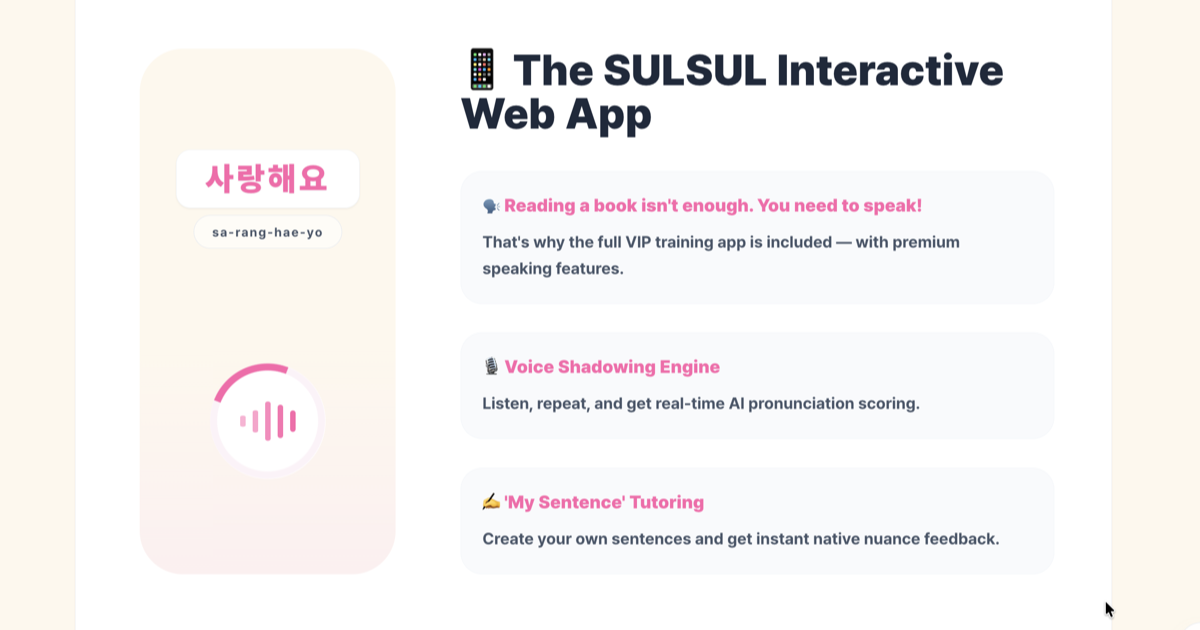
SULSUL is a speaking gym for moments like this: pick a pattern, say it out loud, get an instant fix from the AI pronunciation coach, then use it in a real situation as a mission. The 100-pattern PDF workbook comes along as a bonus.
Now say it out loud
SULSUL says the phrase, you repeat it, and it tells you what came out wrong — 100 survival patterns for cafes, taxis and small talk in Seoul.
Start speaking Korean →