Korean Phrases When Spooky in Love Tops the Streaming Charts


Spooky in Love hit Korea's number-one series ranking in early August 2026 as Park Eun-bin and Yang Se-jong's occult romance pulled viewers across forty-four countries — and the Korean fan thread around a chart-topping weekend drama is simpler than the ghost plot. 벌써 봤어요? (beolsseo bwasseoyo?), "Did you already watch it?" opens the chat after a Saturday drop, and 다음 화 기대돼요 (daeum hwa gidaedwaeyo), "I am looking forward to the next episode," is what you send when the cliffhanger lands.
- Ask if they caught up: 벌써 봤어요? (beolsseo bwasseoyo?), "Did you already watch it?"
- Count down the next drop: 다음 화 기대돼요 (daeum hwa gidaedwaeyo), "I am looking forward to the next episode."
- Recommend the show: 꼭 봐요 (kkok bwayo), "You should definitely watch it."
- React without spoiling: 대박이에요 (daebakieyo), "That is amazing."
- Invite a watch night: 같이 봐요 (gati bwayo), "Let us watch together."

How do you talk about a trending K-drama without spoiling episode eight?
Chart-topping shows move through group chats in Korean even when you watch with English subtitles — a few short lines signal you are caught up.
- After the weekend release, ask 벌써 봤어요? before anyone drops plot details.
- When the ending stings, send 다음 화 기대돼요 instead of typing three paragraphs.
- Recommend the series to a friend with 꼭 봐요 — no ghost lore required.
- React to a scene screenshot with 대박이에요 and stop there.
- Plan a sync watch with 같이 봐요 before the next episode airs.
| Situation | Say this |
|---|---|
| Check if they watched | 벌써 봤어요? (beolsseo bwasseoyo?) |
| Next-episode hype | 다음 화 기대돼요 (daeum hwa gidaedwaeyo) |
| Strong recommend | 꼭 봐요 (kkok bwayo) |
| Spoiler-safe reaction | 대박이에요 (daebakieyo) |
| Watch together | 같이 봐요 (gati bwayo) |
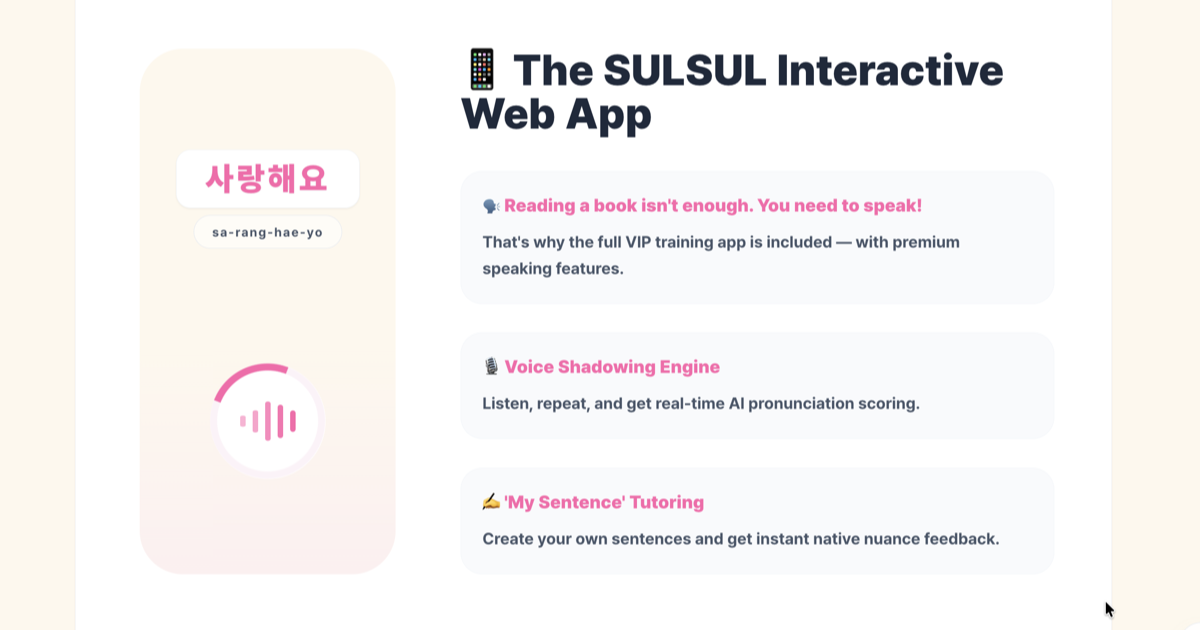
Practice this out loud with SULSUL — the app says it, you repeat it →
What does a Korean friend say when you ask about the latest episode?
Replies in drama threads stay short because everyone is racing the subtitles.
You: 벌써 봤어요? — beolsseo bwasseoyo? — "Did you already watch it?"
Them: 응, 방금 봤어! — eung, banggeum bwasseo! — "Yeah, I just watched it!"
You: 다음 화 기대돼요. — daeum hwa gidaedwaeyo. — "I am looking forward to the next episode."
If they mention the prosecutor-ghost pairing, 재미있어요 (jaemiisseoyo), "It is fun," keeps the chat moving without quoting a scene you have not reached yet.
What usually goes wrong when a chart-topping drama meets real Korean?
Learners copy dramatic confession lines from subtitles but never practice the binge-watch check-in line friends actually send on Sunday morning.
A second mistake is treating every chart headline as a vocabulary test — Spooky in Love is a hook to speak, not a grammar chapter. For comfort lines pulled from the drama itself, see Korean phrases from Spooky in Love.
Say it out loud, not just in your head
Typing 꼭 봐요 in a comment box is not the same as saying it naturally when a coworker asks what you watched this weekend.
SULSUL is a speaking gym for exactly that moment: pick a survival pattern, say it out loud, get an instant fix from the AI pronunciation coach, then run the real situation as a mission. The 100-pattern PDF workbook comes along as a bonus.