Korean Slang Bad Words: What K-Drama Characters Really Say When They Swear


The bad words you hear most in K-dramas are 미친 (michin, "crazy"), 젠장 (jenjang, "damn it"), 꺼져 (kkeojyeo, "get lost"), 닥쳐 (dakchyeo, "shut up"), and 이 자식 (i jasik, "you jerk"). The really strong one, 씨발 (ssibal), is almost never said in full on Korean TV — characters stop at 씨... and the scene moves on. Subtitles tend to flatten all of these into "damn" or "shut up," so you lose how hard each one actually hits. Some are mild enough to say to a friend. Some would end a conversation with a stranger.
Here is the scale, from "fine with friends" to "do not say it":
- 아 진짜 (a jinjja) — "ugh, seriously." Mild, said all day.
- 짜증나 (jjajeungna) — "so annoying." Mild.
- 바보 (babo) / 멍청이 (meongcheongi) — "idiot." Mild to medium, often affectionate.
- 젠장 (jenjang) — "damn it." Medium, a bit old-fashioned.
- 미친 (michin) — "crazy." Medium; can be praise or an insult.
- 꺼져 / 닥쳐 — "get lost" / "shut up." Strong. Fight words.
- 이 자식 / 새끼 (saekki) — "you jerk" / "bastard." Strong.
- 개- (gae-) prefix — "dog-," intensifies anything. Strong in insults.
- 씨발 — the real swear word. Very strong.
How strong each word really is
English speakers tend to rank Korean swearing by how the subtitle reads. Koreans rank it by who you say it to and which ending you put on it.
Almost every bad word in a drama is said in 반말 (banmal), casual speech. 꺼져 and 닥쳐 are already casual commands; there is no natural polite version, because the moment you would use 요, you would not be telling someone to shut up. That is part of why they sound so harsh: the grammar itself drops all respect.
The mild words sit on the other end. 아 진짜 and 짜증나 are aimed at the situation, not a person. You can say 아, 진짜 짜증나 about a delayed bus in front of almost anyone your age. Point the same word at a person — 너 진짜 짜증나 (neo jinjja jjajeungna, "you're so annoying") — and it becomes an attack.
That is the main rule: at the situation = venting, at a person = insult.
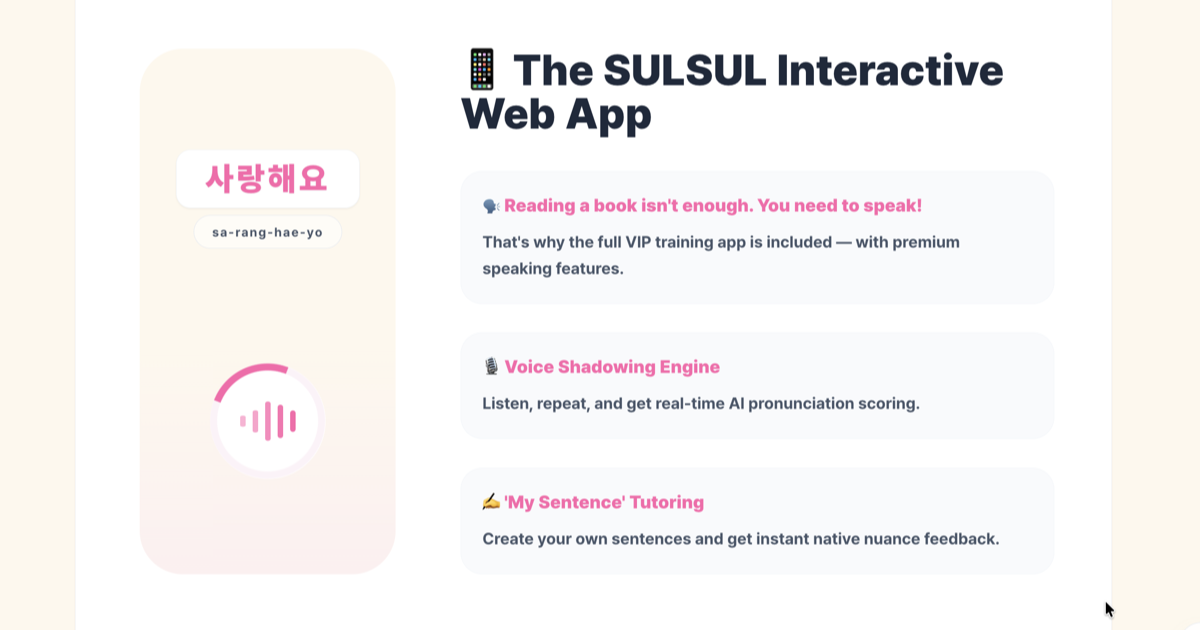
Practice this out loud with SULSUL — the app says it, you repeat it →
미친: the word that is both a compliment and an insult
미친 comes from 미치다 (michida), "to go crazy." It is the most flexible bad word in Korean, and dramas use every version of it.
As an insult, it attaches to a person: 미친놈 (michinnom, "crazy guy") or 미친 거 아니야? (michin geo aniya?, "are you out of your mind?"). This is what the rival says when the heroine throws water in her face.
As praise, it goes in front of a thing: 미친 노래 (michin norae, "an insane song"), 미친 비주얼 (michin bijueol, "unreal looks"). Fans say 미쳤다 (michyeotda, "it's crazy") about a stage or an ending they loved. In a group chat right after a finale, 미쳤다 미쳤다 is the most common review.
So when a drama character mutters 미쳤어... while staring at a text, look at their face. It could mean "this person has lost it" or "I can't believe this is happening to me." Context decides.
젠장, 제기랄, and 씨: the frustration words
When something goes wrong and nobody else is in the room, drama characters reach for these.
젠장 is "damn it," and it sounds slightly dated — you hear it from detectives and older characters in period dramas more than from young people in real life. 제기랄 (jegiral) is the same feeling, even older-sounding.
씨... is the start of 씨발, cut off. Korean broadcasting rules keep the full word off most channels, so writers have characters stop at the first syllable, or the sound is beeped. When an angry character says 씨... and turns away, Korean viewers hear the whole word.
In texting you will see the same word as ㅅㅂ, just the first consonants. It reads lighter than the full word but is still not something you send to a coworker.
The everyday, safe version of all of this is 아 진짜 or 아 왜 (a wae, "ugh, why"). That is what most Koreans actually say when they drop their phone.

꺼져, 닥쳐, and the words that start fights
These are aimed at a person, and they are the lines that come right before someone storms out.
꺼져 is from 꺼지다, "to go out" like a light — "disappear." 닥쳐 is from 닥치다, "shut your mouth." In dramas the pair often comes together: 닥쳐. 그리고 꺼져. — "Shut up. And get lost."
이 자식 (i jasik) literally means "this child," but in a fight it means "you jerk." Between close male friends it can be almost warm — 이 자식, 왔어? ("you idiot, you came?") with a hug. Between strangers it is an insult.
새끼 (saekki) means "baby animal" and is much harsher about a person. You will hear it in crime dramas and in the angriest family scenes. Learners should recognize it and leave it there.
개- in front of a word adds "dog" as an intensifier. In fan slang, 개좋아 (gaejoa, "so good") is just strong enthusiasm, but stuck onto an insult it makes the insult much worse.
A drama scene, word by word
Two brothers, late at night, after one crashed the other's car:
A: 야, 너 미쳤어? 내 차를 왜 끌고 나갔어? — ya, neo michyeosseo? nae chareul wae kkeulgo nagasseo? — "Hey, are you crazy? Why did you take my car out?"
B: 아, 진짜... 미안하다고 했잖아. — a, jinjja... mianhadago haetjanha. — "Ugh, seriously... I said I was sorry."
A: 미안하면 다야? 이 자식이... — mianhamyeon daya? i jasigi... — "Sorry fixes everything? You little..."
B: 됐어, 닥쳐. 나 나갈 거야. — dwaesseo, dakchyeo. na nagal geoya. — "Forget it, shut up. I'm leaving."
A: 젠장... — jenjang... — "Damn it..."
Notice the order. 미쳤어 and 아 진짜 are the warm-up. 이 자식이 is cut off mid-sentence, which is very Korean — the unfinished insult is often scarier than the finished one. 닥쳐 is the point of no return.
What to say instead when you are frustrated
If you want to sound natural without sounding rude, these do the same emotional work:
- 아, 진짜! — "Ugh, seriously!" The all-purpose sigh.
- 헐, 대박. (heol, daebak) — "No way." Shock, good or bad.
- 어이없어. (eoieopseo) — "Unbelievable." For something absurd.
- 말도 안 돼. (maldo an dwae) — "That makes no sense."
- 그만해. (geumanhae) — "Stop it." Firm, not a swear word.
- 그만하세요. (geumanhaseyo) — the polite version, safe with anyone.
그만하세요 is worth practicing. It is what you actually need when someone is bothering you on the street, and it carries weight without a single bad word.
Mistakes learners make with Korean bad words
Copying the drama tone with strangers. A character saying 미친 to their best friend is fine because of the friendship. The same word to a shop worker sounds hostile, even if you meant "this is crazy good."
Thinking 바보 is harmless everywhere. Between couples and friends it is cute. To someone older, or in an argument, it is a real insult.
Using 개- because idols do. You will hear 개웃겨 (gaeutgyeo, "so funny") on variety shows, but it is very casual. With anyone older or new, drop the 개.
Translating English swearing literally. There is no natural Korean "oh my god" swear. The Korean reaction to shock is 헐, 대박, or 어머 (eomeo), not a curse.
For the lighter slang around these words, Korean slang words and what they actually mean covers 대박, 헐, and 사이다. If you want to argue without any of the words above, what to say in Korean when you're angry has the polite version.
Understand it on screen, say the safe one out loud
Recognizing 씨... in a drama takes a second. Saying 그만하세요 firmly, on time, to a real person, is a different skill — and that is the one you will actually use.
SULSUL is a speaking gym for that: pick a pattern, say it out loud, get an instant fix from the AI pronunciation coach, then run the real situation as a mission. The 100-pattern PDF workbook comes along as a bonus.