Basic Korean Phrases for Travel, With Pronunciation That Actually Sounds Korean

If you only have room for a few Korean lines before a trip, take these six: 안녕하세요 (an-nyeong-ha-se-yo, "hello"), 감사합니다 (gam-sa-ham-ni-da, "thank you"), 이거 주세요 (i-geo ju-se-yo, "this one, please"), 얼마예요? (eol-ma-ye-yo?, "how much is it?"), 화장실 어디예요? (hwa-jang-sil eo-di-ye-yo?, "where is the restroom?"), and 있어요? (i-sseo-yo?, "do you have it?"). Notice that two of them are already spelled one way and said another. 감사합니다 is written with a ㅂ but spoken with an m, and 있어요 is written 있-어-요 but comes out as i-sseo-yo. Get those sound shifts right and a Korean shopkeeper hears a sentence, not a string of syllables.
- Hello: 안녕하세요 — an-nyeong-ha-se-yo
- Thank you: 감사합니다 — sounds like gam-sa-ham-ni-da
- This one, please: 이거 주세요 — i-geo ju-se-yo
- How much?: 얼마예요? — eol-ma-ye-yo? (rise at the end)
- Where is ?: ** 어디예요?** — eo-di-ye-yo?
- Do you have ?: ** 있어요?** — sounds like i-sseo-yo?
- Sorry / excuse me: 죄송합니다 — sounds like joe-song-ham-ni-da
Why the spelling and the sound don't match
Hangul is very close to phonetic, but Korean speakers smooth the edges between syllable blocks. Two rules cover almost every surprise in a beginner's travel list.
The first is the slide. When a block ends in a consonant and the next block starts with the silent ㅇ, the consonant slides forward. 있어요 becomes [이써요], 맛있어요 ("it's delicious") becomes [마시써요], and 괜찮아요 ("it's okay") becomes [괜차나요] because the ㅎ disappears on the way. Read them block by block and you will sound like a robot reading a sign.
The second is the nose. A ㅂ sitting right before ㄴ turns into an m. That is why every formal "-합니다" ending is pronounced -ham-ni-da. 감사합니다, 죄송합니다, 실례합니다 — all three end in the same -ham-ni-da. Romanizations like gamsahabnida are technically spelling the letters, not the sound, so if a phrasebook gives you that version, say the m.
Practice this out loud with SULSUL — the app says it, you repeat it →
The four patterns behind almost every travel phrase
Most of what a tourist needs to say fits into four frames. Learn the frame once and swap the noun.
[Noun] 주세요 — "please give me." This is the workhorse for cafes, restaurants, and shops: 물 주세요 (mul ju-se-yo, "water, please"), 영수증 주세요 (yeong-su-jeung ju-se-yo, "receipt, please"), 봉투 주세요 (bong-tu ju-se-yo, "a bag, please"). Put 좀 (jom) in the middle — 물 좀 주세요 — and it softens from a request into a polite ask.
[Noun] 있어요? — "do you have…?" Before you hunt through a store, ask: 우산 있어요? (u-san i-sseo-yo?, "do you have umbrellas?"), 카드 돼요? is the cousin for "do you take cards?" The answer is either 있어요 or 없어요 (eop-seo-yo, "we don't"), which is also said with a slide: [업써요].
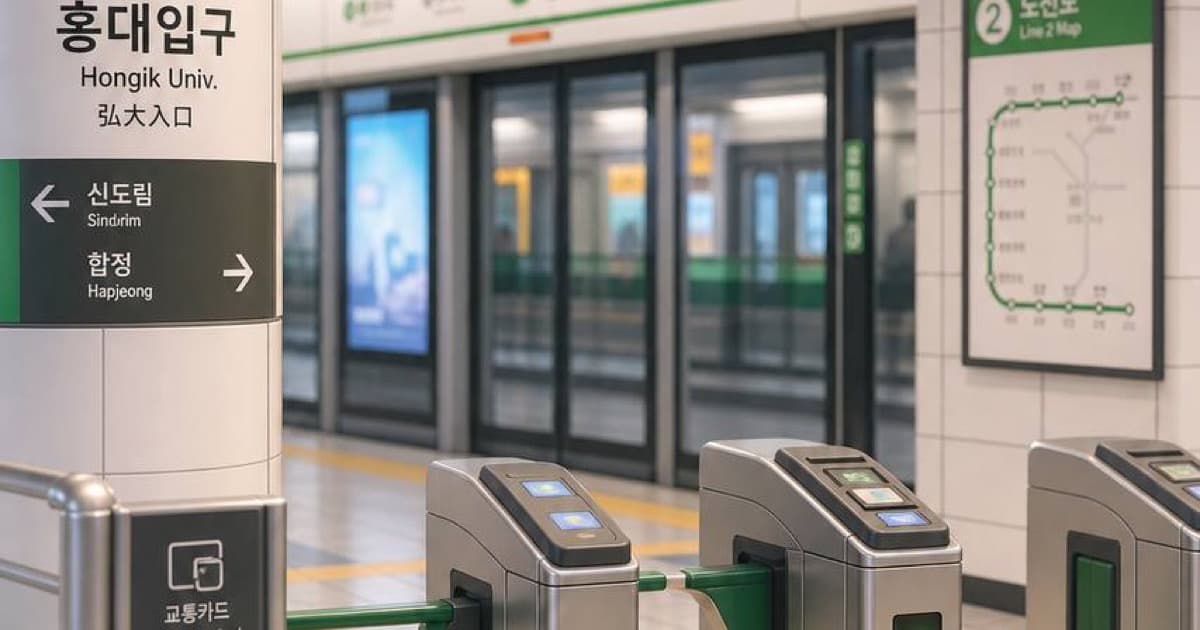
[Place] 어디예요? — "where is…?" 역 어디예요? (yeok eo-di-ye-yo?, "where is the station?"), 출구 어디예요? (chul-gu, "exit"). If the word ends in a consonant, some people say 어디 있어요? instead; both land fine.
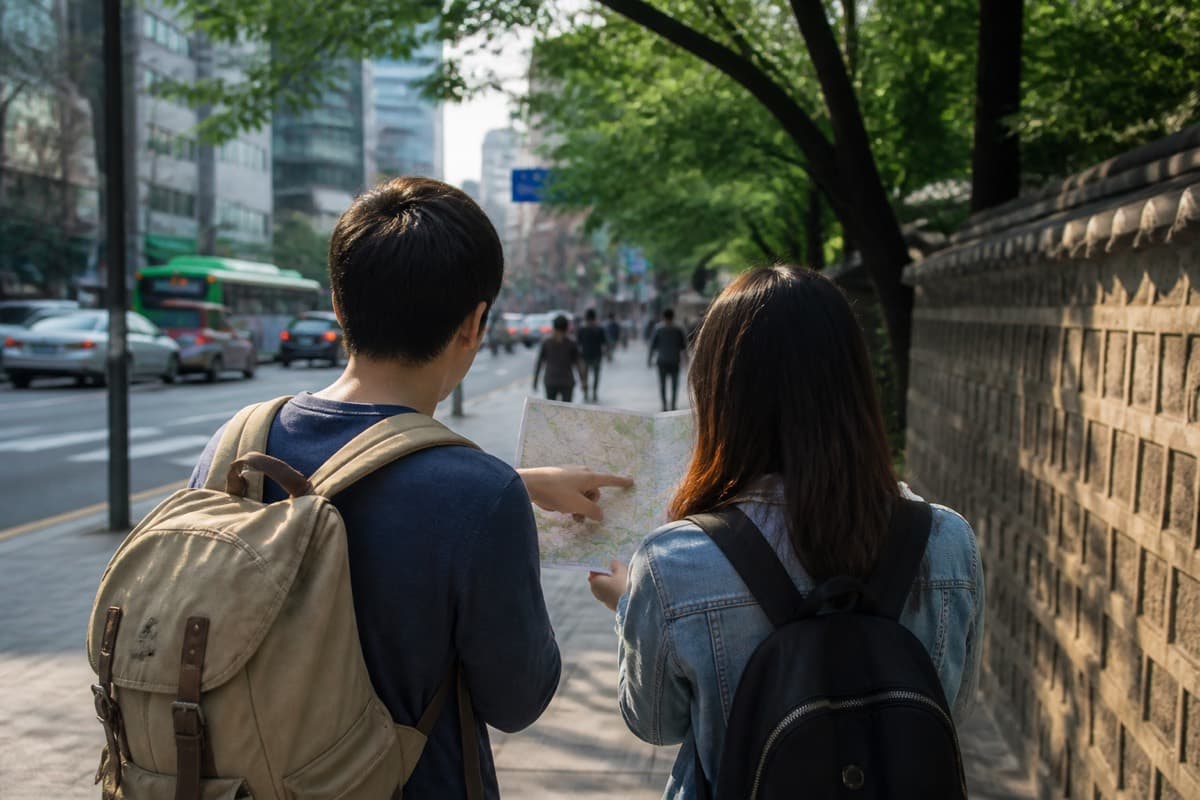
[Verb] 고 싶어요 — "I want to…" 명동 가고 싶어요 (myeong-dong ga-go si-peo-yo, "I want to go to Myeongdong"). Point at a map while you say it and a stranger will walk you halfway there.

A short scene: one street, four phrases
Here is how the same handful of lines carries you through ten minutes in Seoul.
You: 안녕하세요. 이거 있어요? an-nyeong-ha-se-yo. i-geo i-sseo-yo? — Hello. Do you have this? (showing a photo)
Clerk: 네, 있어요. 이쪽이에요. ne, i-sseo-yo. i-jjo-gi-e-yo. — Yes, we do. It's over here.
You: 얼마예요? eol-ma-ye-yo? — How much is it?
Clerk: (points to the price on the register)
You: 이거 주세요. 봉투도 주세요. i-geo ju-se-yo. bong-tu-do ju-se-yo. — This one, please. A bag too, please.
You: 감사합니다! 아, 지하철역 어디예요? gam-sa-ham-ni-da! a, ji-ha-cheol-lyeok eo-di-ye-yo? — Thank you! Oh, where's the subway station?
Look at 지하철역: the spelling says jihacheol-yeok, but the sound picks up an extra l and comes out ji-ha-cheol-lyeok. You don't need to know the rule's name. Just copy the sound, the way you would copy a song lyric.
Melody: where the sentence goes up and where it drops
A Korean question is mostly told apart from a statement by pitch, not word order. 있어요 said flat and dropping means "we have it." 있어요? with the last syllable lifted means "do you have it?" Same three syllables. If a clerk looks confused, the fix is usually to lift the 요 higher, not to add words.
Particles like 은, 는, 이, 가 are the shadows of a sentence — let them go quiet and lean on the noun. 화장실이 어디예요? sounds natural with the weight on 화장실. Tourists who punch every syllable the same sound like they are reading a ticket machine.
Small slips that make people ask you to repeat
- Saying gamsahabnida with a hard b. Close your lips into an m: gam-sa-HAM-ni-da.
- Splitting 있어요 into three beats. Glide it: i-sseo-yo.
- Ending 얼마예요? flat. Without the rise it can sound like you are announcing a price.
- Dropping 요. 이거 줘 is what you say to a sibling. With strangers keep 주세요 and the 요 endings.
- Over-apologizing. 죄송합니다 is for real mistakes. To get past someone in a crowd, 실례합니다 or a quick 잠시만요 (jam-si-man-yo, "one moment") is the natural choice.
Building your own travel list from here
Every phrase above is a frame with an empty slot. Before your trip, write down the five nouns you will actually need — your hotel's neighborhood, the station near it, a food you want to try, a medicine you take, the word for your charger — and drop each one into 주세요, 있어요?, 어디예요?, and 고 싶어요. That gives you twenty sentences built from things you will really ask for, instead of a hundred phrases you will never say.
Say them out loud before you land
Pronunciation does not stick from reading. Say each line out loud until the slide in 있어요 and the m in 감사합니다 feel automatic, then try the street scene above as a full exchange. When you can say it without looking, you are ready for the real counter.