How to Say It in Korean When You Don't Know the Word: 한국어로 뭐예요?

To ask how to say something in Korean, say the word in English (or point at the thing) and ask 한국어로 뭐예요? (han-gu-geo-ro mwo-ye-yo?): "What is it in Korean?" It works with any Korean person, in any shop, at any age gap, because it ends in polite 요. If you want to sound a little more natural when asking about a word or phrase, use 한국어로 뭐라고 해요? (han-gu-geo-ro mwo-ra-go hae-yo?), "What do you call it in Korean?" These two questions are the most useful sentences a beginner can carry, because every other word you need can be pulled out with them.
- What is it in Korean?: 한국어로 뭐예요? — han-gu-geo-ro mwo-ye-yo?
- What do you call it in Korean?: 한국어로 뭐라고 해요? — han-gu-geo-ro mwo-ra-go hae-yo?
- What is this?: 이거 뭐예요? — i-geo mwo-ye-yo?
- What does it mean?: 무슨 뜻이에요? — mu-seun tteu-si-e-yo?
- Please say it again: 다시 말해 주세요 — da-si mal-hae ju-se-yo
- Could you write it down?: 써 주세요 — sseo ju-se-yo
Break the question into three pieces
The sentence looks long, but it is only three small parts glued together, and once you see them you can rebuild it any time.
- 한국어 (han-gu-geo) means the Korean language.
- 로 (ro) means "in" or "by way of." Stuck onto 한국어 it becomes 한국어로, "in Korean."
- 뭐예요? (mwo-ye-yo?) means "What is it?"
So 한국어로 뭐예요? is literally "In Korean, what is it?" Swap the first piece and the same question works for other languages: 영어로 뭐예요? (yeong-eo-ro mwo-ye-yo?) is "What is it in English?" That reverse version is handy when a Korean friend says a word you don't know and you want the English to anchor it.
Raise your voice at the end, on 요. In Korean the same words can be a statement or a question, and the rising tone is what tells the listener you are asking.
Practice this out loud with SULSUL — the app says it, you repeat it →
Put the English word in front
If you can't point at the thing, say the English word first and add the particle 이/가. Use 이 after a word that ends in a consonant sound and 가 after a vowel sound. Beginners do not need to be perfect here, because people understand you either way.
- Spoon이 한국어로 뭐예요? — "What is 'spoon' in Korean?"
- Receipt가 한국어로 뭐예요? — "What is 'receipt' in Korean?"
- "Excuse me"가 한국어로 뭐예요? — "How do you say 'excuse me' in Korean?"
The answer usually comes back short: 숟가락이에요 (sut-ga-ra-gi-e-yo), "It's 숟가락." Repeat it once out loud. Koreans are used to learners doing this and will often say it again, slower, without being asked.
When it's a whole sentence you want, not one word, 뭐라고 해요? fits better: "Can I sit here?" 한국어로 뭐라고 해요? The person will often answer with the full line, like 여기 앉아도 돼요?, which you can use right away.
When the thing is right in front of you
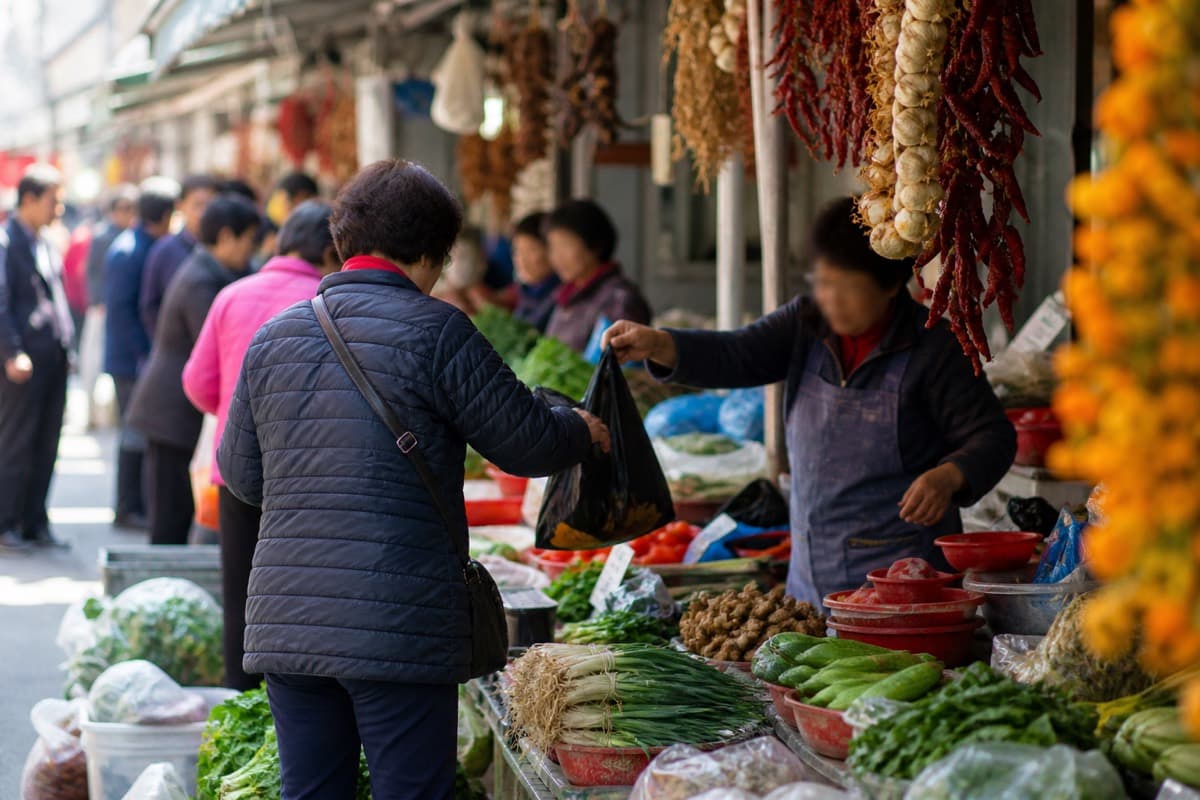
At a market stall, a bakery counter, or a menu with pictures, you don't need the English at all. Point and ask 이거 뭐예요? (i-geo mwo-ye-yo?), "What is this?" It is one of the first patterns in the SULSUL textbook for exactly this reason: it turns everything you can see into vocabulary.

Pair it with 이거 이름이 뭐예요? (i-geo i-reu-mi mwo-ye-yo?), "What is this called?", when the shop owner answers with a description instead of a name. If you hear something like "떡이에요, 쌀로 만든 거예요," you've just learned that 떡 is rice cake and 쌀 is rice, all from one question.
Asking what a word means
The opposite problem is hearing a Korean word and not knowing it. For that, say the word you heard and add 무슨 뜻이에요? (mu-seun tteu-si-e-yo?), "What does it mean?"
- "포장" 무슨 뜻이에요? — "What does 포장 mean?"
- 그게 무슨 뜻이에요? — "What does that mean?"
If you only caught part of it, don't guess. Use the textbook pattern for understanding:
- 잘 모르겠어요. (jal mo-reu-ge-sseo-yo) — "I don't quite get it."
- 잘 알겠어요. (jal al-ge-sseo-yo) — "Got it, I understand."
잘 모르겠어요 is much softer than a flat "I don't know," and it invites the other person to explain again instead of giving up on you.
Getting it said again, slower, or written down
Even when someone answers kindly, Korean words go by fast. These three requests keep the conversation alive:
- 다시 말해 주세요. (da-si mal-hae ju-se-yo) — "Please say it again."
- 천천히 말해 주세요. (cheon-cheon-hi mal-hae ju-se-yo) — "Please say it slowly."
- 여기 써 주세요. (yeo-gi sseo ju-se-yo) — "Please write it here." Hold out your phone's notes app.
The last one is the secret weapon. Once a word is written in Hangul, you can read it, save it, and look it up later. Shop staff and taxi drivers are usually happy to type a word on your phone.
A short scene at a street stall
You: (pointing) 저기요, 이거 뭐예요? jeo-gi-yo, i-geo mwo-ye-yo? — Excuse me, what is this?
Owner: 호떡이에요. 달아요. ho-tteo-gi-e-yo. da-ra-yo. — It's hotteok. It's sweet.
You: 죄송해요, 다시 말해 주세요. joe-song-hae-yo, da-si mal-hae ju-se-yo. — Sorry, please say it again.
Owner: 호-떡.
You: 아, 호떡! "Sweet"이 한국어로 뭐예요? a, ho-tteok! "sweet"-i han-gu-geo-ro mwo-ye-yo? — Ah, hotteok! What is "sweet" in Korean?
Owner: 달아요. 달다.
You: 아, 잘 알겠어요. 호떡 하나 주세요! a, jal al-ge-sseo-yo. ho-tteok ha-na ju-se-yo! — Oh, got it. One hotteok, please!
Two questions, one repeat, and you walked away with two words and a snack.
Slips that make people switch to English
- Saying "in Korea" instead of "in Korean." 한국에서 (han-gu-ge-seo) means "in Korea," the place. 한국에서 뭐예요? sounds like you're asking what something is in the country. The language is 한국어, so keep 한국어로.
- Dropping 요. 한국어로 뭐야? is casual speech for close friends. With a stranger or shop owner, keep 뭐예요.
- Asking with a flat tone. Without the rise at the end, 한국어로 뭐예요 can sound like you're muttering to yourself. Lift the last syllable.
- Apologizing too much first. A long "sorry, my Korean is bad" makes people reach for English to help you. A bright 저기요 followed straight by the question keeps them in Korean.
- Not repeating the answer. If you just nod, the person doesn't know if you got it. Say the word back. It shows you're learning, and they'll correct you if it's off.
Make it automatic before you need it
These questions only work if they come out without a pause. Say them out loud now, five times each, with the rise at the end: 한국어로 뭐예요? 이거 뭐예요? 무슨 뜻이에요? 다시 말해 주세요. Then pick three things on your desk and ask about each one in English plus 이/가 한국어로 뭐예요.
If you want the pattern drilled until it's a reflex, SULSUL walks you through 이거 뭐예요, 다시 말해 주세요, and the rest of the survival questions with speaking practice built in.