K-Drama Expressions: 세상에, 말도 안 돼, 어이없어, and What Characters Say When the Plot Turns


The K-drama expressions you hear most are short reactions, not long speeches: 세상에 ("oh my god"), 말도 안 돼 ("no way"), 어이없어 ("unbelievable"), and 됐어 ("forget it"). Characters use them the moment a secret comes out or a fight turns ugly, and subtitles often flatten them into something generic. Learn them by the kind of moment they belong to, and you will start catching them before you read the translation.
- 세상에. — Oh my god. (fine with anyone)
- 말도 안 돼. — No way. / That makes no sense. (casual)
- 설마. — Surely not. (casual)
- 어이없어. — Unbelievable. (casual, annoyed)
- 됐어. — Forget it. (casual, cold)
- 어떡해. — What do I do? / Oh no. (casual)
- 다행이다. — Thank goodness. (casual)
When the news is too big to take in
세상에 (se-sang-e) literally means "in the world," as in "in all the world, how could this be?" It works as a gasp, and it has no rude edge at all, so a grandmother can say it about a grandchild's height and a nurse can say it over a test result. Stretch the middle for extra drama: 세~상에.
말도 안 돼 (mal-do an dwae) breaks down as "even words don't work." The thing that just happened will not fit into a sentence that makes sense. Characters use it for shock and for flat refusal to believe something. Add 요 for anyone you need to be polite to: 말도 안 돼요.
설마 (seol-ma) is the one learners miss, because it is often only half a sentence. It means "surely not," and it shows up when a character is starting to suspect the worst. Listen for the pause after it: 설마… 네가 그랬어? ("You didn't... that wasn't you, was it?"). The stock follow-up is 설마 그럴 리가, "surely that can't be." When you hear 설마 in episode 3, the show is usually telling you what episode 8 will confirm.
Practice this out loud with SULSUL — the app says it, you repeat it →
When someone has gone too far
어이없어 (eo-i-eop-seo) has no neat English match. It says you are stunned by something so absurd or unfair that you are half angry and almost laughing. A dry little laugh often comes right before it. The longer form, 어이가 없네, became a catchphrase after the 2015 film Veteran, and Koreans still quote it.
미쳤어? (mi-chyeo-sseo) means "Are you crazy?" It is said to someone's face, so it belongs with close friends, siblings, or an actual fight.
웃기지 마 (ut-gi-ji ma) is literally "don't make me laugh," and it means "don't be ridiculous." Its sarcastic cousin 웃기네 is closer to "oh, that's rich."
너나 잘해 (neo-na jal-hae) comes out to "worry about yourself." Word for word it is "you just do well." Nobody says this to be kind. It is what a character snaps at someone giving advice they never asked for. For the words that sit one step harsher than these, see Korean bad words in K-dramas.
When a character gives up
These are the quiet ones, and they often hurt more than the shouting.
됐어 (dwae-sseo) means "forget it" or "never mind." It is the past tense of 되다, "to become" or "to be done," so the feeling is "this is over." A character turning away from an apology says 됐어 and keeps walking.
몰라 (mol-la) is the plain word for "I don't know," but in a fight it means "I don't care, stop asking." Said twice, 몰라, 몰라, it is a person refusing to think about something any longer.
어쩔 수 없지 (eo-jjeol su eop-ji) means "it can't be helped." You hear it when a character accepts something painful, often with a small smile that makes the scene worse.
When fear or relief takes over
어떡해 (eo-tteo-kae) means "what do I do?" and it doubles as "oh no!" It is a shortened 어떻게 해, and you will hear it when something goes wrong and when a friend shares bad news. When it is about someone else's trouble, it works like "oh no, you poor thing."
깜짝이야 (kkam-jja-gi-ya) is "you scared me!" and it is what comes out when someone appears behind a character in a dark hallway.
다행이다 (da-haeng-i-da) means "thank goodness" or "what a relief." It is the line at the hospital bed once the doctor walks away. Politely, it becomes 다행이에요.
그럴 줄 알았어 (geu-reol jul a-ra-sseo) means "I knew it." A friend says it when the bad boyfriend turns out to be exactly that. It can be smug or sad, depending on who is talking.

One argument, six expressions
Two best friends on a bench by the river. Watch how the reactions get shorter as the fight gets worse.
지은: 나 어제 민준이 만났어. I met Minjun yesterday.
수아: 뭐? 설마… 그 민준이? What? Surely not... that Minjun?
지은: 응. 우리 다시 만나기로 했어. Yeah. We decided to get back together.
수아: 말도 안 돼. 너 미쳤어? 걔가 너한테 어떻게 했는지 벌써 잊었어? No way. Are you crazy? Have you already forgotten what he did to you?
지은: 알아. 그래도 사람은 변할 수 있잖아. I know. But people can change, you know.
수아: 어이없어, 진짜. 그럴 줄 알았어. Unbelievable, really. I knew it.
지은: 됐어. 너한테 말한 내가 바보지. Forget it. I'm the fool for telling you.
Su-a starts with a question, and that first 설마 still leaves room for a good answer. By 어이없어, she has stopped asking and started judging. Ji-eun's 됐어 ends the conversation. It is the shortest line in the scene and the one that does the most damage. If you want the line that often comes right before a fight like this, see what do you mean in Korean.
Same words, opposite mood
Tone changes several of these completely, which is why they can confuse you on a second watch.
- 미쳤다! Change the ending and "are you crazy?" becomes praise. 이 노래 미쳤다 means "this song is insane," and fans say it all the time.
- 됐다! With a bright voice, this means "got it, it worked!" You might hear it when someone finally fixes a broken printer.
- 몰라~ With a stretched, whiny ending, this is teasing, not a wall. It is a staple of couple scenes, where the person saying it clearly does want to be asked again.
- 웃겨! In a laughing voice, this just means "you're so funny!" There is no sarcasm left in it.
Which ones to actually use
Hearing these is one thing. Saying them to a real person takes more care, since most of them are in casual speech and you can only use them with people close to you.
Safe almost anywhere: 세상에, 다행이에요, 말도 안 돼요, and 어떡해요. These react to a situation, not to the person in front of you, so they rarely cause trouble.
Friends only: 설마, 그럴 줄 알았어, and 어이없어. Aim 어이없어 at the situation, as in a three-hour wait, and not at your friend.
Leave them on the screen: 너나 잘해, 웃기지 마, and 미쳤어? in a serious voice. These are attacks, and a foreign accent won't soften them.
Three mistakes come up again and again:
Saying 됐어요 to turn down an offer. It sounds like a polite "no thanks," but it can feel cold, especially to a host holding out food. 아니요, 괜찮아요 is the warmer choice.
Answering a teacher or boss with 몰라요. Even with 요, it can sound like you have stopped trying. Say 잘 모르겠어요, "I'm not really sure," instead.
Mixing up 어떡해 and 어떻게. They sound almost the same, but 어떡해 stands alone as "what do I do?" while 어떻게 means "how" and needs a verb after it, as in 어떻게 가요? ("How do I get there?"). Korean speakers mix up the spelling too, so don't feel bad about it.
If politeness endings still feel slippery, how to be polite in Korean walks through them. And if you want more words from the shows, Korean words in K-dramas covers the ones subtitles tend to leave out.
Get the timing into your mouth
Reactions only work when they come out fast. If you have to build the sentence first, the moment is gone. Pick three you can really use, such as 세상에, 말도 안 돼요, and 다행이에요, and say each one out loud five times with the feeling attached. Gasp on the first. Shake your head on the second. Breathe out on the third.
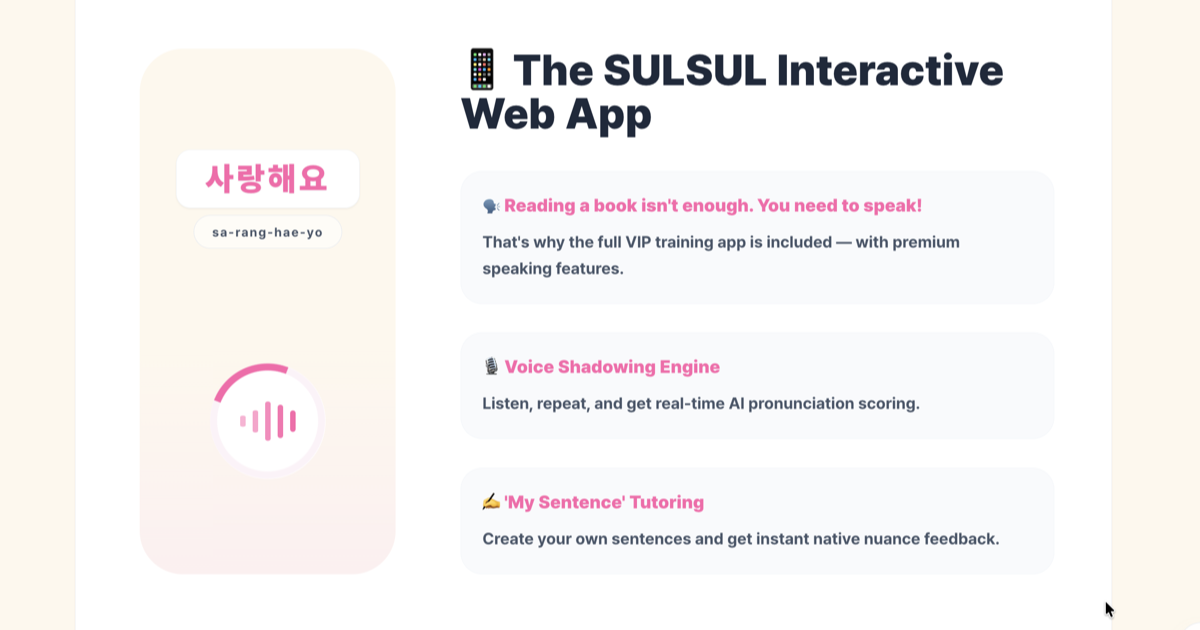
SULSUL is a speaking gym built for exactly this: pick a pattern, say it out loud, get an instant fix from the AI pronunciation coach, then run the whole situation as a mission. The 100-pattern PDF workbook comes along as a bonus. For the big romantic and tearful scenes, see K-drama lines every fan knows by heart.