What Do You Mean in Korean? 무슨 말이야?, 무슨 소리야?, and the Lines K-Drama Characters Throw Back


"What do you mean?" in Korean is 무슨 말이에요? (mu-seun ma-ri-e-yo?) when you are being polite, and 무슨 말이야? (mu-seun ma-ri-ya?) with a friend. Word for word it is "what words?", which is why it works for both a confused "wait, what do you mean?" and an offended "excuse me, what is that supposed to mean?" The sharper version you hear in every K-drama fight is 무슨 소리야? (mu-seun so-ri-ya?), literally "what sound is that?", closer to "what are you talking about?" And if you only want the meaning of a single word, the question is 무슨 뜻이에요? (mu-seun tteu-si-e-yo?), "what does it mean?"
- 무슨 말이에요? — What do you mean? (polite, neutral)
- 무슨 말이야? — What do you mean? (casual)
- 무슨 소리야? — What are you talking about? (casual, pushback)
- 그게 무슨 뜻이에요? — What does that mean? (asking about a word)
- 그게 말이 돼? — Does that even make sense? (casual, disbelief)
- 무슨 말인지 잘 모르겠어요. — I'm not sure what you mean. (polite, soft)
Three Korean words hiding behind "mean"
English uses one verb, mean, for several jobs. Korean splits them, and picking the right noun is most of the battle.
말 (mal) is "words, speech." 무슨 말이야? asks what someone is saying, so it covers both "I didn't follow" and "I don't like what you just implied." The tone of your voice decides which one it is.
소리 (so-ri) is "sound, noise." Calling someone's words a sound is a little dismissive, as if what they said is just noise. That is why 무슨 소리야? and the even blunter 뭔 소리야? (mwon so-ri-ya?) carry pushback. A character who hears an outrageous accusation does not ask 무슨 말이야. They snap 무슨 소리야.
뜻 (tteut) is "meaning" in the dictionary sense. "포장" 무슨 뜻이에요? asks what the word 포장 means. It almost never sounds rude, because you are asking about vocabulary, not the speaker's intentions. For more on asking about words you don't know, see how to say it in Korean when you don't know the word.
Practice this out loud with SULSUL — the app says it, you repeat it →
How the line escalates in a K-drama argument
Watch any confrontation scene and you can hear the question climb in steps. Each step adds heat.
- 무슨 말이야? — "What do you mean?" Calm, but on guard. Often the first reaction when someone drops bad news.
- 그게 무슨 소리야? — "What are you talking about?" The listener has heard it and does not accept it.
- 그게 말이 돼? — "Does that even make sense?" Now it is disbelief. 말이 되다 means "to make sense," literally "to become words."
- 무슨 말이냐고! — "I said, what do you mean!" The 냐고 ending repeats a question the other person failed to answer. When you hear 냐고, someone has run out of patience.
The polite versions climb the same ladder, just in 요 form: 무슨 말씀이세요? (mu-seun mal-sseu-mi-se-yo?) uses 말씀, the honorific word for speech, and is what an employee says to a boss or a son-in-law says to his future father-in-law right before the tension breaks. It sounds respectful on paper but can be delivered ice-cold. Characters also love 지금 무슨 말을 하는 거야? — "What are you even saying right now?" The 지금 ("right now") adds the sense that the other person has crossed a line this very second.

When you genuinely did not understand
Outside a drama, most of the time you just missed something. Here the goal is to sound puzzled, not offended, and a few small choices do that.
- 죄송한데, 무슨 말인지 잘 모르겠어요. — "Sorry, I'm not sure what you mean." Starting with 죄송한데 and ending with 잘 모르겠어요 takes the edge off completely.
- 그러니까 내일 못 온다는 거예요? — "So you're saying you can't come tomorrow?" The ~다는 거예요? pattern repeats back what you think they meant and lets them confirm. It is often better than asking "what do you mean?" at all.
- 다시 한번 말해 주세요. — "Please say it once more." Use this when the problem is speed, not meaning. If it happens a lot, what to say when Korean is too fast has more options.
Keep your voice rising and soft at the end. A flat, falling 무슨 말이에요. with no smile reads as a challenge, even with the polite ending.
A short scene: two friends after the finale
지수: 나 그 드라마 결말 마음에 들어. I liked the ending of that drama.
민호: 무슨 소리야? 주인공이 떠났잖아! What are you talking about? The lead left!
지수: 그러니까 그게 진짜 이별이 아니라는 거지. I mean, that's not a real breakup.
민호: 무슨 말이야? 마지막에 공항 장면 나왔잖아. What do you mean? There was the airport scene at the end.
지수: 잘 봐. 비행기 표가 왕복이었어. Look closely. The plane ticket was round-trip.
민호: 헐, 그게 말이 돼? 다시 봐야겠다. Whoa, does that even make sense? I need to rewatch it.
Notice how 민호 starts with 무슨 소리야 because he disagrees, then softens to 무슨 말이야 once he is actually curious. Between friends, both are completely normal. The ending 잖아 ("you know, right?") shows up twice too, which is very typical of a friendly argument.
Mistakes that make it sound like a fight
Using 무슨 소리야 with someone older. Even in 요 form, 무슨 소리예요? to a teacher, boss, or stranger sounds like you are rejecting what they said. Stick to 무슨 말씀이세요? or the soft 잘 모르겠어요 line.
Using 말 when you mean 뜻. If you point at a menu word and say 이거 무슨 말이에요?, people will understand, but 이거 무슨 뜻이에요? is what you actually want. 말 is about what a person is saying, 뜻 is about what a word means.
Copying the drama tone. Characters say 무슨 말이야 with a sharp, falling voice because the script wants tension. In real life, a rising, curious tone plus a small laugh tells your friend you are confused, not angry. If you really are angry, what to say in Korean when you're angry covers that side.
Dropping 그게. 그게 무슨 말이야? ("what do you mean by that?") points at a specific thing they said. Without 그게, it can sound like you missed the whole conversation.
Practice the tone, not just the words
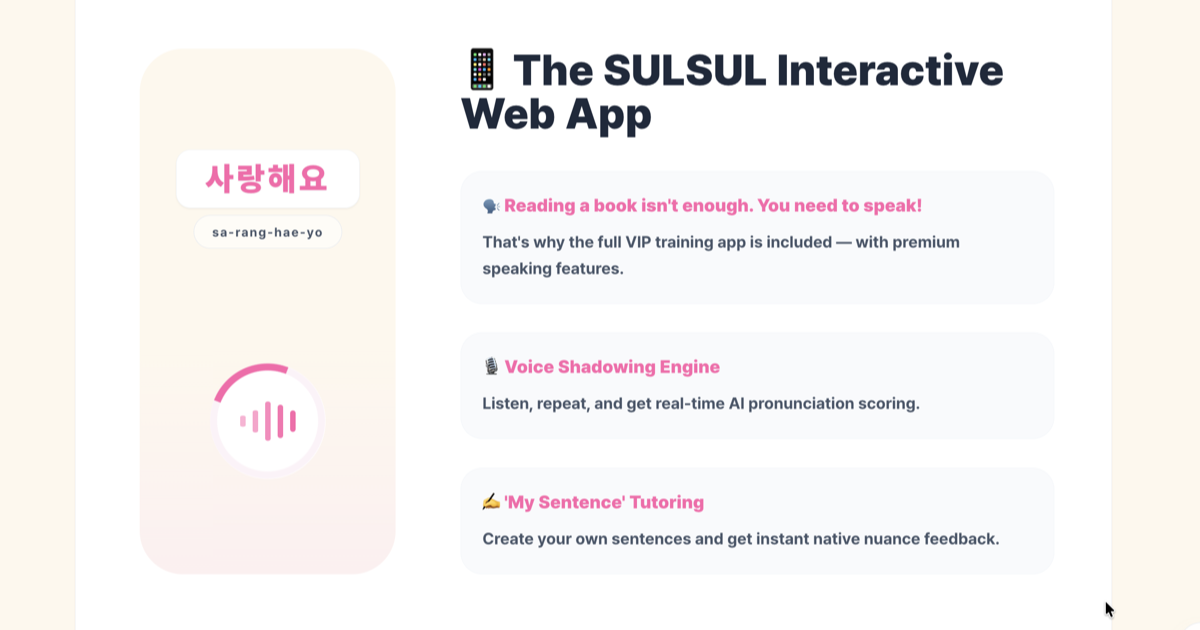
The words in 무슨 말이야 are easy. What takes practice is the tone, because the same four syllables can be curious, defensive, or furious depending on how your voice moves. Say 무슨 말이에요? out loud three times with a gentle rise, then 무슨 소리야? once the way a drama character would, and feel the difference in your own mouth.
SULSUL is a speaking gym built for exactly this: pick a pattern, say it out loud, get an instant fix from the AI pronunciation coach, then run the whole situation as a mission. The 100-pattern PDF workbook comes along as a bonus. For more scenes you can borrow, see K-drama lines every fan knows by heart.