What Does Dakchyeo Mean in Korean? 닥쳐 as 'Shut Up,' and the Softer Lines to Use Instead


Dakchyeo (닥쳐) means "shut up" in Korean. It is a blunt, casual command, pronounced roughly dak-cheo, and it is the word K-drama characters snap when an argument has gone past the point of politeness. It is rude. Between very close friends it can be a joke, but said to anyone else it starts a fight. If you only want someone to be quiet, the everyday line is 조용히 해 (jo-yong-hi hae), or 조용히 해 주세요 (jo-yong-hi hae ju-se-yo) when you need to be polite.
- 닥쳐. — Shut up. (casual, rude)
- 입 닥쳐. — Shut your mouth. (stronger)
- 입 다물어. — Close your mouth. (casual, cold)
- 시끄러워. — You're being loud. / Quiet. (casual, annoyed)
- 그만해. — Stop it. (casual, firm)
- 조용히 해 주세요. — Please be quiet. (polite)
Where 닥쳐 comes from
The dictionary form is 닥치다 (dak-chi-da), "to shut one's mouth." Add the casual command ending and 닥치 + 어 shrinks into 닥쳐, a form that gives an order to someone you are not bothering to respect.
Korean has a second, unrelated verb with the same spelling. 닥치다 can also mean "to be close at hand," as in 시험이 코앞에 닥쳤어요 ("the exam is right around the corner"). So if you see the word in a news headline about a coming storm, nobody is being told to shut up. The phrase 닥치는 대로 ("whatever comes along") uses this second meaning too.
Practice this out loud with SULSUL — the app says it, you repeat it →
Why it sounds like "dak-cheo"
You will see this word spelled dakchyeo, dakchyo, and dakcheo in subtitles and fan posts. All three point to 닥쳐. The written syllable 쳐 is pronounced like 처 in normal speech, so there is no real "y" sound in the middle. The final ㄱ in 닥 is also clipped short, with no puff of air after it. Say dak, stop the sound in your throat, then land hard on cheo. In a drama, the second syllable usually gets all the force.
How strong is it, really?
Think of these lines as a ladder. Each step leaves less room for the other person.
- 조용히 해 — "Be quiet." Plain and common. A parent to a noisy kid, or a friend during a movie.
- 시끄러워 — "You're loud." It describes the noise but works as a complaint, and it is often a brush-off between siblings.
- 입 다물어 — "Close your mouth." Colder and more controlled, the line of someone who has stopped shouting because they are truly angry.
- 닥쳐 — "Shut up." Openly rude, a clear attack on the person.
- 입 닥쳐 — "Shut your mouth." Adding 입 ("mouth") points straight at the person's mouth and turns up the insult.
There is also a formal version that surprises learners: 닥치세요 (dak-chi-se-yo) and the stiffer 닥치십시오. They carry polite endings on top of a rude word, and the clash is the point. Calm, formal contempt is often scarier on screen than yelling.

닥치고: "shut up and..."
The word also links to a second action as 닥치고 (dak-chi-go), "shut up and..." This is a pattern worth recognizing because you will hear it often:
- 닥치고 따라와. — "Shut up and follow me."
- 닥치고 들어. — "Shut up and listen."
- 닥치고 먹어. — "Shut up and eat."
The last one can even be affectionate between friends, or a playful way to say a dish is so good there is nothing to discuss. Online, 닥치고 sometimes works as a strong recommendation in the same spirit, like telling friends to stop debating and just go. You may also see ㄷㅊ in chats, the first consonants of 닥쳐, usually teasing rather than furious.
A short scene: siblings at the kitchen table
동생: 언니, 어제 그 남자 또 만났지? 엄마한테 말한다? You saw that guy again yesterday, didn't you? Should I tell Mom?
언니: 시끄러워. 밥이나 먹어. Quiet. Just eat your food.
동생: 사진도 봤는데? 머리 스타일 진짜 이상하던데. I saw his photo, too. His hair is really weird.
언니: 닥쳐. Shut up.
동생: 와, 지금 나한테 닥치라고 했어? Wow, did you just tell me to shut up?
언니: 그래, 했어. 닥치고 먹어. Yes, I did. Shut up and eat.
The sister starts with 시끄러워 and only reaches for 닥쳐 once her patience is gone. Notice 닥치라고 했어, too. That is how you report the word: "you told me to shut up." It is a useful way to recognize the verb when it does not look like 닥쳐 at all. Because these two are siblings, this reads as bickering rather than a break in the relationship. The exact same words to a coworker would be a very different scene. For more of the words around it, see Korean bad words in K-dramas.
What to say instead
Most of the time, what you actually want is quiet, not a fight. These lines get you there:
- 조용히 해 주세요. — "Please be quiet." Clear and polite, fine with a stranger.
- 죄송한데, 조금만 조용히 해 주시겠어요? — "Sorry, could you keep it down a little?" The softest choice, good for a neighbor or a stranger on a train.
- 잠깐만, 내 말 좀 들어 봐. — "Hold on, listen to me for a second." For a friend who keeps talking over you.
- 그 얘기는 그만하자. — "Let's stop talking about that." When the topic is the problem, not the volume.
If you are upset and want to say so without wrecking anything, what to say in Korean when you're angry has a full set of lines.
Mistakes learners make with 닥쳐
Thinking 요 fixes it. The polite ending does not make it polite. 닥치세요 to a shop clerk is a shock, not a courtesy, because the verb itself is the insult.
Copying it as a joke too early. Korean friends do say 닥쳐 ㅋㅋ while laughing, but that comfort takes a long friendship. A newer friend, especially an older one, may not read it as a joke, and the age gap makes it land harder. For how levels of respect shape what you can say, see how to be polite in Korean.
Mixing up 다물어 and 닥쳐. 입 다물어 means closing your lips and is still harsh, but it is less of an open insult. Neither one belongs in a conversation with a teacher, a boss, or a stranger.
Reaching for it when you mean "no way." In English, "shut up!" can mean "I can't believe it!" 닥쳐 doesn't carry that meaning. For happy disbelief, say 진짜? or 헐, 대박! instead.
Say the polite version out loud
You will probably never need 닥쳐 outside a drama, and recognizing it is enough. The line worth having ready is the soft one, because it comes up in real life and it is long enough to trip over. Say 죄송한데, 조금만 조용히 해 주시겠어요? out loud three times, slowly at first, until it stops feeling like a mouthful.
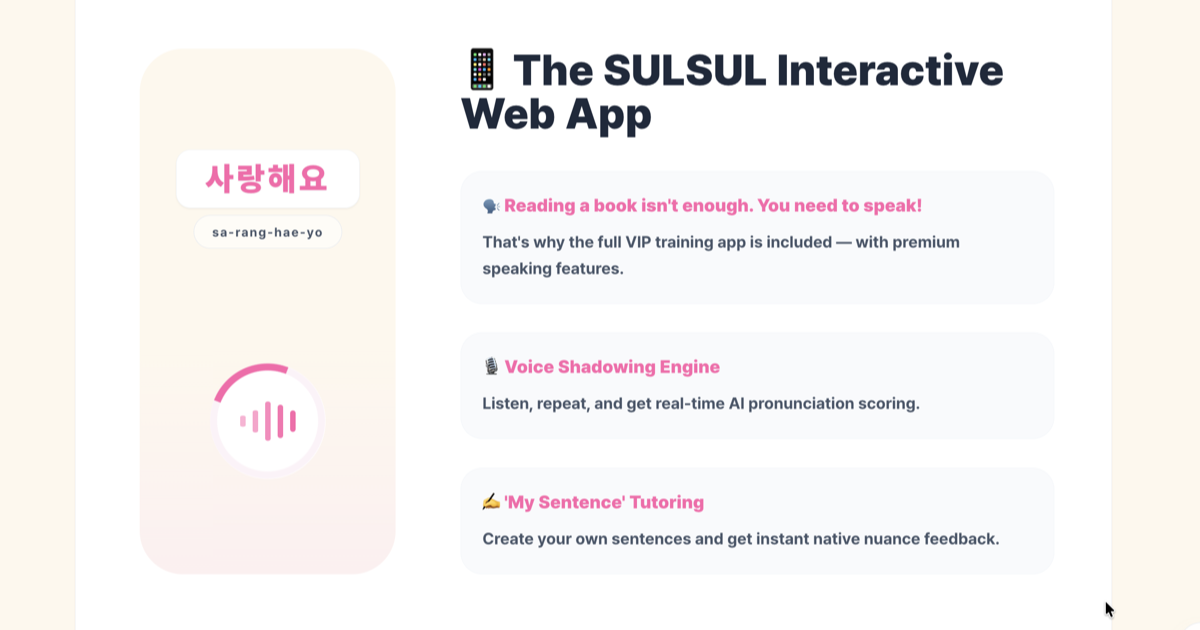
SULSUL is a speaking gym built for exactly this: pick a pattern, say it out loud, get an instant fix from the AI pronunciation coach, then run the whole situation as a mission. The 100-pattern PDF workbook comes along as a bonus. For more lines from the shows you love, see K-drama lines every fan knows by heart.