Korean Phrase of the Day: 14 Days of Lines You'll Actually Say in Korea (with Swaps for Each)


Here is your Korean phrase of the day for today: 이거 뭐예요? (i-geo mwo-ye-yo?) — "What is this?" Point at anything on a menu, a shelf, or a street stall, say it, and you'll get an answer. Below are 13 more, one for each day of the next two weeks. Every one is a pattern, not a fixed sentence: learn the line, then swap one word and you have five more lines for free.
- Day 1 · 이거 뭐예요? — "What is this?"
- Day 2 · 카드 돼요? — "Can I pay by card?"
- Day 3 · 사진 찍어도 돼요? — "Can I take a photo?"
- Day 4 · 잠깐만요 — "Just a moment / Excuse me (coming through)."
- Day 5 · 괜찮아요 — "It's okay / No, thanks."
- Day 6 · 이거 하나 더 주세요 — "One more of this, please."
- Day 7 · 명동역 어떻게 가요? — "How do I get to Myeongdong Station?"
- Day 8 · 얼마나 걸려요? — "How long does it take?"
- Day 9 · 안 맵게 해 주세요 — "Please make it not spicy."
- Day 10 · 여기 앉아도 돼요? — "May I sit here?"
- Day 11 · 이거 한국어로 뭐예요? — "What's this in Korean?"
- Day 12 · 조금만 깎아 주세요 — "Could you knock a little off?"
- Day 13 · 다 먹었어요 — "I'm finished (eating)."
- Day 14 · 또 올게요 — "I'll come again."
Why one phrase a day works better with patterns
A phrase-of-the-day habit fails when each day is a random, isolated line. By day ten you've forgotten day two, because nothing connects them.
Korean makes it easy to fix that. A handful of endings do most of the work in daily life: 주세요 (please give me), 돼요? (is it possible?), 해도 돼요? (may I?), 어떻게 가요? (how do I get to?). If each day's phrase is one of those endings plus a noun, you aren't memorizing 14 sentences. You're learning a few slots and filling them. That's the same idea behind the SULSUL textbook's survival patterns: one frame, many sentences.
So for each day, do three things: say the line, say two swaps, and use it once for real (or out loud to yourself).
Practice this out loud with SULSUL — the app says it, you repeat it →
Week 1: lines for paying, asking, and getting through a crowd
Day 1 — 이거 뭐예요? (i-geo mwo-ye-yo?) "What is this?" Swap 이거 (this) for 저거 (that, over there) or 그거 (that, near you). At a restaurant, point at the next table: 저거 뭐예요? Staff will happily tell you, and you can follow with 저거 주세요.
Day 2 — 카드 돼요? (ka-deu dwae-yo?) "Can I pay by card?" 돼요? asks whether something works or is allowed. Swaps: 포장 돼요? (Can I get it to go?), 환불 돼요? (Is a refund possible?), 와이파이 돼요? (Is there Wi-Fi?). One ending, a whole trip's worth of yes/no questions.
Day 3 — 사진 찍어도 돼요? (sa-jin jji-geo-do dwae-yo?) "Can I take a photo?" -어도 돼요? asks permission. Swaps: 입어 봐도 돼요? (Can I try it on?), 들어가도 돼요? (Can I go in?). The answer is usually 네, 돼요 (yes) or 안 돼요 (no).
Day 4 — 잠깐만요 (jam-kkan-man-yo) "Just a moment." Say it when you need a second to find your card, or when you're squeezing past people on a packed subway. It's the polite version of "excuse me, coming through."
Day 5 — 괜찮아요 (gwaen-chan-a-yo) "It's okay." The most flexible word you'll learn. It means "I'm fine," "no problem," and, with a small hand wave, "no thanks." When a shop clerk offers a bag, 괜찮아요 politely declines.
Day 6 — 이거 하나 더 주세요 (i-geo ha-na deo ju-se-yo) "One more of this, please." 더 means "more." Swaps: 물 좀 더 주세요 (a bit more water, please), 반찬 더 주세요 (more side dishes, please). In Korean restaurants, refills of side dishes are normal to ask for.
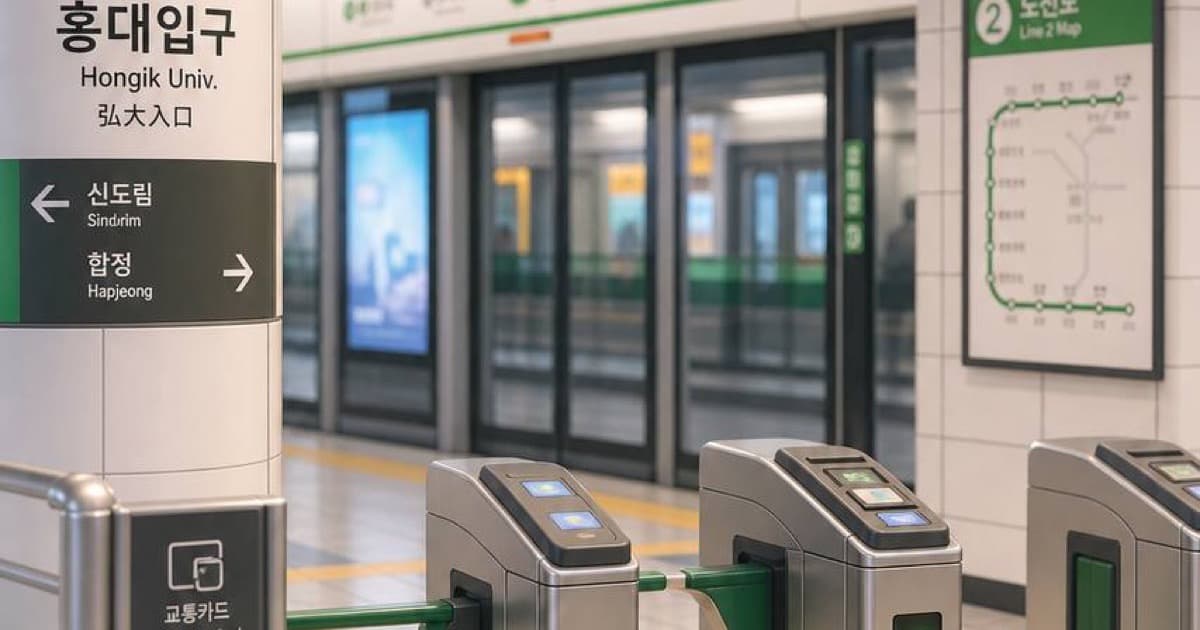
Day 7 — 명동역 어떻게 가요? (myeong-dong-yeok eo-tteo-ke ga-yo?) "How do I get to Myeongdong Station?" Put any place in front: 공항 어떻게 가요? (How do I get to the airport?), 호텔 어떻게 가요? You'll often hear back 쭉 가세요 (go straight) and 오른쪽 / 왼쪽 (right / left).
Week 2: lines for food, sitting down, and saying goodbye
Day 8 — 얼마나 걸려요? (eol-ma-na geol-lyeo-yo?) "How long does it take?" Ask it after Day 7, or at a restaurant with a queue. Answers sound like 10분 (sip-bun, 10 minutes) or 한 시간 (han si-gan, one hour).
Day 9 — 안 맵게 해 주세요 (an maep-ge hae ju-se-yo) "Please make it not spicy." -게 해 주세요 means "please make it ___." Swaps: 덜 맵게 (less spicy), 크게 (large), 따뜻하게 (warm). Handy at tteokbokki shops and noodle places.
Day 10 — 여기 앉아도 돼요? (yeo-gi an-ja-do dwae-yo?) "May I sit here?" Day 3's permission pattern again, now with 앉다 (to sit). You'll use it in food courts, cafés, and on park benches.
Day 11 — 이거 한국어로 뭐예요? (i-geo han-gu-geo-ro mwo-ye-yo?) "What's this in Korean?" The phrase that makes every other phrase easier. Point at something and Koreans will teach you the word on the spot.
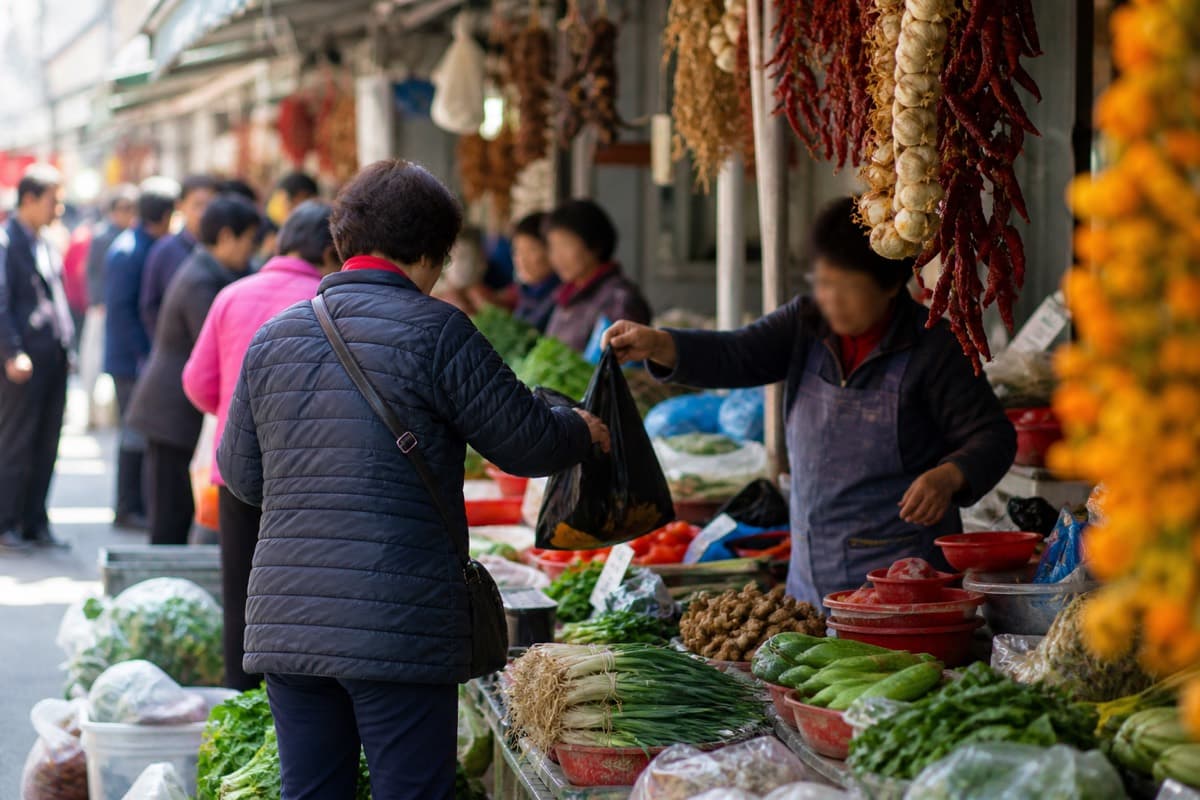
Day 12 — 조금만 깎아 주세요 (jo-geum-man kka-kka ju-se-yo) "Could you take a little off?" Use it at traditional markets and street stalls, with a smile. Department stores and chain shops have fixed prices, so save it for the market.
Day 13 — 다 먹었어요 (da meo-geo-sseo-yo) "I'm finished." Staff may ask 다 드셨어요? (Are you done?) before clearing your plate. This is your answer. If you're not done, 아직이요 (a-jik-i-yo, not yet).
Day 14 — 또 올게요 (tto ol-ge-yo) "I'll come again." The warmest way to leave a place you liked. Pair it with 잘 먹었습니다 after a meal or 감사합니다 after shopping, and the owner will remember you.
A one-minute conversation using five of the phrases
You: 저기요, 이거 뭐예요? (Excuse me, what's this?) Staff: 떡볶이예요. (It's tteokbokki.) You: 안 맵게 해 주세요. 카드 돼요? (Not spicy, please. Can I pay by card?) Staff: 네, 돼요. (Yes, you can.) You: 여기 앉아도 돼요? (May I sit here?) Staff: 네, 앉으세요. (Sure, have a seat.) (later) You: 다 먹었어요. 또 올게요! (I'm finished. I'll come again!)
Mistakes people make with daily phrases
Dropping the 요. 이거 뭐야? and 괜찮아 are fine with friends, but to a shop owner or stranger they sound abrupt. Keep 요 on everything in this list until you're sure.
Saying 돼요 like "dweh-yo" with a flat English vowel. 돼 sounds close to "dweh" said quickly, almost one syllable. Listen to how it rises at the end of a question.
Treating 괜찮아요 as only "I'm fine." Visitors often miss that it's also the polite "no thanks." If you keep getting handed things you don't want, this is the line.
Learning the line but not the answer. Each phrase above lists the reply you're likely to hear. Learning 네, 돼요 / 안 돼요 is half the value of Day 2.
How to keep a phrase-of-the-day habit going
Pick a time you already have, like your morning coffee or commute. Say today's line out loud three times, then say two swaps. Before bed, say yesterday's line once from memory. That tiny review is what turns 14 days into 14 phrases you keep.
Saying them out loud matters more than reading them. Your mouth needs to have made the sounds before you're standing at a counter with someone waiting.

If you'd like a daily speaking routine built on these same patterns, with your voice checked as you practice:
Now say it out loud
SULSUL says the phrase, you repeat it, and it tells you what came out wrong — 100 survival patterns for cafes, taxis and small talk in Seoul.
Start speaking Korean →