To-Go Box in Korean: How to Take Your Leftovers Home (남은 거 포장해 주세요)
To ask for a to-go box in Korean, say 남은 거 포장해 주세요 (na-meun geo po-jang-hae ju-se-yo): "Please pack the leftovers." There is no separate word for a "to-go box" or "doggy bag." Koreans use 포장 (po-jang, packing / to-go) for everything from takeout orders to the half plate of chicken you couldn't finish. If you're not sure the restaurant does it, ask first with 남은 거 포장돼요? (na-meun geo po-jang-dwae-yo?), "Can I take the leftovers?" Most casual restaurants will say yes and either pack it for you or hand you a container.
- Please pack the leftovers: 남은 거 포장해 주세요 — na-meun geo po-jang-hae ju-se-yo
- Can I take the leftovers to go?: 남은 거 포장돼요? — na-meun geo po-jang-dwae-yo?
- Please wrap this up (homey): 이거 싸 주세요 — i-geo ssa ju-se-yo
- A container, please: 포장 용기 주세요 — po-jang yong-gi ju-se-yo
- A bag, please: 봉투 주세요 — bong-tu ju-se-yo
- Separately, please: 따로 담아 주세요 — tta-ro da-ma ju-se-yo
What 포장 (pojang) actually means
포장 is a noun that means "packing" or "wrapping." Gift wrapping at a department store is 포장. So is a takeout order at a gimbap shop, and so is the box for your leftover tteokbokki. When you hear "pojang" in a Korean restaurant, it simply means "this is leaving the building."
To turn it into a request, you use the pattern from the SULSUL workbook for asking someone to do something: verb stem plus 아/어 주세요. 포장하다 (to pack) becomes 포장해 주세요, "please pack it." Add what you want packed in front: 이거 (this), 남은 거 (what's left), 치킨 (the chicken). For an extra-soft version, put 좀 in the middle: 이거 좀 포장해 주세요. Want to sound a bit more careful? Say 포장해 주시겠어요?, "Could you pack it for me?"
The word 남은 comes from 남다, "to be left over," so 남은 거 is literally "the thing that is left." It's the most useful two-word phrase for this situation, and you can point at the plate as you say it.
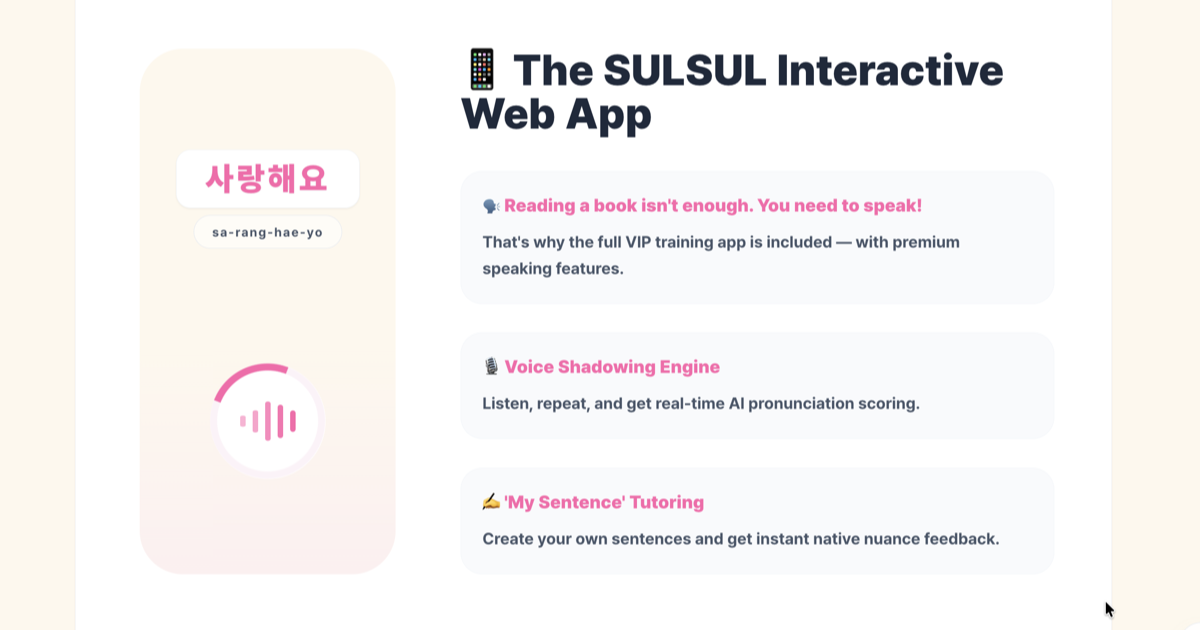
Practice this out loud with SULSUL — the app says it, you repeat it →
Asking first: 남은 거 포장돼요?
If you don't know whether a restaurant packs leftovers, ask before you assume. 포장돼요? (po-jang-dwae-yo?) means "Is packing possible?" It's polite and neutral, and staff hear it all day.
You can also ask with 싸 갈 수 있어요? (ssa gal su i-sseo-yo?), "Can I wrap it up and take it?" Both work. The first sounds a little more like a customer at a counter, and the second a little more like someone at a family meal.
If the answer is 네, 돼요 (ne, dwae-yo), "Yes, you can," you're set. If it's 포장은 안 돼요 (po-jang-eun an dwae-yo), "We don't do to-go," just say 아, 네 and leave it there.
싸 주세요: the homey way to say "wrap it up"
You'll also hear 싸 주세요 (ssa ju-se-yo). It comes from 싸다, "to wrap," the same verb in 쌈 (ssam, food wrapped in lettuce) and 도시락 싸다 (to pack a lunchbox). It feels warmer and more everyday than 포장해 주세요, the kind of thing you'd say to the 이모 at a neighborhood restaurant.
Both are fine. If you only learn one, learn 포장해 주세요. It works in every kind of place, from a chain restaurant to a market stall.
What the server might say back
The request is short. The questions that come back are where people freeze. These are the common ones:
- 포장 용기 갖다 드릴게요. (po-jang yong-gi gat-da deu-ril-ge-yo) — "I'll bring you a container." In many places the server brings a box and you pack it yourself at the table.
- 직접 담으시면 돼요. (jik-jeop da-meu-si-myeon dwae-yo) — "You can pack it yourself." Same idea. Look for a sign that says 셀프 포장 (sel-peu po-jang), self-packing.
- 국물도 담아 드릴까요? (gung-mul-do da-ma deu-ril-kka-yo?) — "Should I pack the soup too?" Answer 네, 같이 담아 주세요 for yes, or 아니요, 건더기만요 (geon-deo-gi-man-yo, "just the solid bits") if you don't want a leaky bag.
- 봉투 필요하세요? (bong-tu pi-ryo-ha-se-yo?) — "Do you need a bag?" Bags often cost a little extra in Korea, so staff ask instead of just handing one over. 네, 주세요 or 괜찮아요 (no thanks).
- 반찬은 포장이 안 돼요. (ban-chan-eun po-jang-i an dwae-yo) — "Side dishes can't be packed." More on that below.
Which foods usually go home, and which don't
Leftovers are normal in Korea, especially with shared dishes. Fried chicken, pizza, jokbal, braised dishes like 찜 (jjim), and stews are all commonly packed. Uncooked meat left over at a barbecue place can often go home too. Ask 고기 남은 거 포장돼요? before it hits the grill.
A few things usually stay behind:
- Free side dishes (반찬). Refills are free because they stay in the restaurant. Many places won't pack them, and asking for a box of kimchi to take home can feel a bit cheeky.
- Buffets and all-you-can-eat places (무한리필, mu-han-ri-pil). Taking food out is generally not allowed. Some places even charge if you leave a lot on the plate.
- Food that won't travel. Cold noodles (냉면) go soggy, and some restaurants politely refuse to pack them for that reason.
At a takeout-friendly place, it helps to ask early. Say 반은 포장해 주세요 (ba-neun po-jang-hae ju-se-yo), "Please pack half of it," when you order something huge.
A short scene at the end of a meal
You: 저기요! 남은 거 포장돼요? jeo-gi-yo! na-meun geo po-jang-dwae-yo? — Excuse me! Can I take the leftovers?
Server: 네, 돼요. 용기 갖다 드릴게요. ne, dwae-yo. yong-gi gat-da deu-ril-ge-yo. — Yes, you can. I'll bring a container.
Server: 국물도 담아 드릴까요? gung-mul-do da-ma deu-ril-kka-yo? — Should I pack the soup too?
You: 아니요, 건더기만요. 그리고 봉투도 주세요. a-ni-yo, geon-deo-gi-man-yo. geu-ri-go bong-tu-do ju-se-yo. — No, just the solids. And a bag too, please.
Server: 네, 여기 있어요. ne, yeo-gi i-sseo-yo. — Sure, here you go.
You: 감사합니다. 잘 먹었습니다! gam-sa-ham-ni-da. jal meo-geo-sseum-ni-da! — Thank you. That was delicious!
Slips that make it awkward
- Saying "doggy bag." Most staff won't know it. Even "take out" can be heard as 테이크아웃, which in Korea usually means coffee. 포장 is the word.
- Packing the shared banchan into your box. If the server didn't offer, don't. Pack only the dish you ordered.
- Dropping the 요. 포장해 on its own is casual and sounds like an order. Keep 주세요.
- Waiting until the plate is cleared. Staff move fast in busy places. Call 저기요 while the food is still on the table.
Say it before your next big meal
The whole thing comes down to three lines. Say them out loud now, a few times each: 남은 거 포장돼요? — 포장 용기 주세요. — 봉투도 주세요. Then try swapping the first word: 치킨 포장해 주세요. 이거 반만 포장해 주세요. 이거 싸 주세요. Once 포장해 주세요 comes out without thinking, it works for takeout orders, leftovers, and even gift wrapping at a shop.