A Korean Odyssey in Korean: What 화유기 Means, and the Words the K-Drama Is Built On

The K-drama known in English as A Korean Odyssey is called 화유기 (hwa-yu-gi) in Korean. The title is a play on 서유기 (seo-yu-gi), the Korean name for the Chinese classic Journey to the West. Swap the first syllable 서 ("west") for 화 ("flower") and the "journey to the west" becomes a "journey of flowers." That one-letter change tells you what the drama is: the old monkey-king story, moved to modern Seoul, with a love story in the middle.
Quick answer
- 화유기 (hwa-yu-gi) — the Korean title of A Korean Odyssey
- 서유기 (seo-yu-gi) — Journey to the West, the story it remakes
- 손오공 (son-o-gong) — the monkey king, Sun Wukong in Chinese
- 요괴 (yo-goe) — a demon or monster, the word the whole cast is built from
One syllable away from 서유기
Old book titles in Korean often end in 기 (gi), "a record" or "a tale." 서유기 breaks down as 서 (west) + 유 (travel) + 기 (record): "the record of travelling west." 화유기 keeps 유 and 기 and changes only the front, so a Korean viewer reads the title and gets the joke at once.
You do not need the Chinese characters to use any of this. What matters is that 서유기 is a story nearly every Korean knows from childhood, through picture books and cartoons. When a Korean friend hears "A Korean Odyssey," they may pause. When they hear 화유기, they will nod. Use the Korean title when you talk about the show:
- 화유기 봤어요? (hwa-yu-gi bwa-sseo-yo?) — "Have you seen A Korean Odyssey?"
- 화유기 너무 재밌었어요. (hwa-yu-gi neo-mu jae-mi-sseo-sseo-yo) — "A Korean Odyssey was so good."
Practice this out loud with SULSUL — the app says it, you repeat it →
Who 손오공, 저팔계, 사오정, and 삼장 are
The main characters carry the Korean names of the Journey to the West cast, so the names are a ready-made vocabulary list.
- 손오공 (son-o-gong) — the monkey king. Korean kids also know this name from Dragon Ball, because Goku is called 손오공 in Korea. The drama plays on how cocky and quick the monkey king is.
- 저팔계 (jeo-pal-gye) — the pig spirit. In the drama he runs his own business and loves to eat and flirt, which fits the old character.
- 사오정 (sa-o-jeong) — the river spirit. Outside the drama, 사오정 is also a joke name: Koreans grew up on "사오정 jokes" about a character who mishears everything. If a friend misses your point three times, someone may laugh and say 사오정이야? — "Are you 사오정?" Say it to friends only.
- 삼장 (sam-jang) — the monk the others must protect, often called 삼장법사 (sam-jang-beop-sa). In A Korean Odyssey, 삼장 is the heroine, 진선미 (jin-seon-mi), a woman who has been able to see ghosts since she was a child.
Then there is 우마왕 (u-ma-wang), the Bull Demon King. 마왕 (ma-wang) on its own means "demon king," and fans use it as a nickname for a charming villain.
요괴 and 귀신: two words for things that aren't human
These are the two words you will hear most, and they are not the same.
요괴 (yo-goe) is a demon or monster: a creature with power, often old and tricky. 손오공, 저팔계, and 우마왕 are all 요괴. 귀신 (gwi-sin) is a ghost, the spirit of a dead person. 진선미 sees 귀신, and that is why her life is hard before the story even starts.
Both words come up in normal Korean, not only in fantasy shows:
- 귀신 봤어? (gwi-sin bwa-sseo?) — "Did you see a ghost?" Said to a friend who looks pale or jumps at nothing.
- 무서워. (mu-seo-wo) — "I'm scared." The most useful line in any horror or fantasy episode.
- 이 집 귀신 나올 것 같아. (i jip gwi-sin na-ol geot ga-ta) — "This house looks like it has ghosts."

금강고 and 운명: the bracelet and the word for fate
In the old story, the monkey king wears a gold band on his head so the monk can control him. In 화유기, that band becomes a bracelet called 금강고 (geum-gang-go), and it ties 손오공 to 진선미: when she calls his name, he has to come.
That set-up gives fans two words worth knowing. 운명 (un-myeong) is fate or destiny, and K-dramas love it: 운명이야 (un-myeong-i-ya), "It's fate." 지켜 줄게 (ji-kyeo jul-ge), "I'll protect you," is the promise the whole bracelet stands for. Both sound natural between close friends, half-joking:
- 우리 만난 건 운명이야. (u-ri man-nan geon un-myeong-i-ya) — "It was fate that we met." Said with a grin to a friend you met by chance.
- 걱정 마, 내가 지켜 줄게. (geok-jeong ma, nae-ga ji-kyeo jul-ge) — "Don't worry, I've got you."
Talking about the show with a Korean friend
Here is a short exchange you can actually have, using the words above:
You: 화유기 알아요? — hwa-yu-gi a-ra-yo? — "Do you know A Korean Odyssey?"
Friend: 네, 서유기 이야기죠? — ne, seo-yu-gi i-ya-gi-jyo? — "Yes, it's the Journey to the West story, right?"
You: 맞아요. 손오공이 진짜 멋있어요. — ma-ja-yo. son-o-gong-i jin-jja meo-si-sseo-yo. — "Right. 손오공 is really cool."
Friend: 저는 우마왕이 더 좋아요. — jeo-neun u-ma-wang-i deo jo-a-yo. — "I like the Bull Demon King more."
You: 좀 무서웠는데 재밌었어요. — jom mu-seo-wonn-neun-de jae-mi-sseo-sseo-yo. — "It was a bit scary, but fun."
Notice that nobody says "A Korean Odyssey" or "Sun Wukong." In Korean, the Korean names do all the work.
Where fans get these words wrong
Using the English title. "A Korean Odyssey" is an export title. Many Koreans will not connect it to the show. Say 화유기.
Mixing up 요괴 and 귀신. Calling 손오공 a 귀신 sounds like calling him a dead person's ghost. He is a 요괴. The heroine sees 귀신.
Saying 사오정 to someone older. The 사오정 joke is teasing. With a teacher, a boss, or anyone you speak 요 Korean with, keep it out.
Saying 운명이야 too seriously. With a friend and a smile, it is playful. Said straight to someone you just met, it sounds like a drama confession.
Say the names before you need them
Read the names out loud, slowly, then at speed: 화유기, 서유기, 손오공, 저팔계, 사오정, 삼장. Then say the three lines that work outside the show: 귀신 봤어?, 무서워, 내가 지켜 줄게. The next time you watch an episode, try to catch 요괴 and 운명 before the subtitle appears.
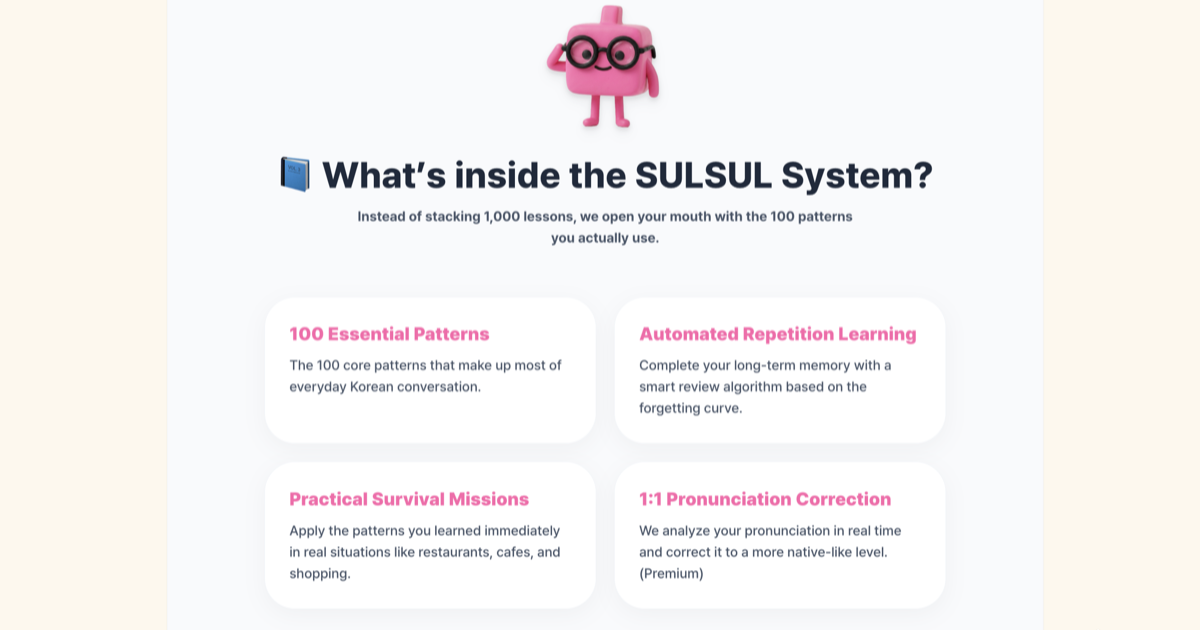
SULSUL is a speaking gym for exactly that step: pick a pattern, say it out loud, get an instant fix from the AI pronunciation coach, then run a real situation as a mission. The 100-pattern PDF workbook comes along as a bonus.