Exchange in Korean: 교환, 환전, and 바꿔 주세요 — Which One Fits Your Situation
"Exchange" in Korean depends on what you are exchanging. 교환 (gyohwan) is swapping a product for another one — a shirt in the wrong size, a cracked phone case. 환전 (hwanjeon) is changing money from one currency to another. And in everyday speech, most Koreans skip both nouns and use the verb 바꾸다 (bakkuda, to change), as in 바꿔 주세요 — "Please switch it for me." If you only remember one line, make it that one: it works at a clothing shop, a cafe counter, and a money exchange booth.
- 교환 (gyohwan) — exchange of a product (store, online order)
- 환전 (hwanjeon) — currency exchange
- 환전소 (hwanjeonso) — money exchange booth
- 바꾸다 (bakkuda) — to change, to switch
- 바꿔 주세요 (bakkwo juseyo) — Please change it (for me)
- 바꿔도 돼요? (bakkwodo dwaeyo?) — Can I change it?
- 환불 (hwanbul) — refund
So you have two nouns for two very different places, and one verb that quietly covers both. The sections below take them one at a time.
Which word for which exchange
| You want to... | Noun | What you actually say |
|---|---|---|
| Swap a product for a different size or color | 교환 | 다른 사이즈로 바꿔 주세요 |
| Change dollars into won | 환전 | 달러를 원으로 바꿔 주세요 |
| Return it and get a refund | 환불 | 환불돼요? |
| Swap one seat, cup, or plate for another | (no noun) | 이거 바꿔 주세요 |
| Practice Korean with a partner | 언어 교환 | 언어 교환 하실래요? |
Notice the last column. Even when the "official" word is 교환 or 환전, the sentence people say out loud usually leans on 바꿔.
Practice this out loud with SULSUL — the app says it, you repeat it →
교환: swapping something you bought
교환 is the word printed on receipts, store signs, and online shop policies: 교환 및 환불 ("exchanges and refunds"), 교환 가능 ("exchange possible"), 교환 불가 ("no exchanges"). You will read it more often than you hear it.
At the counter, the clearest request is 교환하고 싶어요 — "I'd like to exchange this." Hand over the item and the receipt (영수증, yeongsujeung) together. Then say what you want instead:
- 사이즈가 안 맞아요. — The size doesn't fit.
- 한 사이즈 큰 걸로 바꿔 주세요. — Please change it to one size bigger.
- 다른 색으로 바꿔도 돼요? — Can I change it to a different color?
That last line uses the SULSUL textbook's permission pattern (V)아/어도 돼요? — "Is it okay if I...?" It is softer than a direct request, which helps when the item is already opened.
Staff will often ask 영수증 있으세요? ("Do you have the receipt?") and 언제 구매하셨어요? ("When did you buy it?"). A short answer is enough: 네, 여기요 or 어제요 ("Yesterday").

환전: changing money
환전 is only about currency. You will see 환전 on bank windows, airport counters, and booths around Myeongdong, often next to 환율 (hwanyul, exchange rate). The booth itself is a 환전소.
The polite, natural request is 환전하고 싶어요 ("I'd like to exchange money") followed by what you have and what you want:
- 달러를 원으로 바꿔 주세요. — Please change dollars into won.
- 엔화 환전돼요? — Can you exchange yen?
- 오늘 환율이 얼마예요? — What's today's rate?
- 작은 돈도 섞어 주세요. — Please include some small bills.
The particle (으)로 does the heavy lifting here. It marks what something turns into: 원으로 ("into won"), 큰 걸로 ("into a bigger one"). Get that one particle right and your sentence is clear even if the rest is rough.
바꿔 주세요: the everyday verb
Outside shops and banks, nobody says 교환 for small swaps. If your coffee comes hot instead of iced, you don't announce an "exchange." You say 아이스로 바꿔 주세요 — "Please change it to iced." This is Pattern 23 from the SULSUL textbook, (V)아/어 주세요: take a verb, add 아/어, then 주세요, and you have a polite request.
A few you can use right away:
- 자리 바꿔 주실 수 있어요? — Could you switch seats with me?
- 이 접시 바꿔 주세요. — Please change this plate (it's dirty or chipped).
- 현금으로 바꿔 주세요. — Please change it to cash (payment).
- 잔돈으로 바꿔 주세요. — Please break this into small change.
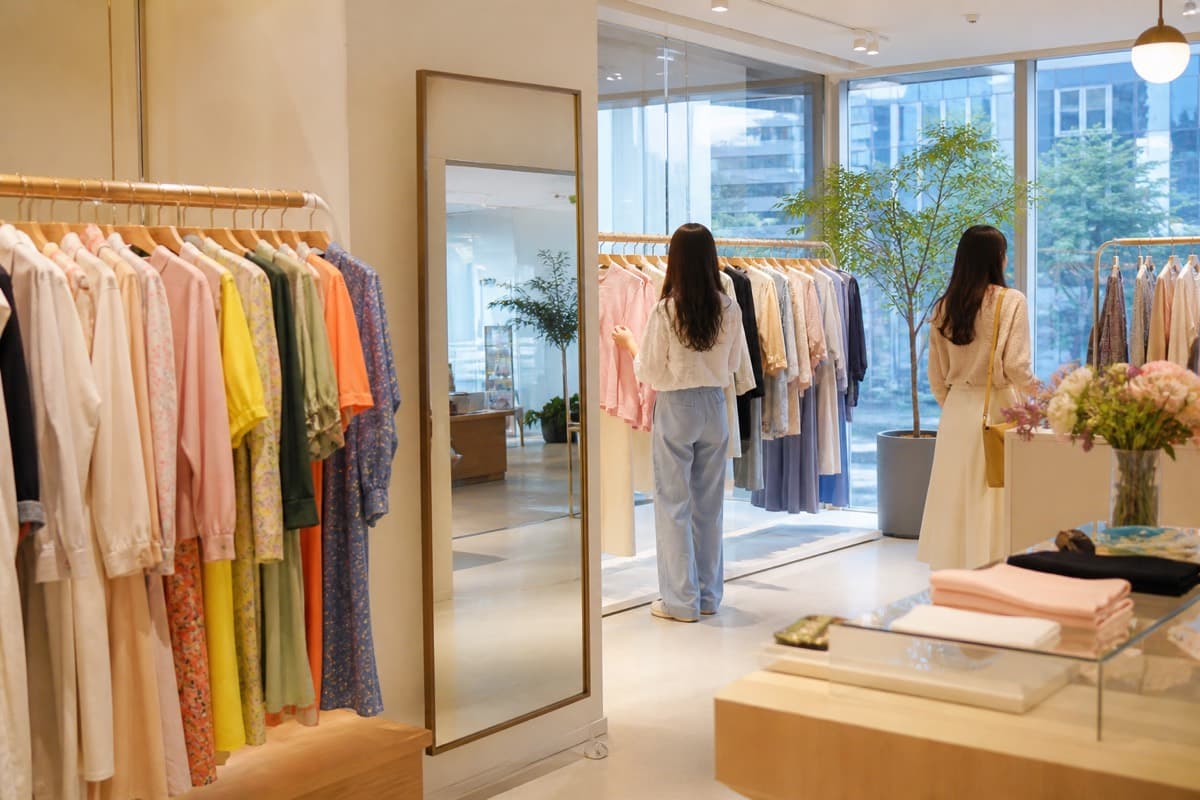
A real exchange at a clothing shop
You: 저기요, 이거 교환하고 싶어요. Jeogiyo, igeo gyohwanhago sipeoyo. — Excuse me, I'd like to exchange this.
Staff: 네, 영수증 있으세요? Ne, yeongsujeung isseuseyo? — Sure, do you have the receipt?
You: 네, 여기요. 사이즈가 좀 작아요. Ne, yeogiyo. Saijeuga jom jagayo. — Yes, here. The size is a bit small.
Staff: 어떤 사이즈로 드릴까요? Eotteon saijeuro deurilkkayo? — Which size would you like?
You: 한 사이즈 큰 걸로 바꿔 주세요. Han saijeu keun geollo bakkwo juseyo. — One size up, please.
Staff: 잠시만요. 여기 있습니다. Jamsimanyo. Yeogi itseumnida. — Just a moment. Here you go.
Two lines did all the work: 교환하고 싶어요 to open, 바꿔 주세요 to close.
Mix-ups that confuse people
Using 교환 for money. "돈 교환해 주세요" sounds like you want to trade cash with someone. For currency, the word is 환전.
Asking for 교환 when you want a refund. 교환 means you leave with a different item. If you want to return it for a refund, the word is 환불 — 환불돼요? ("Can I get a refund?").
Dropping (으)로. "아이스 바꿔 주세요" is understandable, but "아이스로 바꿔 주세요" is what a Korean would say. The 로 tells the listener what you want it changed into.
Mispronouncing 바꿔. The ㄲ is a tense sound, not a soft g. Say ba-kkwo with a little catch before the second syllable, as if you were about to say "kw" quickly.
Practice the lines out loud
- 이거 교환하고 싶어요. — opening an exchange at a shop.
- 다른 색으로 바꿔도 돼요? — asking politely.
- 달러를 원으로 바꿔 주세요. — at the exchange booth.
- 아이스로 바꿔 주세요. — fixing a cafe order.
Read each one aloud three times, then swap the noun before 로: 큰 걸로, 작은 걸로, 검은색으로, 현금으로. Once 바꿔 주세요 feels automatic, you can fix almost any wrong size, wrong drink, or wrong currency on your trip.
SULSUL is a speaking gym for moments like this: pick a pattern, say it out loud, get an instant fix from the AI pronunciation coach, then run the real situation as a mission. The 100-pattern PDF workbook comes along as a bonus.