Korean Words Meaning in Tagalog: Ate, Kuya, Kumain Ka Na? and the K-Drama Words Filipino Fans Already Know

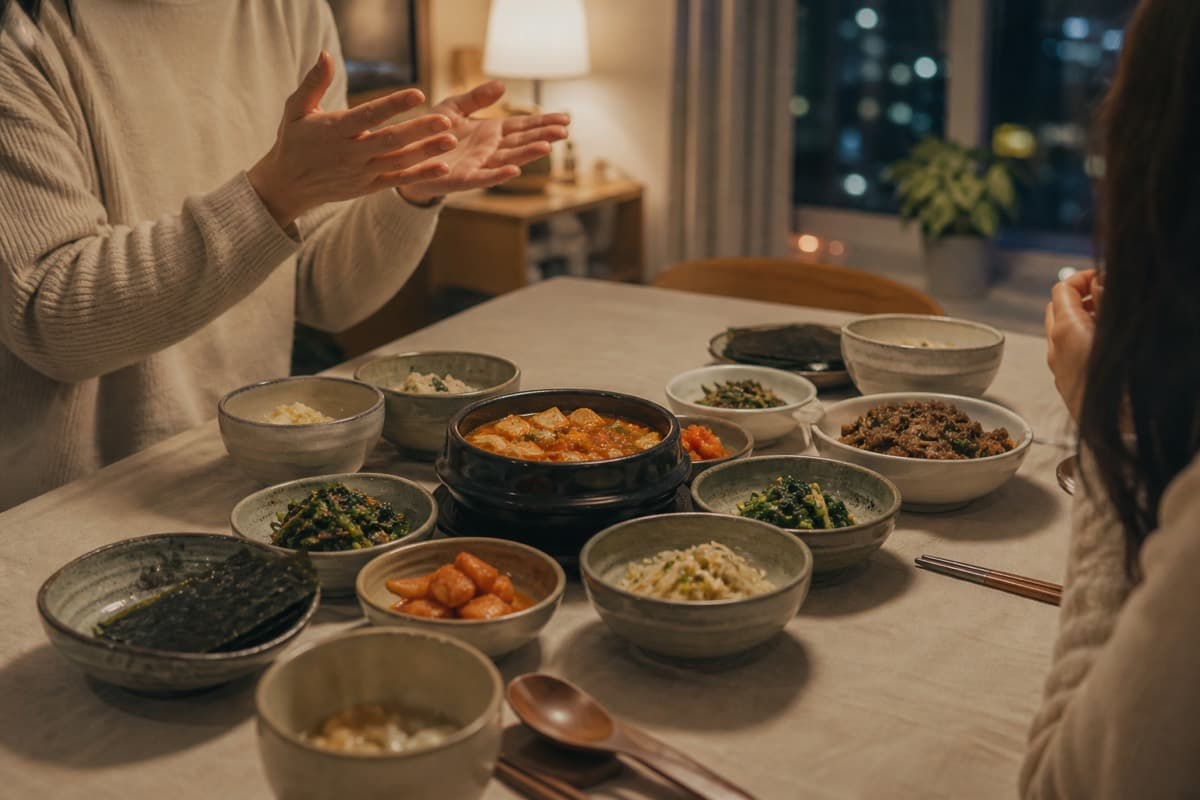
If you grew up speaking Tagalog, K-dramas already sound a little like home. 언니 (eon-ni) and 누나 (nu-na) are your ate. 오빠 (o-ppa) and 형 (hyeong) are your kuya. And the line a Korean mom says before anything else — 밥 먹었어? (bap meo-geo-sseo?) — is word for word "Kumain ka na?"
- 언니 / 누나 — ate — "older sister"
- 오빠 / 형 — kuya — "older brother"
- 밥 먹었어? — Kumain ka na? — "Have you eaten?"
- 진짜? — Talaga? — "Really?"
- 아이고 — Hay naku! — "Oh my, good grief"
Below: the family words, the Korean version of po and opo, the reactions you hear in every episode, the sweet lines from the romance scenes, and three sound-alikes that mean something completely different.
Ate and kuya in Korean: four words instead of two
In Tagalog, ate and kuya work for anyone older — your real sister, your cousin, the girl at the sari-sari store. Korean does the same thing, but the word changes with who is speaking.
| Korean | Who says it | Tagalog | English |
|---|---|---|---|
| 언니 (eon-ni) | a girl, to an older woman | ate | older sister |
| 누나 (nu-na) | a boy, to an older woman | ate | older sister |
| 오빠 (o-ppa) | a girl, to an older man | kuya | older brother |
| 형 (hyeong) | a boy, to an older man | kuya | older brother |
| 동생 (dong-saeng) | anyone, about someone younger | bunso, nakababata | younger sibling |
So a female lead calls her best friend's older sister 언니, and her little brother calls the same woman 누나. Same person, two words.
Here is where Tagalog and Korean split: a Korean girl calls her boyfriend 오빠. Calling your boyfriend kuya would be strange in Manila, but in Seoul 오빠 sounds sweet and a little playful. That is why fans scream it at concerts.
The parents are easy: 엄마 (eom-ma) is nanay or mama, and 아빠 (a-ppa) is tatay or papa. 할머니 (hal-meo-ni) is lola, and 할아버지 (ha-ra-beo-ji) is lolo.
Practice this out loud with SULSUL — the app says it, you repeat it →
Po and opo in Korean: the little 요 at the end
Filipino kids learn early: add po when you talk to someone older, and say opo instead of oo. Korean has the same habit, and it lives at the end of the sentence.
- 고마워 (go-ma-wo) — "Salamat" — to a close friend
- 고마워요 (go-ma-wo-yo) — "Salamat po" — everyday polite
- 감사합니다 (gam-sa-ham-ni-da) — "Maraming salamat po" — formal, to a boss or elder
The yes-words line up too:
| Korean | Tagalog | When |
|---|---|---|
| 응 (eung) | oo | to friends |
| 네 (ne) | opo | to anyone older or a stranger |
| 아니 (a-ni) | hindi | no, casual |
| 아니요 (a-ni-yo) | hindi po | no, polite |
Think of 요 as Korean po. Leave it off with a stranger, and it lands the way a missing po does with your tita — not a crime, but people notice.
Talaga? Grabe! The K-drama reactions in Tagalog
These are the words you hear even when the subtitles are off.
- 진짜? (jin-jja?) — Talaga? — "Really?"
- 대박! (dae-bak!) — Grabe! Ang galing! — "Amazing!"
- 헐 (heol) — Ha?! Ano raw? — "Wait, what?"
- 아이고 (a-i-go) — Hay naku! / Aray! — the sigh for a sore back, a big bill, or a silly friend
- 어떡해 (eo-tteo-ke) — Paano na 'to? — "What do I do now?"
- 괜찮아? (gwaen-chan-a?) — Okay ka lang? — "Are you okay?"
- 괜찮아 (gwaen-chan-a) — Okay lang / Ayos lang — "It's fine."
- 화이팅! (hwa-i-ting!) — Laban! Kaya mo 'yan! — "You've got this!"
- 잠깐만 (jam-kkan-man) — Teka lang — "Wait a second."
Notice how 괜찮아 does double duty, just like okay lang. Asked with a rising voice, it is a question. Said flat, it is the answer — even when the character is clearly not okay.
Kumain ka na? How Koreans say "I care"
Filipino families show love with food before words. Korean families do too, and the lines match almost one to one.

- 밥 먹었어? (bap meo-geo-sseo?) — Kumain ka na? — It means "I was thinking about you."
- 밥 먹었어요? (bap meo-geo-sseo-yo?) — Kumain ka na po? — the polite version
- 많이 먹어 (ma-ni meo-geo) — Kain ka pa — "Eat more." Every grandma's line.
- 잘 먹겠습니다 (jal meok-ge-sseum-ni-da) — said before eating, a thank-you to whoever cooked
- 조심해 (jo-sim-hae) — Ingat ka — "Take care."
- 잘 자 (jal ja) — Good night, tulog na — "Sleep well."
A short exchange between two friends:
A: 밥 먹었어? (bap meo-geo-sseo?) — Kumain ka na? B: 아니, 아직. 너는? (a-ni, a-jik. neo-neun?) — Hindi pa. Ikaw? A: 나도. 같이 먹자! (na-do. ga-chi meok-ja!) — Ako rin. Sabay na tayo!
Mahal kita in Korean: the romance-scene lines
The love words in K-dramas come in steps, just like in a teleserye.
- 좋아해 (jo-a-hae) — Gusto kita — "I like you." The first confession.
- 사랑해 (sa-rang-hae) — Mahal kita — "I love you."
- 보고 싶어 (bo-go si-peo) — Miss na kita — "I miss you." Literally "I want to see you."
- 가지 마 (ga-ji ma) — Huwag kang umalis — "Don't go." The airport scene.
- 내 거야 (nae geo-ya) — Akin ka — "You're mine."
- 자기야 (ja-gi-ya) — Mahal / Babe — the pet name couples use
Three sound-alikes that fool Filipino ears
나 (na) means "I" or "me." In Tagalog, na means "already," so 나 가 (na ga) can sound like "aalis na." It actually means "I'm going." Close, but the 나 is the person, not the timing.
아니 (a-ni) means "no," but to a Tagalog ear it sounds like ano — "what?" When a Korean friend says 아니, 아니, they are not asking a question. They are saying "no, no, that's not it."
오빠 to strangers. Filipinos call any older man kuya — the jeepney driver, the guard, the delivery guy. In Korean, a girl calling a stranger 오빠 sounds flirty. For a shop owner, use 사장님 (sa-jang-nim). To get someone's attention, say 저기요 (jeo-gi-yo) — the Korean "excuse me po."
Same heart, different word order
Tagalog often puts the verb first: "Kumain ako ng kanin." Korean saves the verb for the very end:
나는 밥을 먹었어. (na-neun ba-beul meo-geo-sseo.) I — rice — ate.
The trick is to hold the action until the last word. Small markers like 은/는 and 을/를 do the job Tagalog gives to ang and ng — they tell you who is doing what, so the order can move without the meaning breaking.
Say them out loud before the next episode
Knowing that 진짜? means talaga? takes one second. Saying it fast enough to react with the character takes a few days of practice out loud.
Pick three lines — 밥 먹었어?, 괜찮아?, and 화이팅! — and say each five times. Then play both A and B in the dialogue above. Next time a drama mom asks 밥 먹었어?, you will hear "Kumain ka na?" and answer before the subtitle does.
SULSUL is a speaking gym for that moment: pick a pattern, say it out loud, get an instant fix from the AI pronunciation coach, then run the real situation as a mission. The 100-pattern PDF workbook comes along as a bonus.