Dentist in Korean: 치과 vs 치과 의사, and How to Say 'My Tooth Hurts'


The Korean word for dentist is 치과 의사 (chi-gwa ui-sa), literally "dental doctor." But the word you'll use far more often is 치과 (chi-gwa), which means the dental clinic itself. Koreans say 치과 가야 돼요 (chi-gwa ga-ya dwae-yo), "I have to go to the dentist," the same way English speakers say "go to the dentist" and mean the place. Once you're inside, address the dentist as 선생님 (seon-saeng-nim), not 치과 의사. And the one line that gets you help fastest is 이가 아파요 (i-ga a-pa-yo), "My tooth hurts."
Dentist words in Korean, the short version
- Dental clinic / "the dentist": 치과 — chi-gwa
- Dentist (the person): 치과 의사 — chi-gwa ui-sa
- What you call the dentist: 선생님 — seon-saeng-nim
- Tooth: 이 — i (formal: 치아, chi-a)
- "My tooth hurts": 이가 아파요 — i-ga a-pa-yo
- "I need to go to the dentist": 치과 가야 돼요 — chi-gwa ga-ya dwae-yo
치과, 치과 의사, 선생님: three words for three jobs
English uses "dentist" for both the person and the place. Korean splits them, and each word has its own spot in a sentence.
| Korean | Say it | Meaning | When you use it |
|---|---|---|---|
| 치과 | chi-gwa | Dental clinic | Signs, maps, "I'm going to the dentist" |
| 치과 의사 | chi-gwa ui-sa | Dentist (job title) | Talking about someone's profession |
| 선생님 | seon-saeng-nim | Doctor / teacher (respectful) | Speaking to the dentist directly |
| 치과의원 | chi-gwa-ui-won | Small dental clinic | The full name on many street signs |
| 치과병원 | chi-gwa-byeong-won | Larger dental hospital | Bigger buildings, more specialists |
So if a friend asks what your sister does, you'd say 치과 의사예요 (chi-gwa ui-sa-ye-yo), "She's a dentist." But in the chair, calling out "치과 의사님" sounds stiff and odd. Every patient says 선생님.
On the street, look for the character 치 (chi, tooth). It starts the name on every dental sign, usually followed by 과, 과의원, or 과병원. In a map app, typing 치과 is enough to show every clinic nearby.
Practice this out loud with SULSUL — the app says it, you repeat it →
Words for teeth and what's wrong with them
Your workbook's Special Unit 1 builds a body map for exactly this kind of moment: name the part, add -이/가 아파요, and you've described the problem. For a dental visit, these are the parts you'll need:
| Korean | Say it | Meaning |
|---|---|---|
| 이 / 치아 | i / chi-a | Tooth (casual / formal) |
| 잇몸 | in-mom | Gums |
| 사랑니 | sa-rang-ni | Wisdom tooth (literally "love tooth") |
| 어금니 | eo-geum-ni | Molar |
| 앞니 | am-ni | Front tooth |
| 충치 | chung-chi | Cavity |
| 스케일링 | seu-ke-il-ling | Cleaning (scaling) |
| 신경 치료 | sin-gyeong chi-ryo | Root canal |
| 때우다 | ttae-u-da | To fill (a cavity) |
| 마취 | ma-chwi | Anesthesia, numbing |
사랑니 always gets a smile from learners. The usual explanation is that it comes in around the age people first fall in love, and it can hurt just as much.

Describing the pain in one line
"It hurts" is a start, but Korean has short, vivid words for the kind of pain, and dentists listen for them. Swap the part and the feeling into the same slot:
- 이가 시려요. — i-ga si-ryeo-yo. — "My tooth is sensitive (to cold)."
- 이가 욱신거려요. — i-ga uk-sin-geo-ryeo-yo. — "My tooth is throbbing."
- 잇몸이 부었어요. — in-mo-mi bu-eo-sseo-yo. — "My gums are swollen."
- 잇몸에서 피가 나요. — in-mo-me-seo pi-ga na-yo. — "My gums are bleeding."
- 씹을 때 아파요. — ssi-beul ttae a-pa-yo. — "It hurts when I chew."
- 이가 깨졌어요. — i-ga kkae-jyeo-sseo-yo. — "I chipped a tooth."
부었어요 (swollen) also comes straight from Special Unit 1, where it's paired with 얼굴 (face) and 다리 (legs). The pattern is identical, only the body part changes. If you can't find the word at all, point and say 여기가 아파요 (yeo-gi-ga a-pa-yo), "It hurts here."
A short exchange at the front desk
Reception will ask why you came and how long it has hurt. Two lines from you are enough:
Staff: 어떻게 오셨어요? — eo-tteo-ke o-syeo-sseo-yo? — "What brings you in?"
You: 사랑니가 아파요. — sa-rang-ni-ga a-pa-yo. — "My wisdom tooth hurts."
Staff: 언제부터 아프셨어요? — eon-je-bu-teo a-peu-syeo-sseo-yo? — "Since when?"
You: 사흘 전부터요. — sa-heul jeon-bu-teo-yo. — "Since three days ago."
Staff: 예약 하셨어요? — ye-yak ha-syeo-sseo-yo? — "Do you have an appointment?"
You: 아니요. 오늘 진료 돼요? — a-ni-yo. o-neul jil-lyo dwae-yo? — "No. Can I be seen today?"
진료 (jil-lyo) means "seeing a patient," and you'll see it everywhere on clinic signs: 진료 시간 is opening hours, 진료 중 means "in session." For the full visit from check-in to the chair, the post on Korean phrases at a dentist in Korea walks through it step by step.
Mistakes that confuse the front desk
Asking for a 치과 의사 at reception. It isn't wrong, but it sounds like you're looking for a specific person. Say 치과 진료 받고 싶어요 (chi-gwa jil-lyo bat-go si-peo-yo), "I'd like to see the dentist," or simply describe the pain.
Going to a 병원 for a toothache. 병원 is a general hospital or clinic, and most of them don't treat teeth. Toothaches go to 치과. The exception is a broken jaw or a serious injury at night, where an emergency room is the right call.
Saying 이빨 to the dentist. 이빨 also means tooth, but it's blunt and used mostly for animals or in casual speech. With staff, 이 or 치아 sounds better.
Nodding through 마취. If the dentist says 마취할게요 (ma-chwi-hal-ge-yo), "I'll numb it now," that's your moment to mention allergies or nerves. 잠깐만요 (jam-kkan-man-yo), "Just a moment," buys you time.
Say it before the tooth decides for you
Reading 이가 아파요 on a screen is calm. Saying it with half your face swollen while a receptionist waits is not. The vowels in si-ryeo-yo and uk-sin-geo-ryeo-yo are easy to blur, and a blurred symptom means a second round of questions. Say the lines out loud a few times now, while nothing hurts.
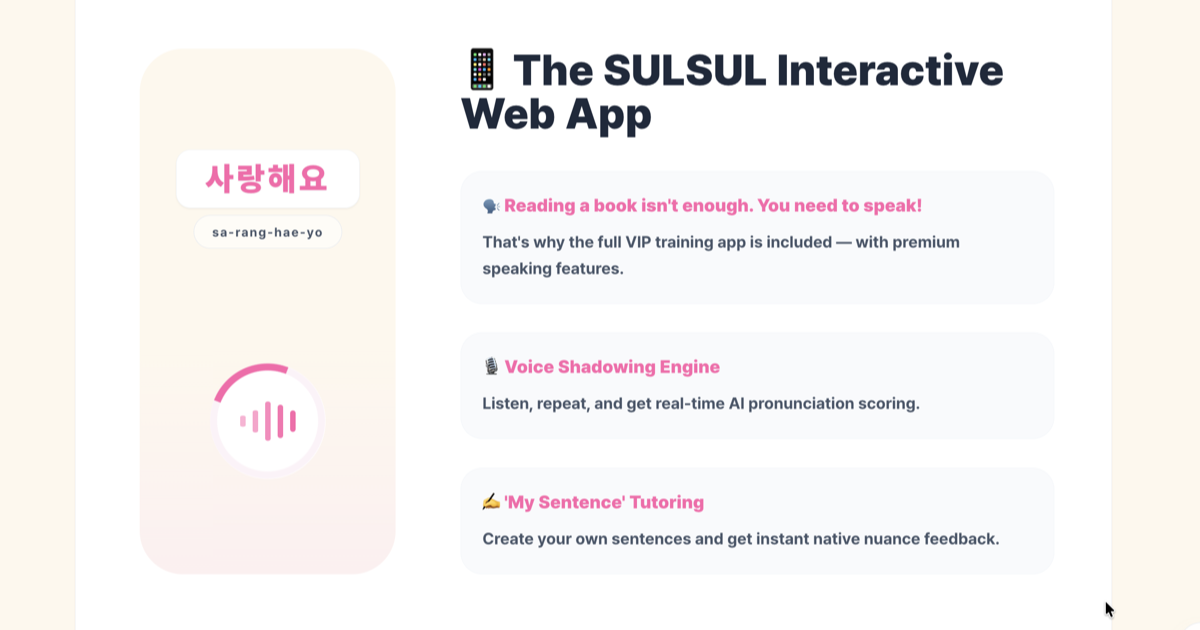
SULSUL is a speaking gym built for moments like that: pick a pattern, say it out loud, get an instant fix from the AI pronunciation coach, then run the real situation as a mission. The 100-pattern PDF workbook comes along as a bonus.
Now say it out loud
SULSUL says the phrase, you repeat it, and it tells you what came out wrong — 100 survival patterns for cafes, taxis and small talk in Seoul.
Start speaking Korean →