Coffee Juseyo: What 커피 주세요 Means, and How to Say It So a Korean Barista Gets It
"Coffee juseyo" means "Coffee, please." Written in Korean, it's 커피 주세요, and it sounds like keo-pi ju-se-yo. It's correct and polite, so you can say it to anyone serving you. Just expect one more question at a Korean café, because 커피 covers the whole menu and the barista still needs to know which drink you want. The line that usually ends the conversation faster is 아메리카노 한 잔 주세요 (a-me-ri-ka-no han jan ju-se-yo), "One Americano, please."
Coffee juseyo, the short version
- Meaning: "Coffee, please"
- In Korean: 커피 주세요 — keo-pi ju-se-yo
- Politeness: fine for cafés, restaurants, and shops
- Likely follow-up: 어떤 커피로 드릴까요? — "Which coffee would you like?"
- Faster order: 아메리카노 한 잔 주세요 — "One Americano, please"
What each word is doing
커피 (keo-pi) is the English word "coffee," borrowed into Korean. 주세요 (ju-se-yo) is the request form of "to give," so the whole line is literally "coffee, please give." It's Pattern 01 in the SULSUL workbook, (N) 주세요, and it's about the most useful sentence a traveler can learn: put any noun in front, and you've made a polite request.
The word order is the part that feels backward at first. The thing you want comes first and the request comes last. You don't need a word for "I," and you don't need the object particle either. Grammar books would give you 커피를 주세요, but at a counter people almost always drop the 를. For more on the pattern itself, read how to say please give me in Korean.
Practice this out loud with SULSUL — the app says it, you repeat it →
Why it isn't quite "coffee" out loud
If you've only seen this phrase in Latin letters, the sound is where you can trip. Korean has no F sound, so "coffee" became keo-pi. Here's what to aim for, sound by sound:
| Written | Say it like | What to watch |
|---|---|---|
| 커 (keo) | "kuh" | A K with a puff of air, and a relaxed "uh," not "caw" |
| 피 (pi) | "pee" | A P with a puff of air, never an F |
| 주 (ju) | "joo" | A soft J that can sound close to "choo" |
| 세 (se) | "seh" | Short, like "set" without the T, not "say" |
| 요 (yo) | "yo" | Short and clean, not "yoh-oo" |
That soft ㅈ explains the spelling mess you'll find online. Juseyo, jusaeyo, joo-say-yo, and chuseyo are all trying to write the same word, and Korean speakers would only ever write 주세요. If a barista hears you say "coffee" with an F, they'll almost certainly still understand. But the Korean sound will carry better in a loud café, and it's a small change that makes the rest of your sentence easier to catch.
Keep the end of the sentence level or falling. If your voice rises on 요, it can sound like you're asking whether they'd like some coffee.
The question you'll probably get back
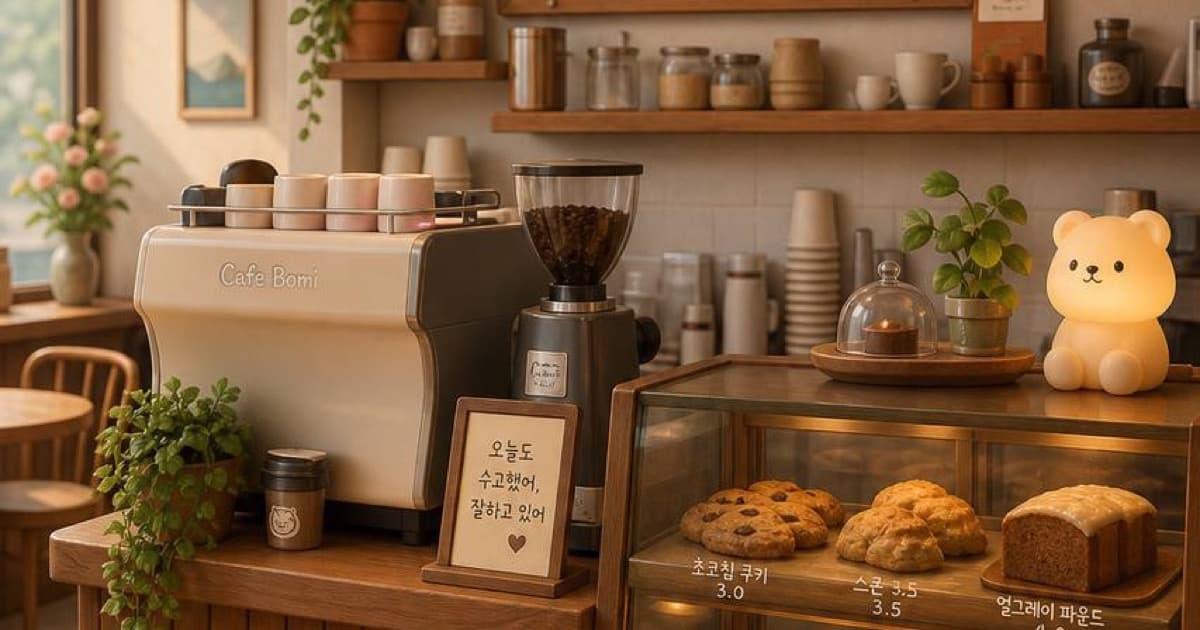
Most cafés in Korea don't have one default "coffee" waiting in a pot. Espresso drinks are the norm, and the closest thing to plain coffee is the Americano. So a short exchange often goes like this:
You: 커피 주세요. Barista: 어떤 커피로 드릴까요? You: 아메리카노요. 한 잔 주세요. Barista: 따뜻한 걸로 드릴까요, 아이스로 드릴까요? You: 아이스로 주세요.
어떤 커피로 드릴까요? (eo-tteon keo-pi-ro deu-ril-kka-yo?) means "Which coffee shall I get you?" 아메리카노요 (a-me-ri-ka-no-yo) is a quick, polite one-word answer, since adding 요 to a noun is enough at a counter. Asking for drip coffee is a good idea only if you see it on the menu, listed as 드립 커피 (deu-rip keo-pi) or, at many chains, 오늘의 커피 (o-neu-rui keo-pi), "today's coffee."
Here's the short menu you can swap into the sentence:
| On the menu | Say it | What you get |
|---|---|---|
| 아메리카노 | a-me-ri-ka-no | Espresso and water, the everyday order |
| 카페라테 | ka-pe-ra-te | Latte |
| 바닐라 라테 | ba-nil-la ra-te | Vanilla latte, usually sweet |
| 카푸치노 | ka-pu-chi-no | Cappuccino |
| 믹스커피 | mik-seu-keo-pi | Sweet instant coffee with cream and sugar |
The last one is worth knowing. If an older person offers you 커피, or you find a free machine by the door of a neighborhood restaurant, it's often 믹스커피. Don't expect an espresso drink. The order-to-pickup flow at a café, including size and for-here or to-go, is laid out in what to say when ordering coffee in Korean.
Where plain 커피 주세요 works as is
The short line suits places with only one coffee on offer. A diner, a guesthouse breakfast, or a restaurant serving coffee after a meal may need nothing more, and there 커피 좀 주세요 (keo-pi jom ju-se-yo) sounds a little softer. The syllable 좀 works like "a bit" or "if you could," and it takes the edge off any request.
To check first whether they have it at all, use Pattern 03: 커피 있어요? (keo-pi i-sseo-yo?), "Do you have coffee?"
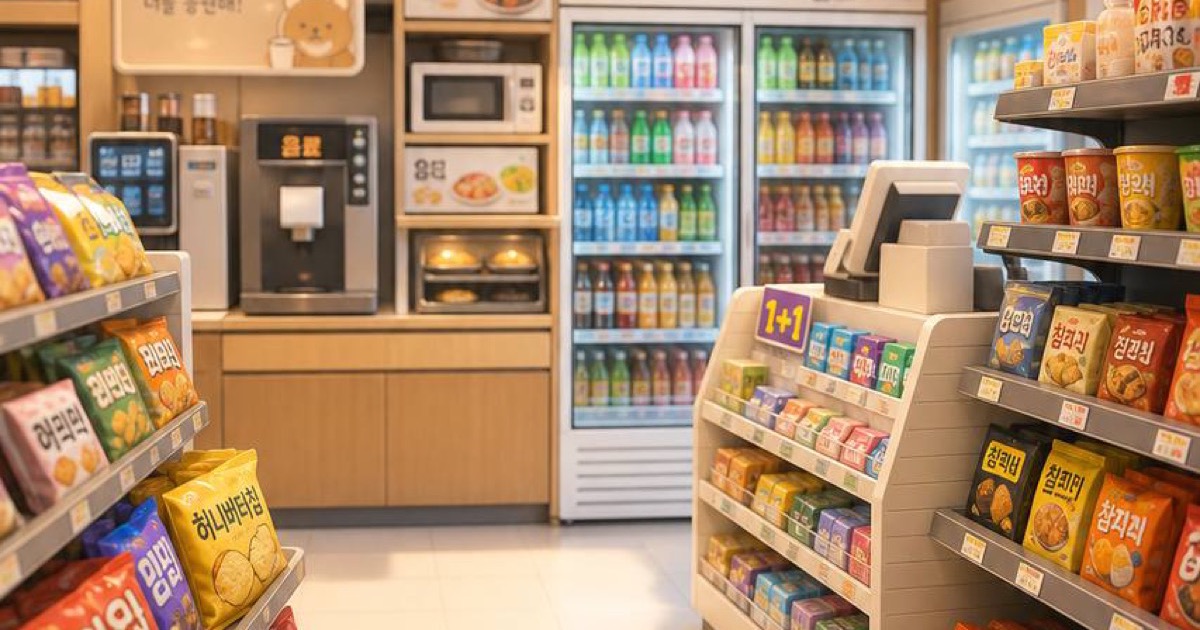
Convenience stores are the other case travelers run into, and they work differently. You usually don't ask a person to make your coffee. Instead, you pick up a cup or a bagged drink, pay at the counter, and then use the machine yourself. Stores vary, so these are good lines to have ready:
- 아이스 컵 어디 있어요? (a-i-seu keop eo-di i-sseo-yo?) — "Where are the iced cups?"
- 커피 머신 어떻게 써요? (keo-pi meo-sin eo-tteo-ke sseo-yo?) — "How do I use the coffee machine?"
- 따뜻한 커피 있어요? (tta-tteu-tan keo-pi i-sseo-yo?) — "Do you have hot coffee?"
More on that counter is in the guide to Korean phrases for the convenience store.
Everything else you can ask for the same way
Once you've got your drink, the same pattern gets you the extras. Only the noun changes:
- 빨대 주세요. (ppal-dae ju-se-yo) — "A straw, please."
- 얼음 더 주세요. (eo-reum deo ju-se-yo) — "More ice, please."
- 뚜껑 주세요. (ttu-kkeong ju-se-yo) — "A lid, please."
- 냅킨 좀 주세요. (naep-kin jom ju-se-yo) — "Some napkins, please."
- 영수증 주세요. (yeong-su-jeung ju-se-yo) — "The receipt, please."
To change the strength rather than ask for a thing, use Pattern 23, (V)아/어 주세요: 연하게 해 주세요 (yeon-ha-ge hae ju-se-yo) means "Please make it weak," and 진하게 해 주세요 (jin-ha-ge hae ju-se-yo) means "Please make it strong."
When you're not asking a barista
Coffee comes up outside the counter too, and 주세요 isn't the right tool for those moments:
- 커피 마시고 싶어요. (keo-pi ma-si-go si-peo-yo) — "I want to drink some coffee." This is Pattern 02, for telling a friend what you feel like.
- 커피 한잔 할래요? (keo-pi han-jan hal-lae-yo?) — "Want to grab a coffee?" This is Pattern 25, and it's the usual friendly invitation.
- 커피 드릴까요? (keo-pi deu-ril-kka-yo?) — "Would you like some coffee?" You'll hear this one as a guest, and you can answer 네, 감사합니다 (ne, gam-sa-ham-ni-da), "Yes, thank you."
Mistakes people make with this phrase
Using 줘 because a K-drama did. You may hear 커피 줘 (keo-pi jwo) on screen. That's casual speech between close friends or family, and it comes across as rude to a barista. Stick with 주세요.
Saying "say" in 주세요. Joo-say-yo is the most common English-speaker version. Shorten the middle to seh and the whole word gets quicker and more natural.
Counting with the wrong numbers. Cups take native Korean numbers: 한 잔 (han jan), 두 잔 (du jan), 세 잔 (se jan). Saying 일 잔 for one cup will sound off. The full system is in Korean numbers for paying and counting.
Stopping when the barista asks something back. Follow-up questions don't mean you got it wrong. They're a normal part of the order, and a one-word answer plus 요 is all you need.
Make it automatic before your first café
커피 주세요 takes two seconds to read. Saying it at a busy counter, with a line behind you and a question coming back at full speed, is harder. Say 아메리카노 한 잔 주세요 out loud a few times, then 아이스로 주세요, until your mouth does it without you translating first.
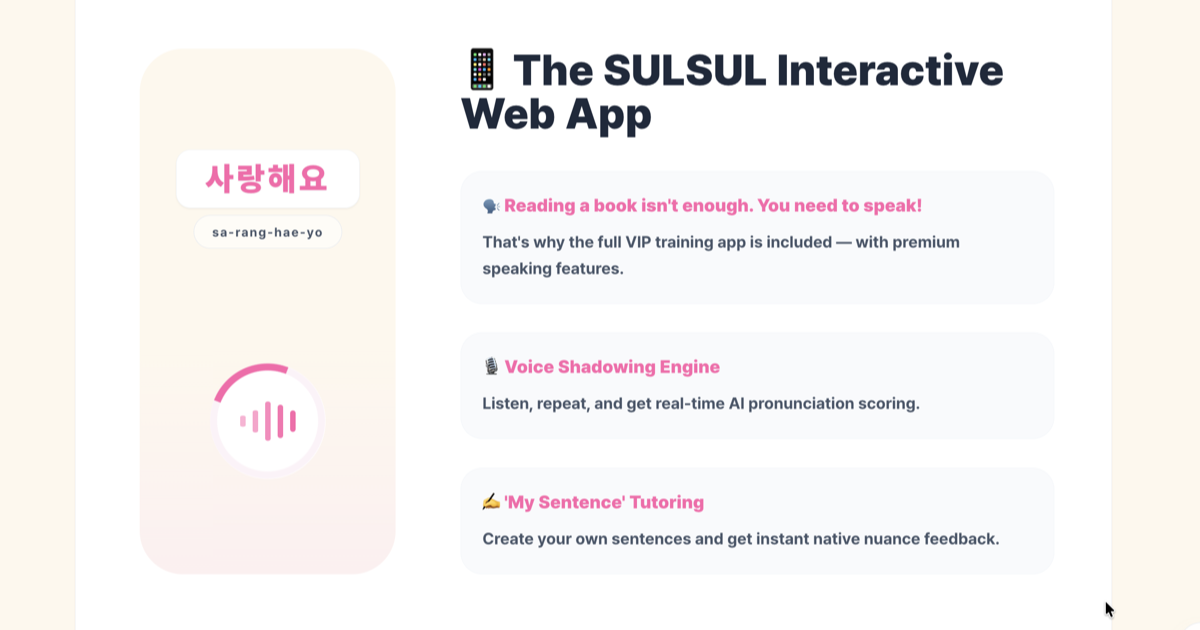
SULSUL is a speaking gym built for moments like that: pick a pattern, say it out loud, get an instant fix from the AI pronunciation coach, then run the real situation as a mission. The 100-pattern PDF workbook comes along as a bonus.
Now say it out loud
SULSUL says the phrase, you repeat it, and it tells you what came out wrong — 100 survival patterns for cafes, taxis and small talk in Seoul.
Start speaking Korean →