Box in Korean: 상자 or 박스, and How to Ask for One at the Mart and Post Office

"Box" in Korean is 상자 (sang-ja) or 박스 (bak-sseu), and you can use either one. 상자 is the native Korean word you'll find in textbooks and on signs. 박스 is the English loanword, and it's what most people say out loud at a mart, a post office, or on moving day. If you need a box right now, the sentence is 상자 있어요? (sang-ja i-sseo-yo?), "Do you have a box?" Swap in 박스 있어요? and you'll be understood just as fast.
- 상자 (sang-ja) — box, the standard word
- 박스 (bak-sseu) — box, the everyday loanword
- 상자 있어요? (sang-ja i-sseo-yo?) — "Do you have a box?"
- 박스 하나 주세요 (bak-sseu ha-na ju-se-yo) — "One box, please."
- 이 박스 가져가도 돼요? (i bak-sseu ga-jyeo-ga-do dwae-yo?) — "Can I take this box?"
- 귤 한 박스 (gyul han bak-sseu) — "a box of tangerines"
상자 vs 박스: which one Koreans actually say
Both words mean the same object, but they don't sound quite the same. 상자 is a little more formal and a little more "written." You'll see it on product labels, in news reports, and in phrases like 선물 상자 (seon-mul sang-ja), "gift box," or 상자를 열어 보세요 (sang-ja-reul yeo-reo bo-se-yo), "Try opening the box."
박스 is what you'll hear from the person behind the counter. A worker restocking shelves says 박스 저기 있어요 (bak-sseu jeo-gi i-sseo-yo), "The boxes are over there." Someone moving apartments says 이사 박스 (i-sa bak-sseu), "moving boxes." A courier calls a parcel a 택배 박스 (taek-bae bak-sseu), "delivery box."
A simple rule for travelers: say 박스 when you're asking for one, and recognize 상자 when you read it. You won't sound wrong either way.
Watch the pronunciation of 박스. It isn't "box" with a Korean accent. The vowel is a flat a, and the ㅅ after ㄱ tightens into a hard ss, so you get bak-sseu. The final eu is short, almost swallowed. If you say "bok-su," people will still get it, but bak-sseu is what you'll hear back.
Practice this out loud with SULSUL — the app says it, you repeat it →
Asking for a box: three patterns that cover every counter
Three patterns from the SULSUL workbook handle almost every box situation.
Pattern 03 — (N) 있어요? / 없어요?, "Do you have…? / There isn't…"
상자 있어요? (sang-ja i-sseo-yo?) — "Do you have a box?"
큰 박스 있어요? (keun bak-sseu i-sseo-yo?) — "Do you have a big box?"
작은 거 있어요? (ja-geun geo i-sseo-yo?) — "Do you have a small one?"
This is the opener. You don't need a verb like "sell" or "give." 있어요? just asks whether the thing exists here. The answer will be 네, 있어요 ("yes, we do") or 없어요 ("no, we don't").
Pattern 01 — (N) 주세요, "please give me"
박스 하나 주세요 (bak-sseu ha-na ju-se-yo) — "One box, please."
제일 큰 거 주세요 (je-il keun geo ju-se-yo) — "The biggest one, please."
Once you know they have boxes, 주세요 gets one into your hands. For the full range of what 주세요 can do, see how to say please give me in Korean.
Pattern 44 — (V)아/어도 돼요?, "May I…?"
이 박스 가져가도 돼요? (i bak-sseu ga-jyeo-ga-do dwae-yo?) — "Can I take this box?"
여기서 포장해도 돼요? (yeo-gi-seo po-jang-hae-do dwae-yo?) — "Can I pack it here?"
This one matters most when the boxes are just sitting there, like a pile of empty cartons near a shop's back door. Asking first turns "is that person stealing our boxes?" into "sure, go ahead."
At a Korean mart: the self-packing table
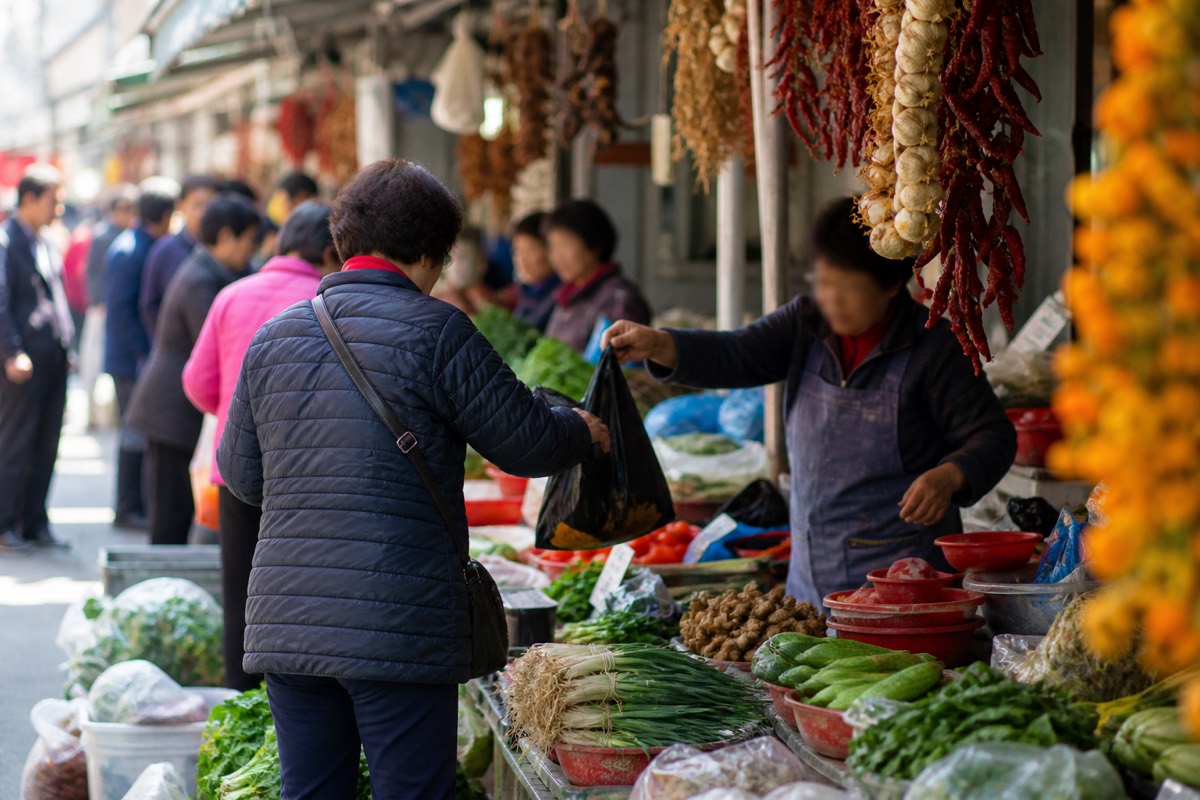
This is where most visitors first need the word. At big supermarkets like E-mart, Homeplus, and Lotte Mart, there's often a 자율 포장대 (ja-yul po-jang-dae), a "self-packing table," just past the checkout. Empty product boxes are often stacked there for shoppers to pack their groceries in. At many stores you can use them, but tape and string aren't always provided, so locals often bring their own bags or a foldable crate.
A typical exchange at the end of the checkout lane:
You: 박스 어디 있어요? — bak-sseu eo-di i-sseo-yo? — "Where are the boxes?"
Cashier: 저쪽 포장대에 있어요. — jeo-jjok po-jang-dae-e i-sseo-yo. — "They're at the packing table over there."
You: 테이프도 있어요? — te-i-peu-do i-sseo-yo? — "Is there tape too?"
Cashier: 테이프는 없어요. — te-i-peu-neun eop-seo-yo. — "There's no tape."
That last line is common, so don't be surprised by it. If you only need a bag, the word is 봉투 (bong-tu), and the mart routine is covered in shopping at a supermarket in Korea.
At the post office: boxes come in numbered sizes
Korean post offices sell their own sturdy boxes, usually called 우체국 박스 (u-che-guk bak-sseu), "post office box." They come in numbered sizes. 1호 (il-ho) is the smallest, and the numbers go up as the boxes get bigger. You don't need to know the exact measurements. Show the clerk your item and let them pick.
You: 이거 보낼 박스 있어요? — i-geo bo-nael bak-sseu i-sseo-yo? — "Do you have a box to send this in?"
Clerk: 몇 호 드릴까요? — myeot ho deu-ril-kka-yo? — "Which size should I give you?"
You: 잘 모르겠어요. 이게 들어가는 걸로 주세요. — jal mo-reu-ge-sseo-yo. i-ge deu-reo-ga-neun geol-lo ju-se-yo. — "I'm not sure. One this fits in, please."
몇 호 literally means "what number," and it's the question you'll hear every time. Tape is usually on the counter for customers to use. The rest of the counter, from the form to choosing standard or express, is in sending a package at the post office.
한 박스: when "box" becomes a counter
Here's the part textbooks skip. At traditional markets, fruit stalls, and farm shops, 박스 works as a counting word, the same way English says "a box of."
귤 한 박스 주세요 (gyul han bak-sseu ju-se-yo) — "A box of tangerines, please."
사과 반 박스도 돼요? (sa-gwa ban bak-sseu-do dwae-yo?) — "Can I get half a box of apples?"
한 박스에 몇 개예요? (han bak-sseu-e myeot gae-ye-yo?) — "How many are in one box?"
Notice the native Korean numbers: 한 (one), 두 (two), 세 (three), as in 두 박스 (du bak-sseu), "two boxes." 상자 works as a counter too (한 상자, han sang-ja), and you'll see it printed on gift sets around Chuseok and Lunar New Year.
Box words you'll see on signs and labels
| You see | Read it as | Meaning |
|---|---|---|
| 상자 | sang-ja | box |
| 박스 | bak-sseu | box (loanword) |
| 택배 상자 | taek-bae sang-ja | delivery box |
| 선물 상자 | seon-mul sang-ja | gift box |
| 이사 박스 | i-sa bak-sseu | moving box |
| 자율 포장대 | ja-yul po-jang-dae | self-packing table |
| 취급 주의 | chwi-geup ju-ui | handle with care |
| 박스 버리는 곳 | bak-sseu beo-ri-neun got | where to throw out boxes |
That last sign matters if you're staying in an apartment. Flattened cardboard goes out as recycling, usually labeled 종이 (jong-i), "paper." The sorting rules are in taking out the trash in Korea.
Common mistakes with "box"
Using 박스 for a food container. At a restaurant, a to-go container isn't usually called a 박스. Staff say 포장 (po-jang), "packing up," as in 남은 거 포장해 주세요, "Please pack up the leftovers." That whole situation is in to-go box in Korean.
Forgetting the counter order. In Korean, the item comes first and the number and box come after: 귤 한 박스, not "한 박스 귤." Saying it backward isn't a disaster, but it marks you as a beginner right away.
Taking boxes without asking. Shops sometimes pile empty boxes outside for recycling, and small business owners sometimes save them for their own use. A quick 가져가도 돼요? costs you two seconds and keeps things friendly.
Say it before you need it
The box moment always happens at the end of something: your cart is full, the line behind you is growing, and your hands are busy. That's not the time to put a sentence together. Say 박스 있어요? and 이 박스 가져가도 돼요? out loud five times today, focusing on that tight bak-sseu, and they'll come out on their own at the checkout.
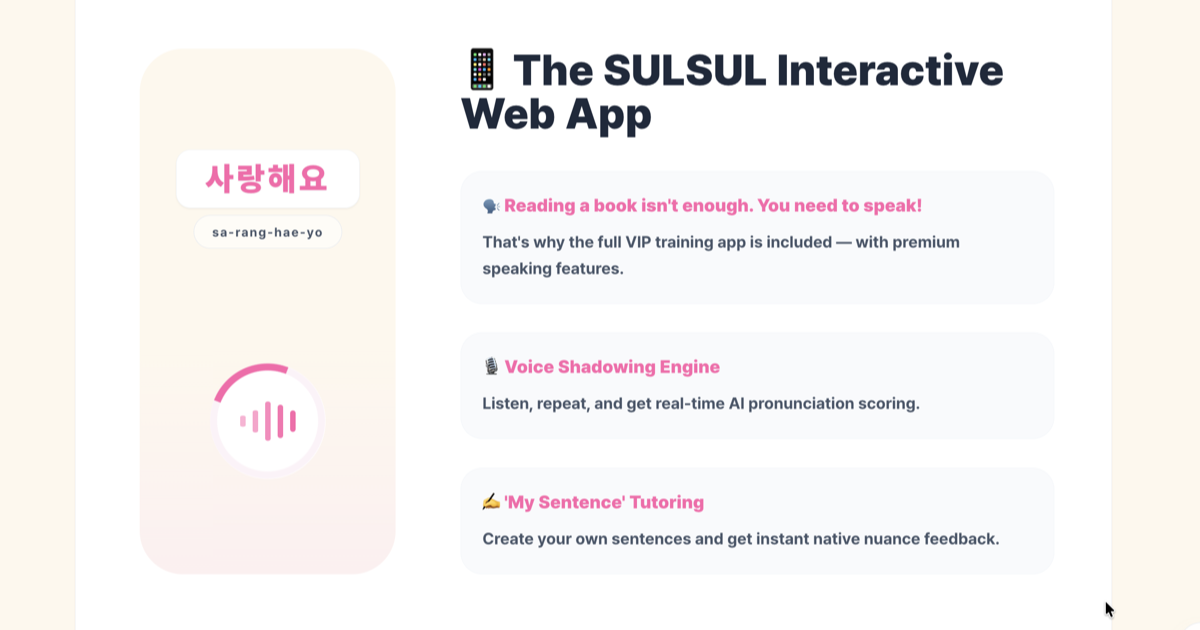
SULSUL is a speaking gym built for this: pick a pattern, say it out loud, get an instant fix from the AI pronunciation coach, then run the whole situation as a mission. The 100-pattern PDF workbook comes along as a bonus.
Now say it out loud
SULSUL says the phrase, you repeat it, and it tells you what came out wrong — 100 survival patterns for cafes, taxis and small talk in Seoul.
Start speaking Korean →