How to Say Sorry in Korean: 죄송합니다 or 미안해요

To say sorry in Korean, say 죄송합니다 (joesonghamnida) to anyone you do not know — a stranger, a shop worker, a taxi driver, someone older than you. To a friend or someone younger, say 미안해요 (mianhaeyo) or 미안해 (mianhae). Unlike 감사합니다 and 고맙습니다, which sit at the same height, these two are not interchangeable: 죄송 carries more deference than 미안, so 죄송합니다 is the one that never misfires. And here is the part that surprises most travellers — the majority of the moments you think need an apology in Korea do not. Squeezing past someone, flagging down a server, getting off a packed subway car: those want 잠시만요 or 저기요, not 죄송합니다.
- Sorry (to anyone) — 죄송합니다 (joesonghamnida)
- Sorry (polite, a little softer) — 죄송해요 (joesonghaeyo)
- Sorry (to friends, polite form) — 미안해요 (mianhaeyo)
- Sorry (to friends) — 미안해 (mianhae)
- Excuse me / coming through — 잠시만요 (jamsimanyo)
- Excuse me (getting attention) — 저기요 (jeogiyo)
- It's fine / no worries — 괜찮아요 (gwaenchanayo)
죄송 and 미안 are not the same height
Both words are Sino-Korean, and their literal meanings explain the gap. 죄송 is built from characters meaning guilt and dread — it says "I feel guilty and small about this." 미안 means not at ease — "I am uncomfortable about what I did to you." One confesses fault upward, the other admits discomfort sideways. That is why a junior employee apologizes to a manager with 죄송합니다 and would sound strange saying 미안합니다, while a friend who says 죄송해 to another friend sounds like they are doing a bit.
| Say this | Romanization | To whom |
|---|---|---|
| 죄송합니다 | joesonghamnida | strangers, staff, elders, anyone at all |
| 죄송해요 | joesonghaeyo | polite but everyday — a neighbour, a familiar coworker |
| 미안합니다 | mianhamnida | formal in shape, rarely used to a real superior |
| 미안해요 | mianhaeyo | someone close but not a peer — a younger coworker |
| 미안해 | mianhae | friends, siblings, people younger than you |
| 사과드립니다 | sagwadeurimnida | written notices, official statements |
The step-down happens on the 미안 side of the family. 죄송해 exists on paper and nobody says it, the same way 감사해요 is technically possible and quietly avoided. So the honest rule for a visitor is short: use 죄송합니다 with everyone for the whole trip, and switch to 미안해 only with people you have started calling by name.
There is one more phrase worth recognizing even if you never need it: 잘못했어요 (jalmothaesseoyo), "I did wrong." That is not a scuffed shoe or a late arrival — it is an admission of actual fault, the phrase a child uses to a parent. Keep it out of your street vocabulary.
Practice this out loud with SULSUL — the app says it, you repeat it →
저기요, 잠시만요, 실례합니다 — the three that are not apologies
English collapses a lot of politeness into "sorry" and "excuse me," and this is where most travellers in Korea sound slightly off. Korean splits the job three ways.
저기요 (jeogiyo) gets someone's attention. It is what you say to a server across a restaurant, to a shop worker stocking a shelf, to a stranger before you ask a question. Literally it means "over there," pointed politely at a person. In a restaurant 여기요 (yeogiyo), "over here," works the same way and is what most people actually call out at a busy table.
잠시만요 (jamsimanyo) — or 잠깐만요 (jamkkanmanyo) — means "just a moment." This is the single most useful phrase on this page. It clears a path on a crowded subway, it holds someone still while you dig out your card, it buys you three seconds when a cashier asks a question you did not catch. Say it going through a crowd and people move without looking up.
실례합니다 (sillyehamnida) means "pardon the rudeness." It is a notch more formal and belongs to the moment you interrupt something — stepping across a row of seated people, breaking into a conversation, entering an office. 실례지만 (sillyejiman), "excuse me, but," opens a question to a stranger.
You: 저기요, 이거 얼마예요? — jeogiyo, igeo eolmayeyo? — "Excuse me, how much is this?" Them: 아, 잠시만요. — a, jamsimanyo. — "Ah, one moment."
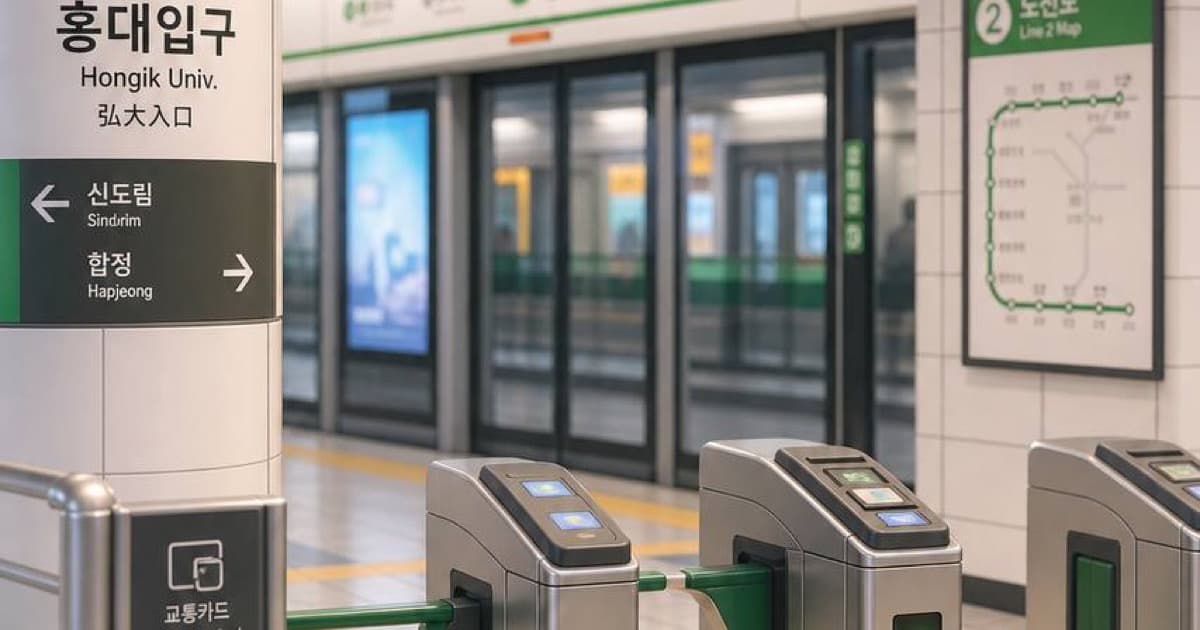
And the thing nobody tells you: on a rush-hour Seoul subway, a light bump draws no apology at all, from anyone, in either direction. It is not rudeness — a packed car is understood as a place where contact is unavoidable. Apologizing for every brush marks you as a tourist more than staying quiet does. Save 죄송합니다 for when you actually land on someone's foot, and use 내릴게요 (naerilgeyo), "I'm getting off," to get to the door.
Naming what you are sorry for: 늦어서 죄송합니다
A bare 죄송합니다 is complete, but attaching the reason is what makes it sound like a sentence instead of a reflex. Take the verb, attach -아/어서 — the "because" ending, Pattern 35 in the SULSUL workbook — and finish with the apology.
- 늦어서 죄송합니다 — neujeoseo joesonghamnida — "Sorry I'm late."
- 기다리게 해서 죄송합니다 — gidarige haeseo joesonghamnida — "Sorry for making you wait."
- 연락이 늦어서 죄송합니다 — yeollagi neujeoseo joesonghamnida — "Sorry for the slow reply."
- 번거롭게 해서 죄송합니다 — beongeorobge haeseo joesonghamnida — "Sorry for the trouble."
- 한국어를 잘 못해서 죄송해요 — hangugeoreul jal mothaeseo joesonghaeyo — "Sorry my Korean isn't good."
Among friends the whole frame relaxes: 늦어서 미안해 (neujeoseo mianhae). The reason clause does not change — only the ending does.
The same 죄송 turns into a request softener with -지만 or -는데요. 죄송하지만 (joesonghajiman) and 죄송한데요 (joesonghandeyo) both mean "sorry, but —" and they make the sentence that follows noticeably easier to say yes to. 죄송하지만 다시 말해 주세요 is the polite way to admit you missed something, which pairs with what to say when Korean is too fast, and 죄송한데요, 화장실 어디예요? is how most people open the question in how to ask where the restroom is in Korean.

How it actually sounds
죄송합니다 looks like six syllables of trouble and is mostly one tricky vowel. The 죄 is a rounded jwe — the "j" of "jam" with a quick "we" glued onto it — and in ordinary speech most Koreans flatten it toward je anyway, so je-song-ham-ni-da will pass anywhere. The 합니다 ending behaves exactly as it does in 감사합니다: a ㅂ in front of a ㄴ becomes ㅁ, so it is ham-ni-da, never hap-ni-da.
미안해요 has the opposite problem — it is easy to say and easy to rush. The 미안 is two clean syllables, mi-an, not "myan." Keep them separate and it sounds deliberate rather than tossed off.
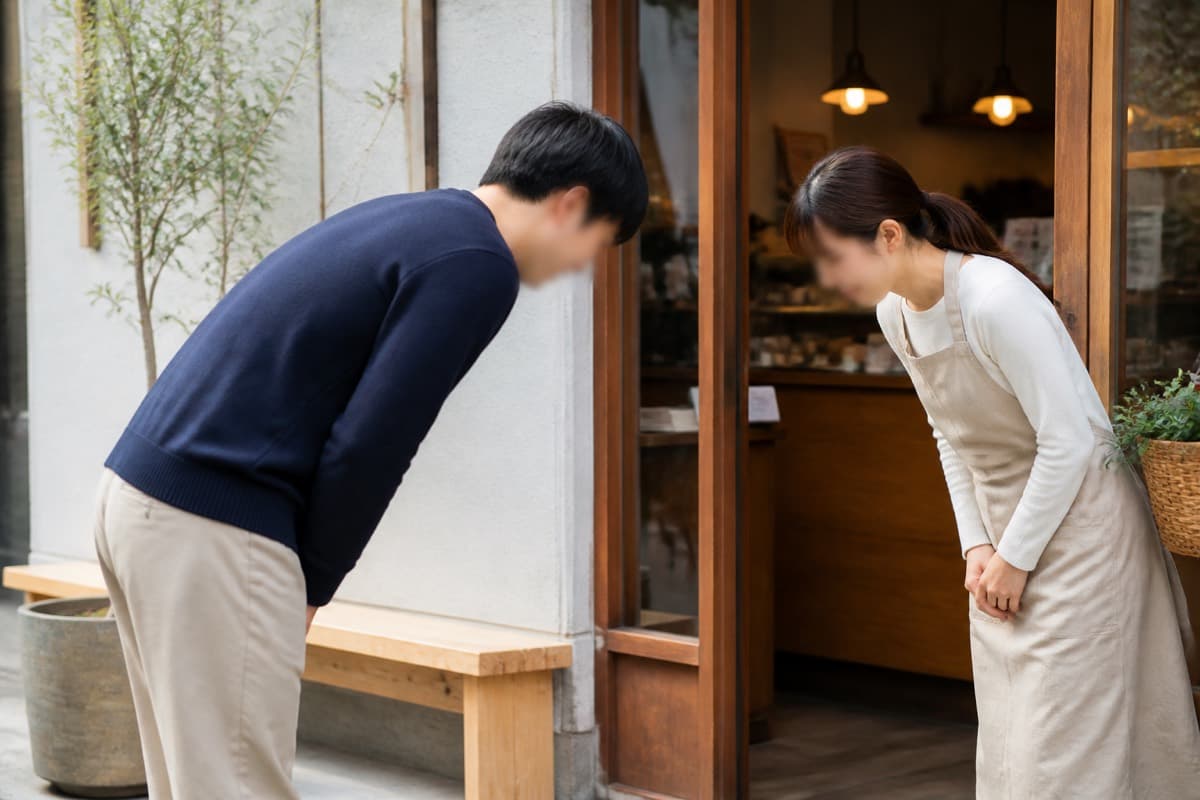
As with gratitude, the body carries half the meaning. A small nod goes with 죄송합니다 to a stranger. A slightly deeper bend from the waist goes with a real apology to someone senior. Hands out of pockets, eyes down for a beat — the posture is what convinces, and it costs nothing to get right.
When someone apologizes to you
The reply you want almost every time is 괜찮아요 (gwaenchanayo), "it's fine." It is the same word that answers "are you okay?", turns down an offer, and waves away trouble, and stretching the vowel a little makes it warm rather than clipped.
| Reply | Romanization | Use it when |
|---|---|---|
| 괜찮아요 | gwaenchanayo | the default "no worries" |
| 괜찮습니다 | gwaenchanseumnida | same thing, formal register |
| 아니에요 | anieyo | "not at all" — waving it off entirely |
| 별거 아니에요 | byeolgeo anieyo | "it's nothing" |
And one to have ready in the other direction: if you bump someone hard enough that they stumble, the useful sentence is not an apology but a question — 괜찮으세요? (gwaenchaneuseyo?), "are you all right?" Checking lands better than apologizing.
What usually goes wrong
Using 죄송합니다 to call a server. It reads as though you did something wrong, and the server will pause to figure out what. 저기요 or 여기요 is the phrase for getting attention.
Saying 미안해 to anyone older or to staff. It is casual speech pointed upward, which is the one direction Korean politeness does not forgive. 죄송합니다 to strangers, always.
Apologizing for every subway bump. Nobody else is, and doing it repeatedly turns a non-event into an event. 잠시만요 to move, silence for the rest.
Reaching for 실례합니다 to squeeze past. It is not wrong, just heavier than the moment. 잠시만요 is what people say.
Piling apologies on top of each other. Three 죄송해요 in a row does not read as three times sorrier — it reads as flustered, and it pulls the other person into reassuring you. One apology, then the reason, then move on.
Saying 잘못했어요 for a small thing. It means "I was in the wrong," and used over a spilled drink it lands far heavier than you intended.
Skipping the nod. A flat 죄송합니다 delivered with a still head reads as recited. The small bow is not decoration — it is the half of the apology people actually register. The same goes the other way in how to say thank you in Korean.
Say it out loud, not just in your head
죄송합니다 is a phrase you will need in a half-second window — the moment after your bag swings into someone, while they are already turning around. Reading it does not put it in your mouth.
SULSUL is a speaking gym for exactly that window: pick a survival pattern, say it out loud, get an instant fix from the AI pronunciation coach, then run the whole exchange — the apology, the reason, the 괜찮아요 coming back — as a mission until it lands clean. The 100-pattern PDF workbook comes along as a bonus.