K-Drama Actresses in Korean: 배우 or 여배우, and the Words Fans Use for Great Acting (연기, 인생캐, 케미)


The Korean word for an actress is 배우 (baeu) — and it is the exact same word Koreans use for an actor. There is a separate word, 여배우 (yeobaeu, "female actor"), but in everyday talk, interviews, and fan comments, a K-drama actress is almost always just 배우. So if you want to say "She is my favorite K-drama actress," the natural Korean is 제일 좋아하는 배우예요 (jeil joahaneun baeu-yeyo). From there, Korean fans have their own vocabulary for talking about acting: who plays the lead, who steals the scene, which role became the "role of a lifetime," and whether two leads have chemistry. Below is each of those words with a sentence you can actually say.
- 배우 (baeu) — actor or actress. The default word.
- 여배우 (yeobaeu) — actress, when gender matters to the sentence.
- 주연 / 주인공 (juyeon / juingong) — lead role / main character.
- 조연 (joyeon) — supporting role.
- 연기 (yeongi) — acting. 연기 잘해요 = "She acts well."
- 인생캐 (insaengkae) — a "life character," the role an actor will be remembered for.
- 케미 (kemi) — chemistry between two actors.
- 발연기 (baryeongi) — "foot acting," i.e. bad acting. Handle with care.
배우 vs 여배우: which word to use
Korean nouns do not change for gender, and 배우 follows that rule. A news article listing a drama's cast writes 배우 ○○○, a talk show host introduces a guest as 배우 ○○○ 씨, and fans write 이 배우 연기 미쳤다 — "this actor's acting is insane" — about women and men alike.
여배우 exists and is not rude, but it shows up when the sentence is specifically about gender: an awards category, a headline about "actresses in their 30s," or a conversation comparing female leads. If you use 여배우 every time you mention a woman, it sounds a little like saying "female doctor" in English when gender has nothing to do with the point.
A safe habit: say 배우 by default, and add the person's name. Korean speakers almost never say "the actress" on its own — they say 그 배우 (geu baeu, "that actor") or the name plus 배우님 (baeunim) when they want to sound respectful, the way fans do in comments.
Practice this out loud with SULSUL — the app says it, you repeat it →
Talking about roles: 주연, 조연, and 주인공
When fans list who is in a drama, three words come up again and again.
주연 (juyeon) is the lead role. 여주 (yeoju) and 남주 (namju) are the shortened forms of 여자 주인공 and 남자 주인공 — "female lead" and "male lead" — and they are everywhere in fan talk. 여주 진짜 예쁘다 means "The female lead is really pretty," and 여주 연기 좋다 means "The female lead's acting is good."
조연 (joyeon) is a supporting role. Korean dramas are famous for supporting actors who carry whole subplots, so you will often see 조연들이 다 살렸어 — "the supporting cast saved the whole thing."
주인공 (juingong) is the main character inside the story, not the casting term. You use it when talking about the plot: 주인공이 너무 답답해 — "the main character is so frustrating."
Two more words help when a show is announced: 캐스팅 (kaeseuting, casting) and 출연 (churyeon, appearing in). 이 배우가 출연해요? asks "Is this actor in it?"

How Korean fans praise acting
The basic compliment is 연기 잘해요 (yeongi jalhaeyo), "She acts well." With friends, drop to 연기 잘한다 (yeongi jalhanda). Everything else is a stronger version of this.
연기 미쳤다 (yeongi michyeotda) — "the acting is insane." In fan Korean, 미쳤다 is high praise, not an insult.
눈빛 연기 (nunbit yeongi) — "acting with the eyes." Korean viewers single this out more than English-speaking fans do, especially in quiet scenes with no dialogue. 눈빛 연기가 대박이에요 means "Her eye acting is amazing."
인생캐 (insaengkae) — short for 인생 캐릭터, "life character." It is the role that fits an actor so perfectly it defines their career. 이게 그 배우 인생캐야 means "This is that actor's role of a lifetime."
인생작 (insaengjak) — "life work," a drama that you personally consider the best you have ever seen. 제 인생작이에요 means "It's the drama of my life."
케미 (kemi) — chemistry, from the English word. 두 배우 케미 좋다 is "The two actors have great chemistry." Fans also say 케미 장인 (kemi jangin, "chemistry master") for an actor who seems to have chemistry with every co-star.
연기 천재 (yeongi cheonjae) — "acting genius," often used for child actors and young leads.
The words to handle carefully
발연기 (baryeongi) literally means "acting with your feet" — bad acting. It is a real, common word, and you will read it in comment sections. Saying it to a Korean friend about an actor they love can sting, and writing it on an actor's own post is simply rude. If you did not enjoy a performance, 저랑은 좀 안 맞았어요 (jeorang-eun jom an majasseoyo, "It didn't really suit me") is the soft, normal way to say so.
연기력 논란 (yeongiryeok nollan) — "controversy over acting skill." This is headline language. It is useful to recognize, but not something you say casually.
얼굴 천재 (eolgul cheonjae, "face genius") is a compliment about looks, not acting. Using it when someone asks about a performance can sound like you are dodging the question.
A conversation about a K-drama actress
A: 요즘 뭐 봐요? (yojeum mwo bwayo?) — What are you watching these days? B: 새 드라마 정주행 중이에요. 여주가 진짜 연기 잘해요. — I'm binge-watching a new drama. The female lead acts really well. A: 아, 그 배우요? 이전 작품도 좋았어요. — Oh, that actor? Her last show was good too. B: 맞아요. 근데 이번이 인생캐 같아요. 눈빛 연기가 대박이에요. — Right. But I think this one's her role of a lifetime. Her eye acting is amazing. A: 남주랑 케미는 어때요? — How's her chemistry with the male lead? B: 케미 미쳤어요. 꼭 보세요! — The chemistry is insane. You have to watch it!
Notice that B never says 여배우. "That actor" is 그 배우, and the role is 여주. That is how the conversation sounds in real life.
Four mistakes learners make
Saying 여배우 every time. It is not wrong, but it marks you as translating from English. Default to 배우.
Pronouncing 배우 like "bay-woo." It is two short, even beats: bae-u, with the 배 closer to the "e" in "bed." The ㅂ is soft, almost between "b" and "p."
Mixing up 연기 and 연극. 연기 is acting; 연극 (yeongeuk) is a stage play. 연극 배우 is a theater actor.
Using 인생캐 for any role you liked. It means the defining role of a career. For a performance you simply enjoyed, 이번 역할 잘 어울려요 — "this role suits her" — fits better.
From reading the words to saying them
Read the dialogue out loud twice, once as each speaker. 눈빛 연기 and 인생캐 are short but have tricky consonant clusters, and they only get smooth in your mouth, not in your head. For more of the vocabulary fans use around the shows, see the K-drama words Koreans use for watching and the Korean words you hear in every K-drama episode.
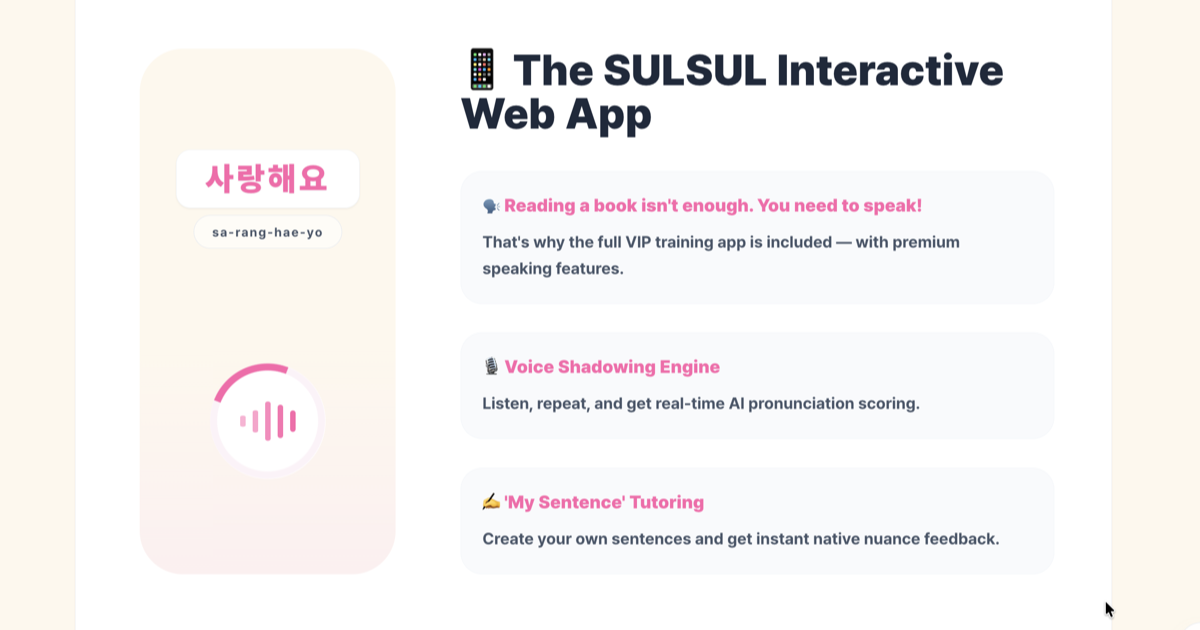
SULSUL is a speaking gym for exactly that step: pick a pattern, say it out loud, get an instant fix from the AI pronunciation coach, then run the real situation as a mission. The 100-pattern PDF workbook comes along as a bonus.
Now say it out loud
SULSUL says the phrase, you repeat it, and it tells you what came out wrong — 100 survival patterns for cafes, taxis and small talk in Seoul.
Start speaking Korean →