Korean Phrases for Returns and Exchanges in Korea


Taking something back to a Korean shop is a conversation with a fixed shape, and the whole thing turns on one sentence: why. Not what you want done — the staff will work that out — but the reason, offered first, before you ask for anything. Two patterns from the SULSUL workbook carry it. Pattern 35 — -아/어서 — is the reason itself, and it is most useful when you stop right after it: 사이즈가 안 맞아서요 (saijeuga an majaseoyo), "Because the size doesn't fit." Pattern 96 — 원래 / 사실 / 솔직히 — is for the second half, when the staff guesses wrong about what happened: 사실 한 번도 안 입었어요 (sasil han beondo an ibeosseoyo), "Actually, I never wore it."
- Open with the errand: 이거 교환하러 왔는데요 (igeo gyohwanhareo wanneundeyo), "I came to exchange this."
- Give the reason: 사이즈가 안 맞아서요 (saijeuga an majaseoyo), "The size doesn't fit."
- Show the proof: 영수증 여기 있어요 (yeongsujeung yeogi isseoyo), "Here's the receipt."
- Correct their guess: 사실 한 번도 안 입었어요 (sasil han beondo an ibeosseoyo), "Actually, I never wore it."
- Ask what's possible: 환불도 돼요? (hwanbuldo dwaeyo?), "Is a refund possible too?"

How do you say why you're bringing something back?
Starting with 환불해 주세요 (hwanbulhae juseyo), "give me a refund," is the move that makes the rest of it hard. It is not rude exactly, it just skips the step the staff needs, and they will ask for the reason anyway. Pattern 35 puts the reason first and lets them offer the solution.
You: 이거 교환하러 왔는데요. — igeo gyohwanhareo wanneundeyo. — "I came to exchange this."
Them: 네, 어떤 게 문제세요? — ne, eotteon ge munjeseyo? — "Sure, what's the problem?"
You: 사이즈가 안 맞아서요. — saijeuga an majaseoyo. — "The size doesn't fit."
Them: 한 사이즈 큰 걸로 드릴까요? — han saijeu keun geollo deurilkkayo? — "Shall I get you one size up?"
You: 네, 그렇게 해 주세요. — ne, geureoke hae juseyo. — "Yes, please do that."
Three things about the grammar. It attaches to the plain stem: ㅏ or ㅗ in the stem takes -아서 (맞다 → 맞아서), everything else takes -어서, and 하다 becomes 해서. Past tense never goes in front of it, even for something that already happened — 맞았어서 is wrong, 맞아서 is right, and this is the single most common mistake learners make with it. And you cannot put a command after it, so 안 맞아서 바꿔 주세요 is not the sentence; either stop at the reason with -아서요, which is what Koreans actually do here, or switch the connector to -으니까: 안 맞으니까 바꿔 주세요 (an majeunikka bakkwo juseyo). Ending on -아서요 leaves the request unsaid and lets the staff volunteer it, which is exactly the tone you want at a counter.
| Reason | Say this |
|---|---|
| Doesn't fit | 사이즈가 안 맞아서요 (saijeuga an majaseoyo) |
| Not the colour you expected | 색깔이 생각한 거랑 달라서요 (saekkkari saenggakhan georang dallaseoyo) |
| There's a flaw | 여기 흠집이 있어서요 (yeogi heumjibi isseoseoyo) |
| You already have one | 같은 게 있어서요 (gateun ge isseoseoyo) |
| You changed your mind | 그냥 마음이 바뀌어서요 (geunyang maeumi bakkwieoseoyo) |
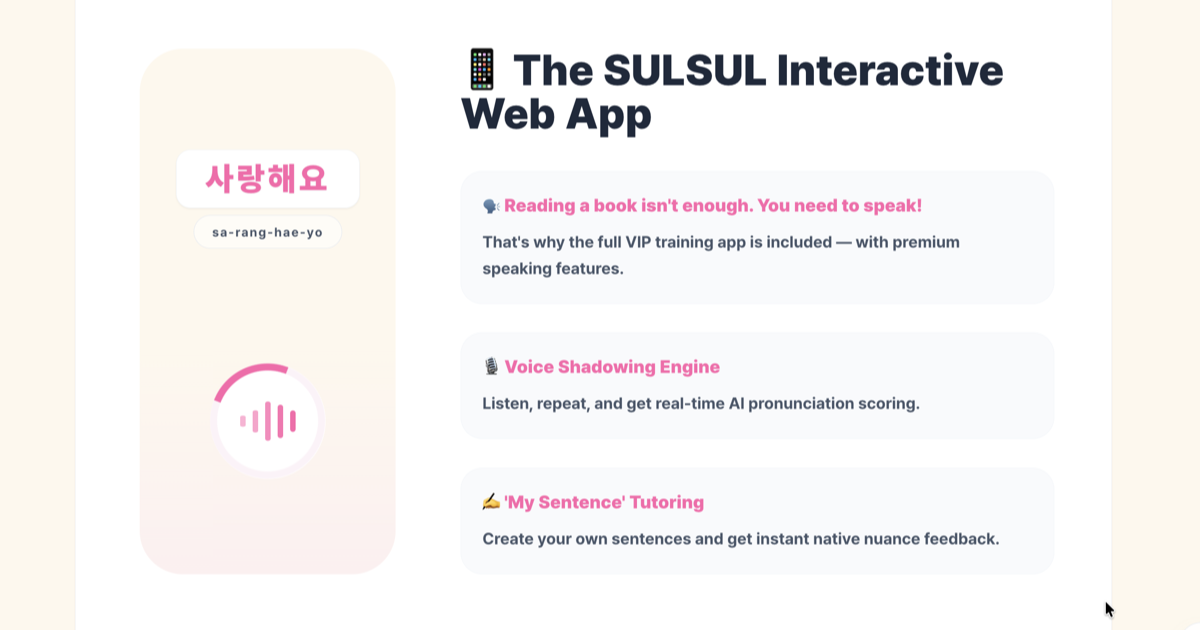
Practice this out loud with SULSUL — the app says it, you repeat it →
What do you say when the staff push back?
The counter has its own script too, and most of it is checking whether the item is still sellable. The questions come fast and they are not accusations, but answering them with a flat 네 or 아니요 leaves the staff guessing. Pattern 96 is three adverbs that put the missing information at the front of the sentence.
Them: 혹시 착용하셨어요? — hoksi chagyonghasyeosseoyo? — "Did you happen to wear it?"
You: 아니요, 사실 한 번도 안 입었어요. — aniyo, sasil han beondo an ibeosseoyo. — "No — actually, I never put it on."
Them: 아, 이건 원래 이런 디자인이에요. — a, igeon wollae ireon dijainieyo. — "Ah, it's meant to look like that."
You: 솔직히 사진이랑 너무 달라서요. — soljikhi sajinirang neomu dallaseoyo. — "Honestly, it's just too different from the photo."
The three are not the same move. 원래 (wollae) means "it was always this way," and at a shop counter you will hear it more than you say it — 원래 그래요 (wollae geuraeyo), "it's like that by design," is the polite way staff close a complaint about a loose thread or an uneven dye. 사실 (sasil) introduces a fact the other person does not have yet, which is why it fits the wear-and-tear question. 솔직히 (soljikhi) is stronger and a little confrontational on its own, so soften it to 솔직히 말하면 (soljikhi malhamyeon), "to be honest," before a complaint you actually want resolved. All three sit at the very front of the sentence, or right after the subject, and nothing else in the sentence changes. If the staff are speaking faster than you can follow — and at a busy counter they will be — the phrases for slowing them down are in what to say when Korean is too fast, and the rest of the fitting-room vocabulary is in buying clothes in Korea.
What usually goes wrong with a Korean return?
The first thing is the three words, which learners use interchangeably and shops do not. 교환 (gyohwan) is a swap for another size or colour. 환불 (hwanbul) is getting your payment reversed. 반품 (banpum) is sending the item back, the word you will see in a delivery app rather than hear in a shop. Asking for 교환 when you meant 환불 usually ends with you holding a different size of something you did not want, so lead with the one you mean, then ask about the other: 교환하려고 왔는데, 환불도 돼요?
The second is proof. 영수증 (yeongsujeung), the receipt, and the 택 (taek), the tag, are what decide the answer, and 택 그대로 있으세요? (taek geudaero isseuseyo?), "is the tag still on?", is the question that ends the conversation if the answer is no. Card payments get reversed as a 카드 취소 (kadeu chwiso) rather than cash handed over, and the money takes 며칠 (myeochil), a few days, to come back — that is normal, not a stall. Watch for 세일 상품은 교환만 돼요 (seil sangpumeun gyohwanman dwaeyo), "sale items can only be exchanged," which is usually printed on a small sign by the till and is binding.
The third is where you bought it. Online orders in Korea have a legal cooling-off window of seven days from delivery, and you start the return inside the shopping app rather than by phone; the courier collects it, and the phrases for that doorstep handover are in Korean phrases for parcel delivery. A physical shop is under no such obligation — department stores and chains like the big beauty retailers are generous by policy, which is its own trip described in shopping at Olive Young, while an underground 지하상가 (jihasangga) stall or a market stand may not take anything back at all. If a return is refused and the item is fine, the practical exit is to resell it, and the phrases for that are in Korean phrases for secondhand trading. One distinction decides who pays the shipping on an online return: 단순 변심 (dansun byeonsim), a simple change of mind, is on you, while a 하자 (haja), a defect, is on the seller — say the word 하자 if that is genuinely what it is.
Say it out loud, not just in your head
사이즈가 안 맞아서요 has to land in the two seconds after the staff ask, with the item already on the counter. Reading it is not the same as having it ready.
SULSUL is a speaking gym for exactly that moment: pick a survival pattern, say it out loud, get an instant fix from the AI pronunciation coach, then run the real situation as a mission. The 100-pattern PDF workbook comes along as a bonus.