Korean Phrases for Parcel Delivery in Korea


택배 (taekbae) is the courier parcel, and in Korea it moves faster than your Korean does. Something you ordered last night is at your door by lunch, the driver calls from the lobby, and the entire exchange is thirty seconds long — which is why it is one of the most useful conversations to have ready. Two patterns from the SULSUL workbook cover both halves of it. Pattern 37 — -기 전에 — sets what happens before the driver arrives: 오기 전에 전화해 주세요 (ogi jeone jeonhwahae juseyo), "Please call before you come." Pattern 38 — -ㄴ/은 후에 / -고 나서 — sets what happens after the parcel is down: 놓고 나서 사진 보내 주세요 (noko naseo sajin bonae juseyo), "Send me a photo after you leave it."
- Ask for a heads-up: 오기 전에 전화해 주세요 (ogi jeone jeonhwahae juseyo), "Please call before you come."
- Say where to leave it: 문 앞에 놔주세요 (mun ape nwajuseyo), "Please leave it at the door."
- Ask for a photo after: 놓고 나서 사진 보내 주세요 (noko naseo sajin bonae juseyo), "Send a photo after you leave it."
- Offer a second place: 경비실에 맡겨 주세요 (gyeongbisire matgyeo juseyo), "Please leave it with the security office."
- Say when you are home: 퇴근한 후에 집에 있어요 (toegeunhan hue jibe isseoyo), "I'm home after work."
What do you say when the driver calls?
The call is almost always the same four lines, and it comes while you are somewhere else. Answering it well is mostly about saying where the parcel should go before you are asked twice.
Them: 택배입니다. 지금 집에 계세요? — taekbaeimnida. jigeum jibe gyeseyo? — "Delivery. Are you home right now?"
You: 지금 집에 없어요. 문 앞에 놔주세요. — jigeum jibe eopseoyo. mun ape nwajuseyo. — "I'm not home. Please leave it at the door."
Them: 공동현관 비밀번호 좀 알려 주세요. — gongdonghyeongwan bimilbeonho jom allyeo juseyo. — "Could you tell me the building entrance code?"
You: 비밀번호 누르고 들어오시면 돼요. — bimilbeonho nureugo deureoosimyeon dwaeyo. — "You can come in with the code."
You address the driver as 기사님 (gisanim), never by name, and the two words you will hear most are 문 앞 (mun ap, the door) and 공동현관 (gongdonghyeongwan, the shared entrance of the building). Pattern 37 is what you add when the timing matters more than the place: 출발하기 전에 문자 주세요 (chulbalhagi jeone munja juseyo), "Text me before you set off," or 오기 전에 연락 주시면 나갈게요 (ogi jeone yeollak jusimyeon nagalgeyo), "If you contact me before you come, I'll come down." Take the verb stem, attach -기 전에, and the batchim does not matter — it never changes.
| Situation | Say this |
|---|---|
| Ask for a heads-up | 오기 전에 전화해 주세요 (ogi jeone jeonhwahae juseyo) |
| Say where to leave it | 문 앞에 놔주세요 (mun ape nwajuseyo) |
| Ask for a photo after | 놓고 나서 사진 보내 주세요 (noko naseo sajin bonae juseyo) |
| Offer a second place | 경비실에 맡겨 주세요 (gyeongbisire matgyeo juseyo) |
| Say when you are home | 퇴근한 후에 집에 있어요 (toegeunhan hue jibe isseoyo) |
Practice this out loud with SULSUL — the app says it, you repeat it →
How do you say what should happen afterwards?
Pattern 38 is the mirror image of Pattern 37, and it is the half most learners skip — which is how parcels end up somewhere nobody can name. Attach -ㄴ 후에 to a stem with no batchim, -은 후에 when there is one, or use -고 나서 for any stem at all; after a noun, plain 후에 is enough, as in 퇴근 후에 (toegeun hue), "after work."
You: 문 앞에 놓고 나서 문자 주시면 돼요. — mun ape noko naseo munja jusimyeon dwaeyo. — "You can text me after you leave it at the door."
Them: 네, 사진 보내 드릴게요. — ne, sajin bonae deurilgeyo. — "Sure, I'll send a photo."
You: 감사합니다. 퇴근한 후에 가지고 들어갈게요. — gamsahamnida. toegeunhan hue gajigo deureogalgeyo. — "Thank you. I'll bring it in after work."
-은 다음에 (-eun daeume) and -은 뒤에 (-eun dwie) mean exactly the same thing, so use whichever comes out of your mouth first. The same shape handles a return, which is the other half of Korean online shopping: 반품 접수했어요. 수거 언제 오세요? (banpum jeopsuhaesseoyo. sugeo eonje oseyo?), "I've filed a return — when do you come to collect it?" and then 접수한 후에 며칠 걸려요? (jeopsuhan hue myeochil geollyeoyo?), "How many days does it take after filing?" If a driver never comes, most returns can also be handed over at a 편의점 counter — the phrasing for that desk is in Korean phrases for the convenience store in Korea, and posting it yourself is Korean phrases for the post office in Korea.
What usually goes wrong with 택배?
The first thing is the parcel that was delivered to a place you have never heard of. Korean buildings have three standard drop points and you should be able to name all three: 문 앞, the 경비실 (gyeongbisil, security office), and the 무인택배함 (muin taekbaeham), the self-service locker in the lobby with its own code. 경비실에 맡기고 나서 문자 주세요 (gyeongbisire matgigo naseo munja juseyo), "Text me after you leave it with the security office," settles it in one line, and the desk itself is covered in Korean phrases at the apartment management office in Korea.
The second is a parcel that says delivered and is not there. Start with the tracking number rather than the complaint: 송장번호 (songjangbeonho) is the waybill number, and 택배가 아직 안 왔는데요 (taekbaega ajik an wanneundeyo), "My parcel still hasn't arrived," is the opening line to the courier company, followed by 언제쯤 도착해요? (eonjejjeum dochakhaeyo?), "Roughly when does it arrive?" If the box arrives but the contents did not survive, there are three lines: 파손됐어요 (pasondwaesseoyo), "It's damaged," 오배송된 것 같아요 (obaesongdoen geot gatayo), "I think it's the wrong delivery," and 박스가 열려 있었어요 (bakseuga yeollyeo isseosseoyo), "The box was open." Photograph it before you unpack anything — that is the same -기 전에 you already know: 열기 전에 사진 찍었어요 (yeolgi jeone sajin jjigeosseoyo), "I took a photo before opening it."
The third is that almost none of this happens by phone anymore. Drivers text, the courier app texts, and the seller answers in a chat window, so the sentences above get typed far more often than spoken — Korean phrases for texting on KakaoTalk covers the tone that fits there. When a call does come and it comes fast, 다시 말해 주세요 (dasi malhae juseyo) is always allowed, and what to say when Korean is too fast has the rest of it. Food arriving hot is a different conversation with a different driver, and that one is Korean phrases for food delivery in Korea.
Say it out loud, not just in your head
문 앞에 놔주세요 is a sentence you cannot look up mid-sentence — the phone is already ringing, the driver is downstairs, and there is a truck double-parked behind them.
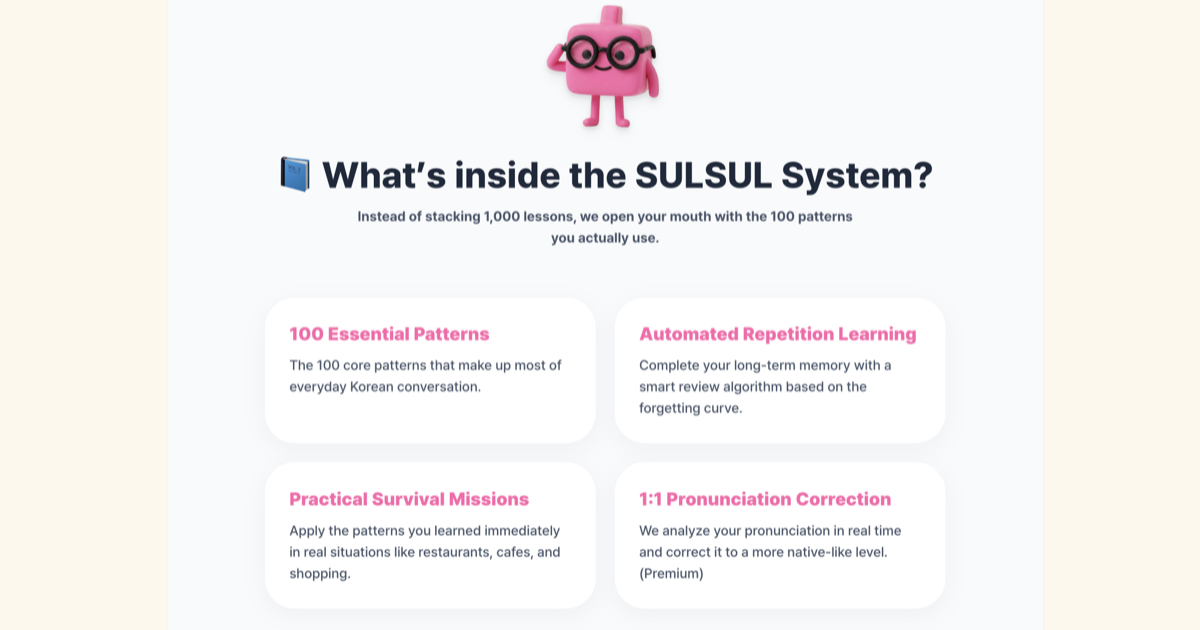
SULSUL is a speaking gym for exactly that moment: pick a survival pattern, say it out loud, get an instant fix from the AI pronunciation coach, then run the real situation as a mission. The 100-pattern PDF workbook comes along as a bonus.