Korean Phrases at the Apartment Management Office in Korea

Every Korean apartment building has a 관리사무소 (gwalli samuso, management office) on the ground floor, and it is the answer to more problems than most residents realise — no hot water, a dead hallway light, a parcel that never arrived, the neighbour above you moving furniture at midnight. Two patterns from the SULSUL workbook carry the whole conversation. Pattern 07 — 안 (an) plus a verb — states the problem without any technical vocabulary: 물이 안 나와요 (muri an nawayo), "The water isn't running." Pattern 23 — verb stem plus 아/어 주세요 (a/eo juseyo) — asks for the fix: 좀 봐 주세요 (jom bwa juseyo), "Please come take a look."
- Say what is not working: 물이 안 나와요 (muri an nawayo), "The water isn't running."
- Say which unit you are: 302호인데요 (sambaegiho indeyo), "This is unit 302."
- Ask for someone to come: 좀 봐 주세요 (jom bwa juseyo), "Please come take a look."
- Ask when: 언제 오실 수 있어요? (eonje osil su isseoyo?), "When can you come?"
- Ask about a parcel: 택배 여기 있어요? (taekbae yeogi isseoyo?), "Is my parcel here?"

How do you report something broken in your apartment?
Almost nobody walks down to the office for this — you call the number posted in the lift. The call is short and it always opens the same way, with your unit number, because that is the only thing they need to look you up.
You: 안녕하세요, 302호인데요. 뜨거운 물이 안 나와요. — annyeonghaseyo, sambaegiho indeyo. tteugeoun muri an nawayo. — "Hello, this is unit 302. The hot water isn't running."
Them: 언제부터 그러셨어요? — eonjebuteo geureosyeosseoyo? — "Since when has it been like that?"
You: 어제부터요. 좀 봐 주세요. — eojebuteoyo. jom bwa juseyo. — "Since yesterday. Please come take a look."
Swap the noun and the same sentence covers most of what breaks: 보일러 (boilleo, the boiler), 불 (bul, a light), 인터넷 (inteonet, the internet), 변기 (byeongi, the toilet). 안 돼요 (an dwaeyo) works when nothing obvious is coming out or going on — 보일러가 안 돼요 (boilleoga an dwaeyo), "the boiler isn't working." And 고장 났어요 (gojang nasseoyo), "it's broken," is the phrase to add when something is properly dead rather than misbehaving.
Practice this out loud with SULSUL — the app says it, you repeat it →
What else does the management office handle?
More than repairs. The office signs for parcels when you are out, controls the barrier for visitor parking, posts the notices about water shut-offs, and knows which day the recycling area opens.
You: 택배 여기 있어요? — taekbae yeogi isseoyo? — "Is my parcel here?"
Them: 몇 호세요? — myeot hoseyo? — "Which unit?"
You: 302호예요. — sambaegiho yeyo. — "Unit 302."
Two more that come up in the first month: 주차 등록하고 싶어요 (jucha deungnokhago sipeoyo), "I'd like to register my car," which is Pattern 02, and 분리수거 언제 해요? (bullisugeo eonje haeyo?), "When is the recycling collection?" — the answer to that one is usually the fixed weekday your building opens the bins, and the rest of that routine is in Korean phrases for taking out the trash in Korea.
| Situation | Say this |
|---|---|
| Say what is not working | 물이 안 나와요 (muri an nawayo) |
| Say which unit you are | 302호인데요 (sambaegiho indeyo) |
| Ask for someone to come | 좀 봐 주세요 (jom bwa juseyo) |
| Ask when | 언제 오실 수 있어요? (eonje osil su isseoyo?) |
| Ask about a parcel | 택배 여기 있어요? (taekbae yeogi isseoyo?) |
What usually goes wrong at a Korean management office?
The first thing is opening with the problem instead of the unit. 고장 났어요 on its own tells the office that something somewhere in a building of hundreds of homes is broken, and the call stalls while they work out who is speaking. 302호인데요 first, problem second — the -인데요 ending is what makes it sound like the opening of a sentence rather than an announcement, and it is why every Korean caller uses it.
The second is the noise upstairs. 층간소음 (cheunggan soum, noise between floors) is the one thing you should not take to the neighbour's door yourself; the office exists to pass it on without a confrontation. Say 윗집이 너무 시끄러워요 (witjibi neomu sikkeureowoyo), "the unit above is too loud," and let them make the call. If the reply on the phone moves faster than you can follow, what to say when Korean is spoken too fast has the fix, and for the repairs the office does not handle — a cracked phone screen, a dead router — see Korean phrases for a phone repair shop in Korea and Korean phrases for getting wifi and internet in Korea.
Say it out loud, not just in your head
302호인데요, 물이 안 나와요 is a sentence you will never get to rehearse — it happens on a Tuesday morning with the shower running cold and somebody already saying "여보세요" on the other end.
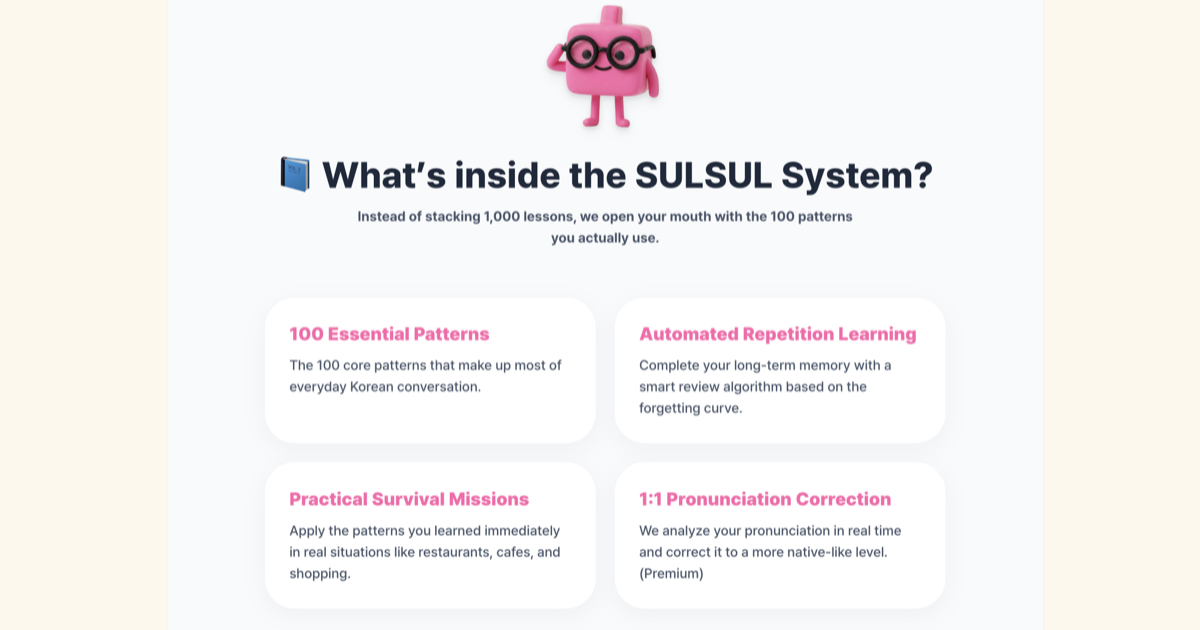
SULSUL is a speaking gym for exactly that moment: pick a survival pattern, say it out loud, get an instant fix from the AI pronunciation coach, then run the real situation as a mission. The 100-pattern PDF workbook comes along as a bonus.