Korean Phrases at a Real Estate Agent in Korea
A Korean 부동산 (budongsan, real estate office) is not a website — it is a small ground-floor room with listings printed on A4 paper and taped to the window, and one agent inside who will walk you to four flats in an afternoon if you ask. Walking in is the whole skill, and two patterns from the SULSUL workbook get you through the door. Pattern 03 — noun plus 있어요? (isseoyo?) — opens the conversation: 원룸 있어요? (wollum isseoyo?), "Do you have any one-room flats?" Pattern 02 — verb stem plus 고 싶어요 (go sipeoyo) — turns the listings on the window into an actual viewing: 방 좀 보고 싶어요 (bang jom bogo sipeoyo), "I'd like to see a room."
- Say what you are looking for: 원룸 있어요? (wollum isseoyo?), "Do you have any one-room flats?"
- Ask to see it: 방 좀 보고 싶어요 (bang jom bogo sipeoyo), "I'd like to see a room."
- Ask what is included: 관리비 포함이에요? (gwallibi pohamieyo?), "Is the maintenance fee included?"
- Ask when you can move in: 언제 들어갈 수 있어요? (eonje deureogal su isseoyo?), "When can I move in?"
- Ask about the walk: 역에서 가까워요? (yeogeseo gakkawoyo?), "Is it close to the station?"

How do you walk into a Korean 부동산?
You do not need an appointment. You push the door open, and the agent will offer you a seat and a paper cup of coffee before you have finished your first sentence. What they need from you is small: what kind of place, roughly which area, and roughly when.
You: 안녕하세요, 원룸 있어요? — annyeonghaseyo, wollum isseoyo? — "Hello, do you have any one-room flats?"
Them: 월세 찾으세요? — wolse chajeuseyo? — "Are you looking for a monthly rental?"
You: 네, 방 좀 보고 싶어요. — ne, bang jom bogo sipeoyo. — "Yes, I'd like to see a room."
월세 (wolse) is rent paid every month on top of a returnable deposit, the 보증금 (bojeunggeum). 전세 (jeonse) is the other Korean system: one large returnable deposit and no monthly rent at all. Say which one you want early, because it changes every listing the agent pulls out. The rest of the vocabulary is short — 원룸 (wollum) is a studio, 투룸 (turum) has a separate bedroom, and an 오피스텔 (opiseutel) is a studio inside an office-style building.
| Situation | Say this |
|---|---|
| Say what you are looking for | 원룸 있어요? (wollum isseoyo?) |
| Ask to see it | 방 좀 보고 싶어요 (bang jom bogo sipeoyo) |
| Ask what is included | 관리비 포함이에요? (gwallibi pohamieyo?) |
| Ask when you can move in | 언제 들어갈 수 있어요? (eonje deureogal su isseoyo?) |
| Ask about the walk | 역에서 가까워요? (yeogeseo gakkawoyo?) |

Practice this out loud with SULSUL — the app says it, you repeat it →
What do you ask while you are standing in the room?
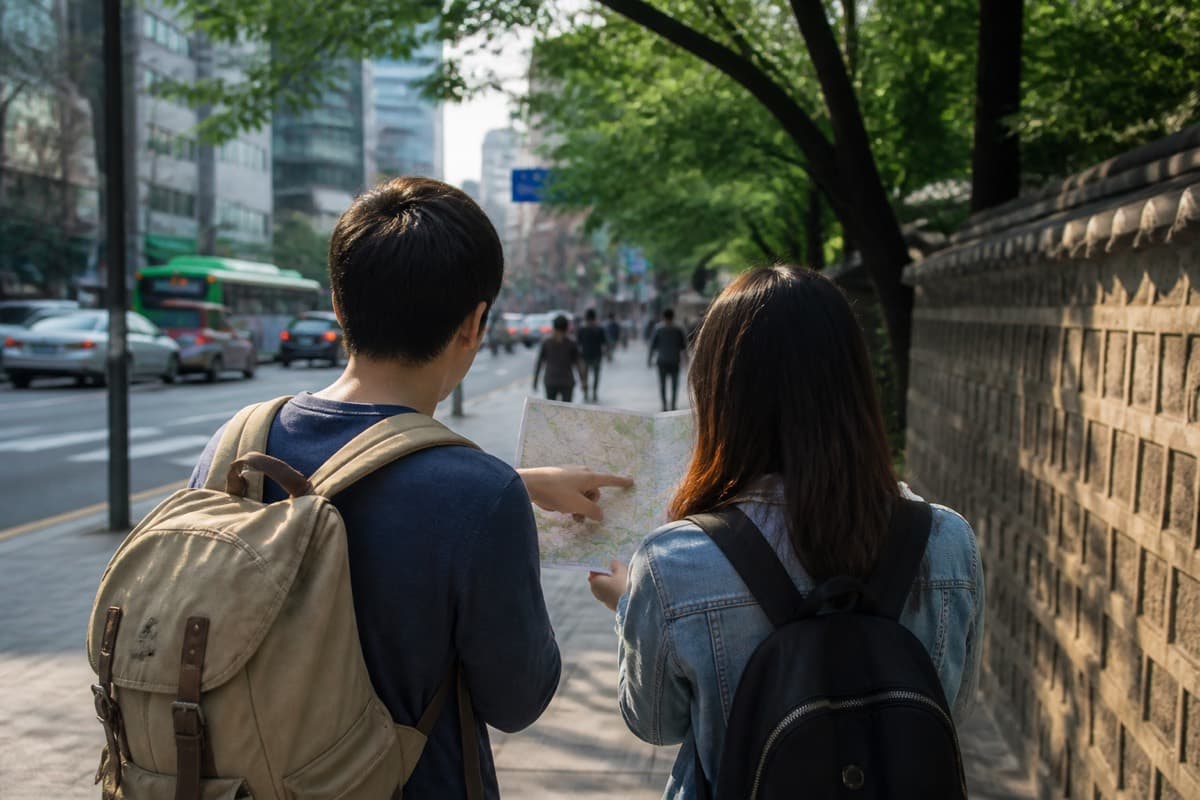
Viewings are fast — the agent unlocks the door, you have maybe three minutes, and then you are back on the street walking to the next one. These are the questions worth having ready before you go in.
You: 관리비 포함이에요? — gwallibi pohamieyo? — "Is the maintenance fee included?"
Them: 아니요, 따로예요. — aniyo, ttaroyeyo. — "No, it's separate."
You: 언제 들어갈 수 있어요? — eonje deureogal su isseoyo? — "When can I move in?"
The 관리비 (gwallibi) is the monthly building fee, and what it covers changes from building to building — sometimes water and the hallway lights, sometimes the internet too. 옵션 뭐 있어요? (opsyeon mwo isseoyo?), "What's included?", is how you find out whether the 세탁기 (setakgi, washing machine) and 에어컨 (eeokeon, air conditioner) stay. Two more that experienced renters always ask: 햇빛 잘 들어요? (haetbit jal deureoyo?), "Does it get good light?", and 곰팡이 없어요? (gompangi eopseoyo?), "No mould?" — the second one matters most in a 반지하 (banjiha, semi-basement) flat. If the reply comes back faster than you can follow, what to say when Korean is spoken too fast has the two sentences that slow it down.
What usually goes wrong at a Korean 부동산?
The first thing is walking in with 집 있어요? ("do you have a place?") and nothing else. In a neighbourhood office that could mean forty listings, and the agent has to reverse into a long interview to narrow it down. Give them the three things unprompted — 월세 or 전세, the area or the station, and the month you need to move — and the conversation jumps straight to keys and a walk around the block.
The second is treating the viewing as the end. After you choose, there is a 계약서 (gyeyakseo, contract) signed with the 집주인 (jipjuin, landlord) present or on the phone, and after you move in there is 전입신고 (jeonipsingo), registering your new address at the local 주민센터 (jumin senteo, community centre). Ask the agent directly: 계약서 언제 써요? (gyeyakseo eonje sseoyo?), "When do we sign the contract?" Once you have the keys, the errands start — Korean phrases at the apartment management office in Korea covers the building office, Korean phrases for taking out the trash in Korea covers the bins downstairs, and Korean phrases for getting wifi and internet in Korea covers the one thing nobody wants to spend a week without.
Say it out loud, not just in your head
방 좀 보고 싶어요 is four words that decide where you will wake up for the next year, and you will say it standing in a doorway with an agent already reaching for their keys.
SULSUL is a speaking gym for exactly that moment: pick a survival pattern, say it out loud, get an instant fix from the AI pronunciation coach, then run the real situation as a mission. The 100-pattern PDF workbook comes along as a bonus.