Korean Phrases for Chuseok in Korea
추석 (chuseok) is the fifteenth day of the eighth lunar month, which lands in late September this year, and for anyone living in Korea it behaves less like a date than like a week when the country quietly empties out. Half the people you know disappear to a 고향 (gohyang, hometown) you have never been to, the motorways stop moving, small shops put a handwritten note on the shutter, and everyone around you starts every conversation with the same two questions: what are you doing, and when are you going. Two patterns from the SULSUL workbook carry the whole holiday. Pattern 39 — -을/ㄹ 때 — pins a sentence to a moment in time: 고향에 갈 때 차가 많이 막혀요 (gohyange gal ttae chaga mani makhyeoyo), "When I go to my hometown the roads are jammed." Pattern 90 — 보고 싶어요 / 걱정돼요 / 다행이에요 — is the feeling half, and a holiday is mostly feelings: 가족들이 정말 보고 싶어요 (gajokdeuri jeongmal bogo sipeoyo), "I really miss my family."
- Wish someone a good holiday: 추석 잘 보내세요 (chuseok jal bonaeseyo), "Have a good Chuseok."
- Ask about their plans: 연휴 때 뭐 하세요? (yeonhyu ttae mwo haseyo?), "What are you doing over the long weekend?"
- Warn about the roads: 고향에 갈 때 차가 많이 막혀요 (gohyange gal ttae chaga mani makhyeoyo), "When I go to my hometown the roads are jammed."
- Say what you are feeling: 가족들이 보고 싶어요 (gajokdeuri bogo sipeoyo), "I miss my family."
- Say you are relieved: 잘 도착해서 다행이에요 (jal dochakhaeseo dahaengieyo), "I'm glad you got there safely."
What do you say to people before the holiday starts?
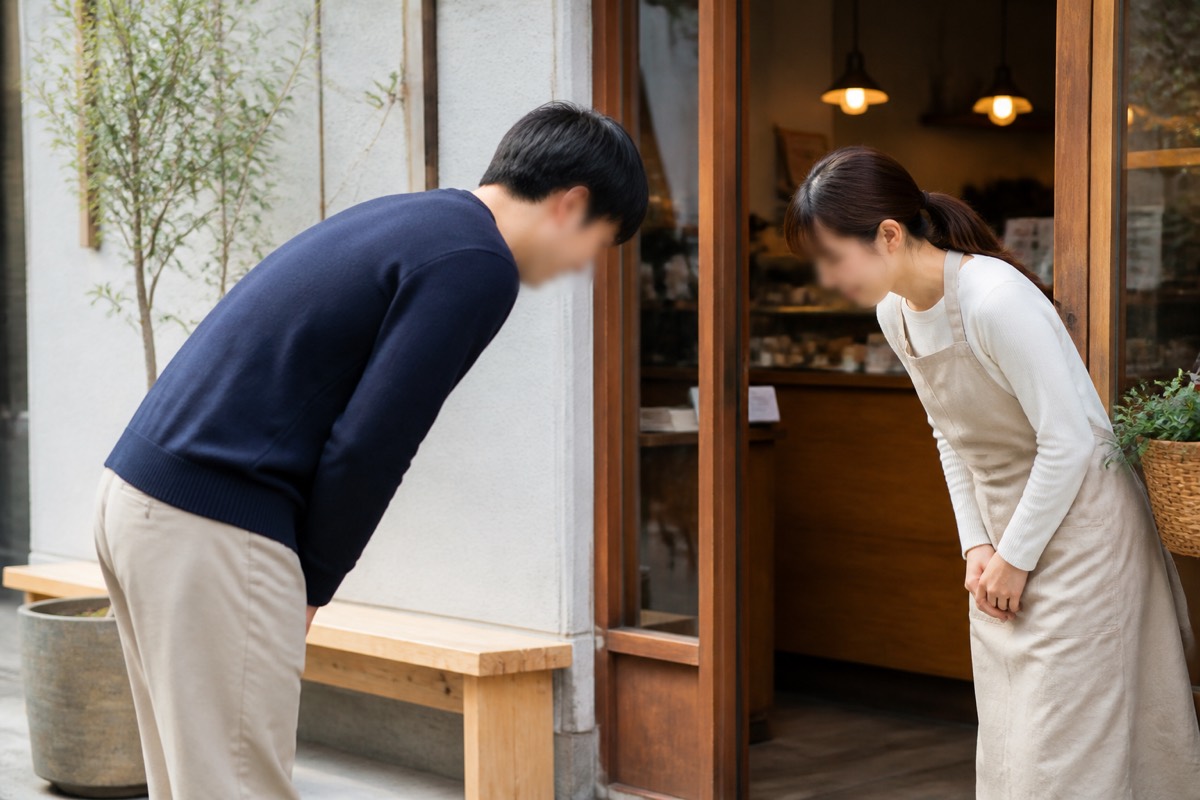
In the week before 추석, the same exchange happens at the office, in the lift, at the counter of the shop you go to every day. Nobody is making conversation for the sake of it — they are working out whether you will be around, and whether they need to say goodbye to you now. The sentence that ends every one of these exchanges is 추석 잘 보내세요, literally "spend Chuseok well." Say it to anyone you will not see again before the break, including the person handing you your coffee.
Them: 이번 연휴 때 뭐 하세요? — ibeon yeonhyu ttae mwo haseyo? — "What are you doing over this long weekend?"
You: 저는 서울에 있을 거예요. 어디 가세요? — jeoneun seoure isseul geoyeyo. eodi gaseyo? — "I'm staying in Seoul. Are you going somewhere?"
Them: 고향에 내려가요. 길이 많이 막힐 것 같아요. — gohyange naeryeogayo. giri mani makhil geot gatayo. — "I'm going down to my hometown. I think the roads will be badly jammed."
You: 아, 조심히 다녀오세요. 추석 잘 보내세요! — a, josimhi danyeooseyo. chuseok jal bonaeseyo! — "Oh, travel safely. Have a good Chuseok!"
Pattern 39 is the shape doing the work in all of that, and it has three rules. On a verb or adjective stem, add -ㄹ 때 with no batchim and -을 때 with one: 갈 때 (when going), 먹을 때 (when eating), 바쁠 때 (when busy). After a noun you need nothing but the word itself — 명절 때 (myeongjeol ttae, at holiday time), 연휴 때 (yeonhyu ttae, over the long break), 학생 때 (haksaeng ttae, back when I was a student). For a moment in the past, the past-tense marker goes in first: 한국에 왔을 때 (hanguge wasseul ttae), "when I came to Korea." The word itself is tense and short — say 때! hard, not "ttae-eh" — and it turns an ordinary sentence into a specific one, which is the difference between talking about the holiday and talking about your holiday.
| Situation | Say this |
|---|---|
| Wish someone a good holiday | 추석 잘 보내세요 (chuseok jal bonaeseyo) |
| Ask about their plans | 연휴 때 뭐 하세요? (yeonhyu ttae mwo haseyo?) |
| Warn about the roads | 고향에 갈 때 차가 많이 막혀요 (gohyange gal ttae chaga mani makhyeoyo) |
| Say what you are feeling | 가족들이 보고 싶어요 (gajokdeuri bogo sipeoyo) |
| Say you are relieved | 잘 도착해서 다행이에요 (jal dochakhaeseo dahaengieyo) |
Practice this out loud with SULSUL — the app says it, you repeat it →
How do you say you miss home, and that you are relieved?
Then the holiday happens, and the register changes. 추석 is the one week of the year when Koreans openly talk about missing people, and if you live far from your own family, this is the week somebody will ask you about it directly. Pattern 90 gives you all three of the answers: 보고 싶어요 when you miss someone, 걱정돼요 when something is sitting on your chest, 다행이에요 when it turns out fine after all.
You: 연휴 잘 보내셨어요? — yeonhyu jal bonaesyeosseoyo? — "Did you have a good holiday?"
Them: 네, 잘 보냈어요. 길은 좀 막혔지만요. — ne, jal bonaesseoyo. gireun jom makhyeotjimanyo. — "Yes, it was good. The roads were a bit jammed, though."
You: 사고 없이 잘 다녀오셔서 다행이에요. — sago eopsi jal danyeoosyeoseo dahaengieyo. — "I'm glad you got there and back without any trouble."
Them: 감사합니다. 가족들 얼굴 봐서 좋았어요. — gamsahamnida. gajokdeul eolgul bwaseo joasseoyo. — "Thank you. It was good to see my family's faces."
None of these three needs conjugating; they are whole chunks. 보고 싶어요 takes either particle on the person you miss, so 가족들이 보고 싶어요 and 가족들을 보고 싶어요 are both fine, and the past tense 보고 싶었어요 (bogo sipeosseoyo) is what you say to the friend standing in front of you after a long gap. 걱정돼요 attaches straight to a noun — 길이 걱정돼요 (giri geokjeongdwaeyo), "I'm worried about the roads." 다행이에요 almost always arrives with its reason in front of it, joined by -아서/어서: 비 안 와서 다행이에요 (bi an waseo dahaengieyo), "I'm glad it didn't rain." Koreans say 다행이다~ half to themselves, hand on the chest, and matching that tone matters more than the grammar does.
What usually goes wrong over Chuseok?
The first thing is the timing of the country itself. The holiday runs three days at minimum, often stretched by a weekend, and the 귀성길 (gwiseonggil), the drive home, is the reason a four-hour trip becomes eight. Trains sell out weeks ahead rather than days, which is a booking to make long before the week arrives — that counter is how to buy a KTX train ticket in Korean, and the stops along the motorway are Korean phrases at a highway rest stop in Korea. Big supermarkets take their mandatory closing days around the holiday and neighbourhood shops simply shut, so the sensible move is to shop before everyone else does at Korean phrases at a supermarket in Korea.
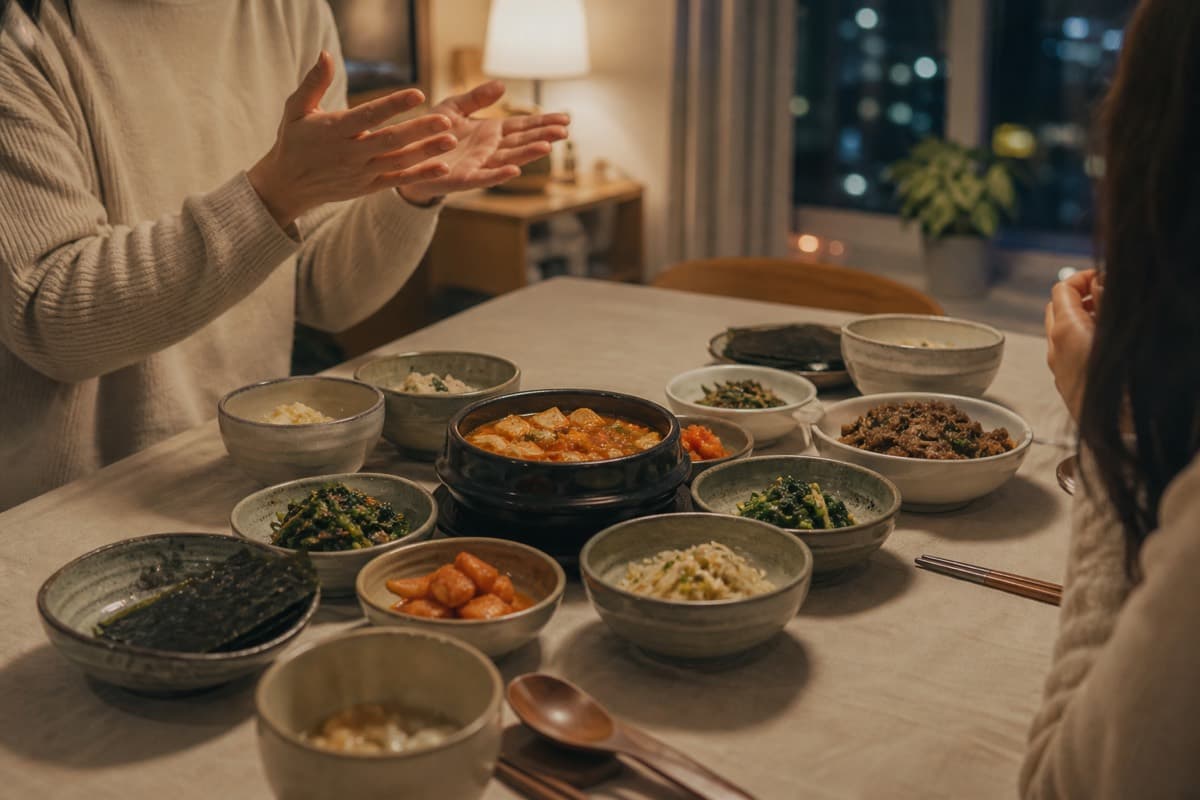
The second is the table. 차례 (charye) is the memorial rite some families hold on the morning of 추석, 성묘 (seongmyo) is the visit to the graves, and 송편 (songpyeon), the folded rice cakes steamed over pine needles, is the food the day is built around. If you are invited to somebody's family home, you are being let into the private half of the holiday, and the two useful things to know are that a boxed 선물세트 (seonmulseteu) — fruit, dried seaweed, tinned tuna, shampoo — is the normal thing to arrive holding, and that food will keep being pushed towards you long after you have stopped. 많이 먹었어요 (mani meogeosseoyo), "I've eaten a lot," is the polite stop sign, 정말 맛있어요 (jeongmal masisseoyo) is the thing to say first, and 잘 먹었습니다 (jal meogeotseumnida) is how you close the meal. The rest of that vocabulary is in how to compliment a Korean friend's cooking.
The third is who everyone is. A holiday gathering is thirty people who all have a title rather than a name, and working out what to call the aunt pouring your drink is a real problem with a real answer in Korean family titles and how to address people. Expect to be asked your age early — that is not nosiness, it is someone trying to work out which speech level to use with you, and Korean greetings and politeness levels explains what they are deciding. When four relatives talk at once and the whole room speeds up, what to say when Korean is too fast buys you the sentence again. And the greeting you will get on your phone all week from people you cannot see in person is the same one you should send back, which is a message worth writing yourself rather than forwarding — the shape of those is in Korean phrases for texting on KakaoTalk.
Say it out loud, not just in your head
추석 잘 보내세요 is a sentence you cannot look up mid-sentence — the lift doors are closing, the person is already half turned away, and you get one second to say it back.
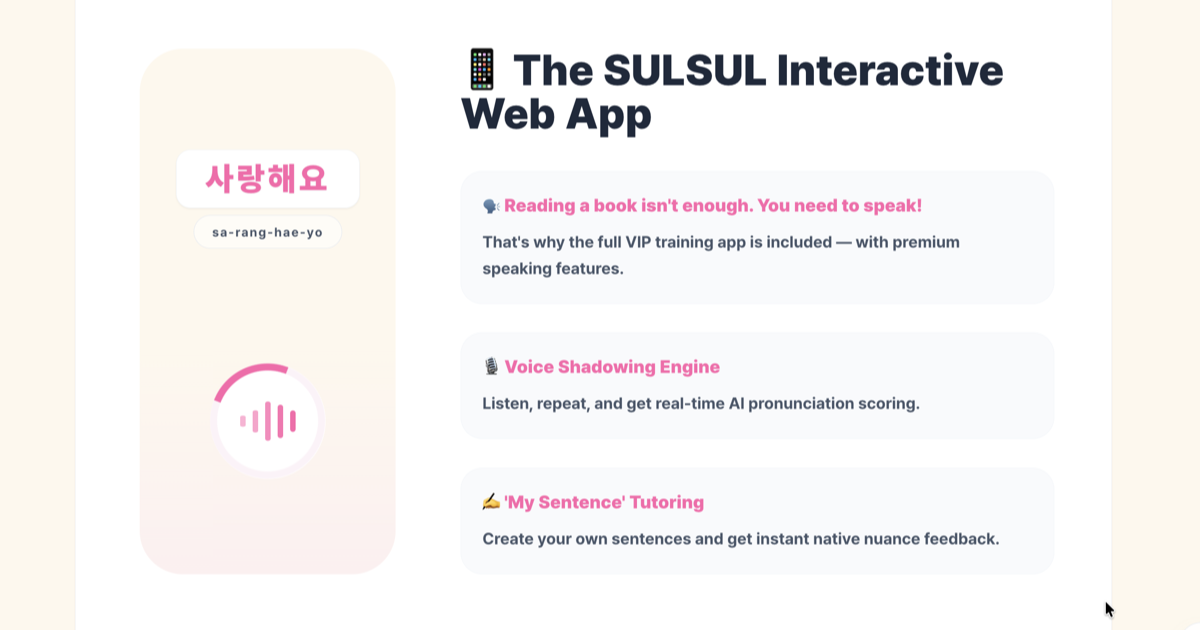
SULSUL is a speaking gym for exactly that moment: pick a survival pattern, say it out loud, get an instant fix from the AI pronunciation coach, then run the real situation as a mission. The 100-pattern PDF workbook comes along as a bonus.