What Does Unnie Mean in Korean?


언니 (eonni) means "older sister," and a woman is the one saying it. A female speaker uses 언니 for her own older sister, for a friend two years ahead of her at school, for the neighbour she grew up beside — and also, and this is the part that surprises fans, for a woman she has never met in her life. The young woman folding sweaters in a Hongdae shop is 언니. The one taking your order at a street stall is 언니. A man in the same situation would reach for 누나 (nuna) with a friend, but he would never call the shop assistant that. 언니 is the only one of Korea's four sibling titles that walks out of the family and into strangers' hands, which makes it the single most useful of the four if you are a woman about to land in Seoul.
- The word: 언니 (eonni), "older sister," said by a female speaker.
- Fan spelling: unnie. Actual sound: eon-ni, closer to "on-nee."
- The male-speaker version: 누나 (nuna), same meaning, different mouth.
- Your actual sister: 친언니 (chineonni), "blood older sister."
- Your brother's wife: 새언니 (saeeonni), "new older sister."
- The fandom use: 언니라인 (eonnirain), "unnie line," the older members of a girl group.
The stranger rule that makes 언니 different
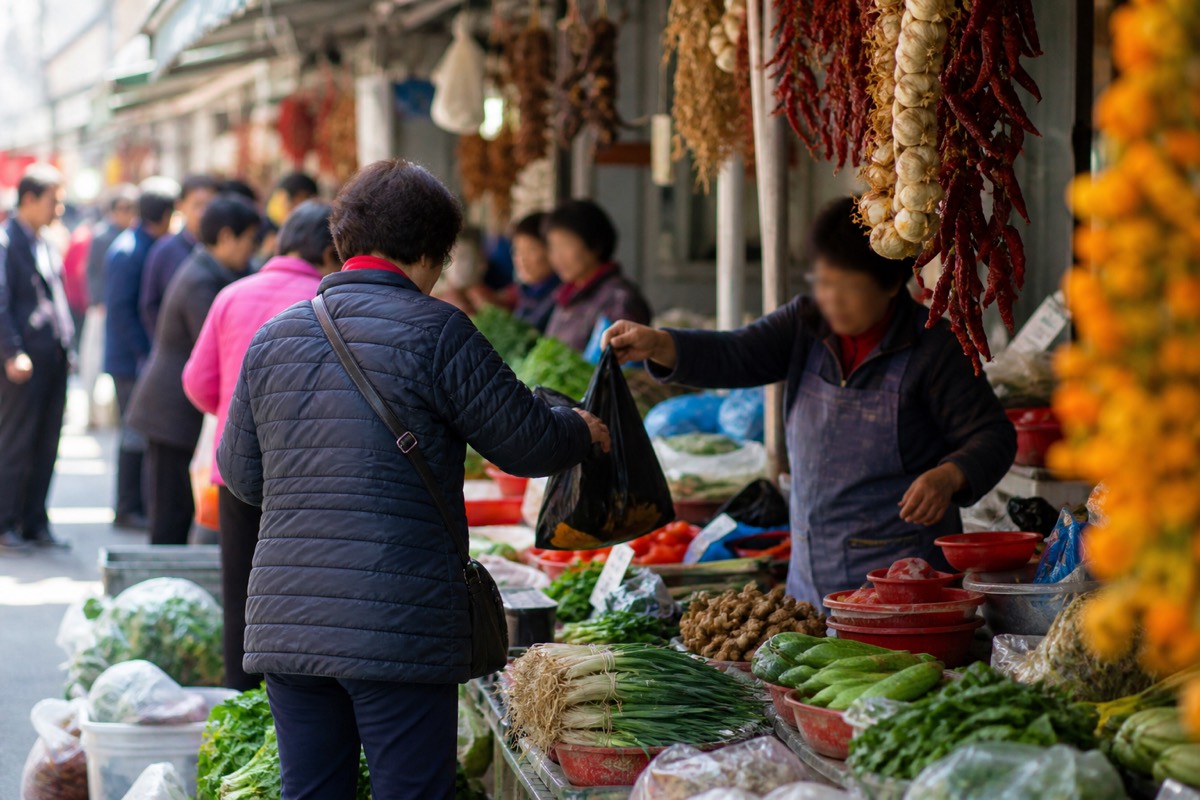
Korean normally makes you earn a title. You establish who is older, you confirm you are close, and only then do you get to use a family word on someone. 언니 quietly breaks that rule in one specific place: service. In a clothing shop, a nail salon, a market stall or a small restaurant, a female customer can call a female employee who looks roughly her own age or older 언니, and nobody blinks.
It works because it is warm without being intimate. 저기요 (jeogiyo), "excuse me," is perfectly correct and perfectly flat. 언니 says I am treating you as a person, not a counter. Vendors use it right back at customers, which is why a market aunt will greet you with 언니, 이거 한번 보세요 — eonni, igeo hanbeon boseyo — "Unnie, take a look at this," before she knows anything about you at all.
There is one line to watch. If the woman is clearly a generation older than you — mid-forties and up — 언니 stops being warm and starts being a stretch. The word for her is 이모님 (imonim), "auntie," or, if she owns the place, 사장님 (sajangnim), "boss." Some older vendors enjoy being called 언니 and will laugh about it, but it is a gamble, and 이모님 never misfires.
Practice this out loud with SULSUL — the app says it, you repeat it →
Who says 언니, and who says 누나
Two women, same age gap, different words — because the difference lives in the speaker, not the listener.
| You are | Older woman | Older man |
|---|---|---|
| Female | 언니 (eonni) | 오빠 (oppa) |
| Male | 누나 (nuna) | 형 (hyeong) |
So the same woman is 언니 to her younger female cousin and 누나 to her younger brother, at the same dinner table, on the same evening. Neither of them is adjusting for anything about her. They are each announcing their own gender. Hearing 언니 in a drama therefore tells you the speaker is a woman before it tells you a thing about the relationship — the same signal 누나 sends in reverse, unpacked in what does noona mean in Korean. The male-speaker half of the grid is in what does oppa mean in Korean.
언니 has no honorific upgrade
Here is a small gap in the system that trips up learners who like patterns. 누나 becomes 누님 (nunim) when you need respect and distance. 형 becomes 형님 (hyeongnim). 언니 becomes nothing. There is no everyday 언님, and adding 님 to it sounds like a learner guessing.
When a woman needs a respectful word for an older woman, Korean sends her elsewhere: 선배님 (seonbaenim) if the woman started at the school or company before her, 이모님 for the generation above, a job title at work. What 선배 covers is laid out in what does sunbae mean in Korean.
And 언니 has a strange in-law twist. Your husband's older sister is not your 언니 — she is 형님 (hyeongnim), a word that looks male and is used by women in exactly this one relationship. Your older brother's wife, meanwhile, is an 언니: 새언니, "new older sister." The whole in-law map, which Koreans themselves look up before holidays, is drawn out in Korean family titles: how to address people in Korea.
What it sounds like in a real exchange
In a shop, 언니 does the work that "excuse me, could I ask you something" does in English, in two syllables:
You: 언니, 이거 다른 색 있어요? — eonni, igeo dareun saek isseoyo? — "Unnie, do you have this in another colour?"
Her: 네, 검정색도 있어요. 입어보실래요? — ne, geomjeongsaekdo isseoyo. ibeobosillaeyo? — "Yes, we have black too. Would you like to try it on?"
You: 네, 한번 입어볼게요. — ne, hanbeon ibeobolgeyo. — "Yes, I'll try it."
With a friend, the same word carries the politeness gap that runs through every Korean friendship with an age difference in it:
You: 언니, 저 먼저 갈게요. — eonni, jeo meonjeo galgeyo. — "Unnie, I'm heading off first."
Her: 어, 조심히 가. — eo, josimhi ga. — "Okay, get home safe."
She answers in 반말 (banmal), the casual form. You stay a step politer. That is not coldness on either side — the older one speaks down casually, the younger one speaks up politely, and the day she tells you 말 편하게 해 (mal pyeonhage hae), "speak comfortably," you can drop the 요 too. Which ending belongs where is sorted out in how to greet someone in different Korean politeness levels.
언니 in fandom, and 언니미
Girl group fans meet this word from inside the group. Members use 언니 for the ones born earlier, and the 언니라인 (eonnirain), "unnie line," is fan shorthand for the senior half of a lineup — the maknae calls all of them 언니, and the oldest member calls nobody. Fans use it upward too: a woman younger than the idol she supports will call her 언니 in comments and at fan signs.
Then there is 언니미 (eonnimi), literally "unnie beauty." It describes a woman with a composed, unbothered, slightly intimidating confidence — the vibe English-speaking fans usually label girl crush. 언니미 터진다 (eonnimi teojinda), "her unnie energy is exploding," is what you comment under a stage where she looks completely in control. More fandom vocabulary that works the same way sits in Korean slang words and what they actually mean.
Mistakes K-drama fans make with 언니
Saying it as a man. If you are male, your word is 누나. You will occasionally hear a man say 언니 as a joke, or inside beauty-industry circles where it is its own in-group habit, but as a default it lands wrong.
Saying "YOO-nee." The fan spelling unnie is doing you no favours. 언니 is eo — the vowel in "won" — followed by a doubled n. Two even syllables, no stress on the second.
Aiming it at a woman a generation older. 이모님 for the auntie generation, 사장님 for the owner. 언니 upward past a certain point reads as flattery rather than warmth.
Using it on a female boss. Offices run on job titles — 과장님 (gwajangnim), 팀장님 (timjangnim). 언니 in a meeting drags a friendship into the wrong room.
Assuming it means you are close. Between friends it does. Across a shop counter it is closer to "miss," and it disappears the moment the transaction ends. The market version of that voice is in Korean phrases for bargaining in markets.
Say it out loud before you need it
언니, 이거 다른 색 있어요? takes a second to read and still comes out sideways when a real person is standing there waiting for it.
SULSUL is a speaking gym built for that gap: pick a pattern, say it out loud, get an instant fix from the AI pronunciation coach, then run the whole situation as a mission. The 100-pattern PDF workbook comes along as a bonus.