What Does Hyung Mean in Korean?


형 (hyeong) means "older brother," and the person saying it is a man. A male speaker uses 형 for his own older brother, for the friend who started school two years ahead of him, for the bandmate born one year earlier, and for the co-worker he drinks with who is old enough that using his bare name would feel wrong. A woman in exactly the same situation says 오빠 (oppa). So the word tells you the speaker's gender before it tells you anything about the relationship. And unlike 언니 (eonni), which a woman can aim at a shop assistant she has never met, 형 stays inside circles a man already belongs to. Calling a stranger on the street 형 is not warm in Korean. It is presumptuous.
- The word: 형 (hyeong), "older brother," said by a male speaker.
- Fan spelling: hyung. Actual sound: hyeong, one syllable, the vowel of "won" plus ng.
- The female-speaker version: 오빠 (oppa), same meaning, different mouth.
- Your actual brother: 친형 (chinhyeong), "blood older brother."
- The respectful upgrade: 형님 (hyeongnim).
- The fandom use: 형라인 (hyeongnain), "hyung line," the older members of a boy group.
Only men say 형, and the gap can be tiny
Two men, one year between them, and the younger one has already stopped using the older one's name. That is normal. Korean does not need a decade to start the title; a single year of school does it. Someone born in 1998 is 형 to someone born in 1999, forever, even when they are both forty.
| You are | Older man | Older woman |
|---|---|---|
| Male | 형 (hyeong) | 누나 (nuna) |
| Female | 오빠 (oppa) | 언니 (eonni) |
Read the grid down, not across. The same man is 형 to his younger brother and 오빠 to his younger sister, at the same table, on the same evening — and neither of them is reacting to anything about him. They are each announcing their own gender. Hearing 형 in a drama therefore means a man is speaking, the way 언니 means a woman is, which is why the two words are laid out side by side in what does unnie mean in Korean. The 오빠 half of the same grid is in what does oppa mean in Korean, and the 누나 half in what does noona mean in Korean.
Because the gap can be one year, Korean men find out early. 몇 년생이세요? — myeot nyeonsaengiseyo? — "What year were you born?" arrives in the first ten minutes of a first meeting, and it sounds like nothing. It is not small talk about star signs. It is the question that decides who calls whom what for the rest of their lives, and how to ask it without it landing strangely is in how to ask someone's age in Korean.
Practice this out loud with SULSUL — the app says it, you repeat it →
형 replaces his name entirely
This is the part that makes subtitles look odd. Once a man is your 형, you mostly stop saying his name to his face. You say 형 where English would say "you," and again where English would say "he."
형, 어디 가? — hyeong, eodi ga? — "Where are you going?" 형이 사줬어. — hyeongi sajwosseo. — "He bought it for me." (Literally "hyung bought it.")
Korean avoids the word "you" with anyone above you, so the title steps in and does that job. When there are several older men around, first names come back attached: 민호 형 (Minho hyeong), 재현이 형 (Jaehyeoni hyeong) — name first, title second, never the other way.

형 or 형님? What the 님 changes
형님 (hyeongnim) is 형 with respect bolted on, and Koreans use it in three places.
With in-laws. A man calls his wife's older brother 형님. It is family, but it is new family, so the 님 stays.
In business and in trades. Two men who are friendly but not close, ten years into knowing each other, often settle on 형님 permanently. It is warmer than a job title and safer than bare 형.
In gangster dramas. Crews call their boss 형님, which is why the word sounds heavier on screen than it does in life. If your only exposure is crime series, 형님 feels like a threat. At a wedding it is just good manners.
One oddity worth knowing: a woman calls her husband's older sister 형님 too. A male-looking word, used by a woman, for a woman, in exactly that one relationship. The full in-law map — the one Koreans themselves check before holidays — is in Korean family titles: how to address people in Korea.
Where 형 lives outside a family
School gives you 선배 (seonbae) for the year above and 후배 (hubae) for the year below, and those are the neutral, gender-free words that work in front of a professor. 형 is what the same two men use once they are out of the building and one is buying dinner. That split — formal title in public, sibling word in private — runs through Korean university life, and what 선배 actually covers is in what does sunbae mean in Korean.
Military service produces the same pair. On duty it is rank. Off duty, and for decades after discharge, the older one is 형. Football teams, bands, kitchens and film crews all work this way: the job has a word for it, and the friendship has 형.
Offices are the exception. Korean companies run on titles — 과장님 (gwajangnim), 팀장님 (timjangnim), 대리님 (daerinim) — and 형 in a meeting drags a private relationship into the wrong room. After the meeting, at the company dinner, 형 comes out again, which is exactly the shift that makes Korean phrases for a company dinner in Korea worth reading before your first one.
형라인, and why female fans never say it
Boy group fans meet this word from inside the group. Members call the older ones 형, and 형라인 (hyeongnain), "hyung line," is fan shorthand for the senior half of a lineup. The 막내 (maknae), the youngest, calls every single member 형 and is called nothing back.
Here is the trap. Fans copy the members, and a female fan starts writing 형 about an idol. She should be writing 오빠. 형 belongs to male speakers only, so a woman saying it about her bias reads as though she has learned Korean entirely from watching men talk to each other — which, to be fair, is what happened. Male fans do say 형, and it sounds completely normal. More fandom vocabulary that splits by speaker like this sits in Korean slang words and what they actually mean.
What it sounds like at a real table
At a barbecue, with one man a few years older than the other:
You: 형, 이거 좀 드세요. — hyeong, igeo jom deuseyo. — "Hyung, have some of this." Him: 어, 너도 많이 먹어. — eo, neodo mani meogeo. — "Yeah, you eat plenty too." You: 형, 제가 계산할게요. — hyeong, jega gyesanhalgeyo. — "Hyung, I'll pay." Him: 아니야, 오늘은 내가 살게. — aniya, oneureun naega salge. — "No, today's on me."
Listen to the endings. He answers in 반말 (banmal), the casual form. You stay a step politer with 요. Nobody is being cold — the older one speaks down casually, the younger one speaks up politely, and the evening he says 말 편하게 해 (mal pyeonhage hae), "speak comfortably," you can drop the 요 as well. Which ending belongs in which room is sorted out in how to greet someone in different Korean politeness levels.
Mistakes K-drama fans make with 형
Saying it as a woman. Your word is 오빠. This is the single most common one, and it comes straight from imitating boy group members.
Pronouncing it "hyung." The spelling is misleading. 형 is one syllable: hy + the vowel in "won" + ng. Closer to "hyuhng" than to "young."
Aiming it at a stranger. 언니 goes to strangers; 형 does not. On the street it is 저기요 (jeogiyo), "excuse me," and to a shop owner 사장님 (sajangnim), "boss."
Using it on a man a generation older. Past roughly your parents' age, 형 stops working. That man is 아저씨 (ajeossi) or, better, whatever his title is.
Adding 님 to someone you are close to. 형님 to a friend you have known for years sounds like you are joking, or about to ask for money.
Say it out loud before you need it
형, 제가 계산할게요. reads easily and still comes out sideways the first time a real person is sitting across the table waiting for it.
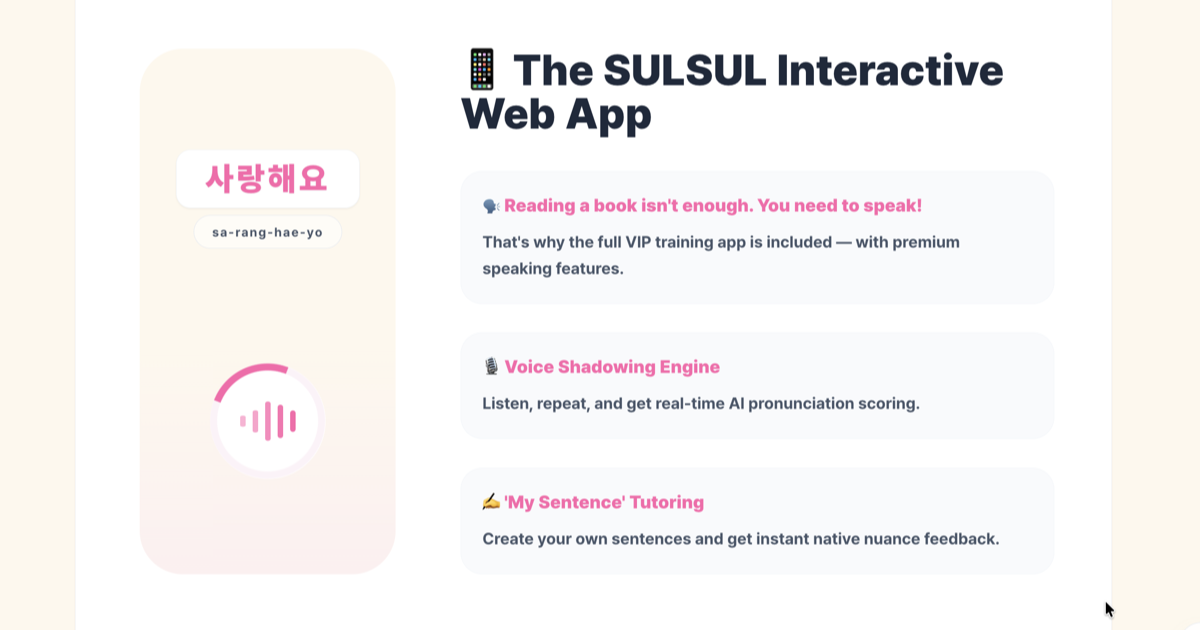
SULSUL is a speaking gym built for that gap: pick a pattern, say it out loud, get an instant fix from the AI pronunciation coach, then run the whole situation as a mission. The 100-pattern PDF workbook comes along as a bonus.