Basic Korean Phrases for Beginners: The First 12 to Learn, in the Order That Makes Them Stick
The best basic Korean phrases for beginners are the ones that let you start a conversation, get what you need, and survive when you don't understand. That's 12 lines, learned in this order: 안녕하세요 (hello), 감사합니다 (thank you), 저기요 (excuse me), 죄송합니다 (sorry), 네 (yes), 아니요 (no), then the three request patterns ___ 주세요 (please give me ), ** 있어요?** (do you have ?), ** 어디예요?** (where is ___?), and finally the rescue lines 잘 모르겠어요 (I don't understand), 다시 말해 주세요 (please say it again), and 천천히 말해 주세요 (please speak slowly). With those, you can handle a café, a shop, a subway station, and a confused moment, all in polite Korean.
- 안녕하세요 (an-nyeong-ha-se-yo) — "Hello."
- 감사합니다 (gam-sa-ham-ni-da) — "Thank you."
- 저기요 (jeo-gi-yo) — "Excuse me." (to get attention)
- 죄송합니다 (joe-song-ham-ni-da) — "I'm sorry."
- 네 / 아니요 (ne / a-ni-yo) — "Yes / No."
- 이거 주세요 (i-geo ju-se-yo) — "This one, please."
- 화장실 있어요? (hwa-jang-sil i-sseo-yo?) — "Is there a restroom?"
- 역 어디예요? (yeok eo-di-ye-yo?) — "Where's the station?"
- 잘 모르겠어요 (jal mo-reu-ge-sseo-yo) — "I'm not sure / I don't understand."
- 다시 말해 주세요 (da-si mal-hae ju-se-yo) — "Please say it again."
- 천천히 말해 주세요 (cheon-cheon-hi mal-hae ju-se-yo) — "Please speak slowly."
Why the order matters more than the list
Most beginner lists hand you 50 phrases at once, sorted by topic: greetings, food, directions, emergencies. You memorize a few, freeze on the first real exchange, and decide Korean is hard.
The problem is that real conversations don't arrive by topic. They arrive in a shape: you open, you ask, they answer, and somewhere in the answer you get lost. If you learn phrases in the order of that shape, every new line has a place to go. That's why the groups below go open → ask → recover. You can stop after the first group and still be polite. Stop after the second and you can get things done. The third group is what keeps you from walking away mid-sentence.
Practice this out loud with SULSUL — the app says it, you repeat it →
Group 1: The lines that open and close everything
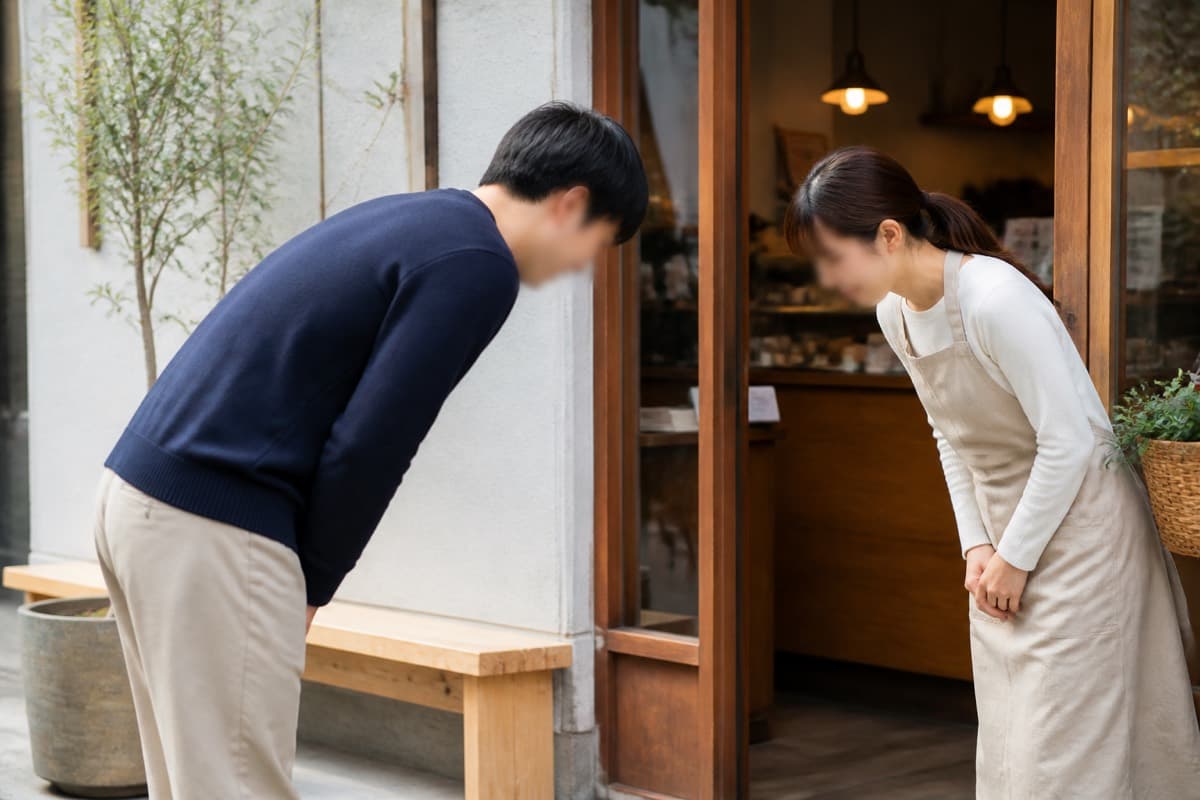
안녕하세요 (an-nyeong-ha-se-yo) works for almost anyone you meet: shop staff, a neighbor, a taxi driver, a teacher. It isn't stiff and it isn't too casual. Say it with a small nod.
감사합니다 (gam-sa-ham-ni-da) is the safe "thank you." You'll also hear 고맙습니다, which means the same thing. For the difference between these and the casual versions, see how to say thank you in Korean.
저기요 (jeo-gi-yo) literally means "over there," but it's how you get a stranger's attention: in a restaurant, on the street, at a counter. It replaces the English "excuse me" when you need help, not when you bump into someone. For a bump, use 죄송합니다 (joe-song-ham-ni-da), "I'm sorry."
네 / 아니요 (ne / a-ni-yo) are yes and no. One beginner surprise: 네 also means "uh-huh, I'm listening," so Koreans say it constantly while you talk. It doesn't always mean they agree.
Group 2: Three patterns that build hundreds of sentences
This is where beginners get the biggest return. Instead of memorizing whole phrases, learn three frames and drop nouns into them.
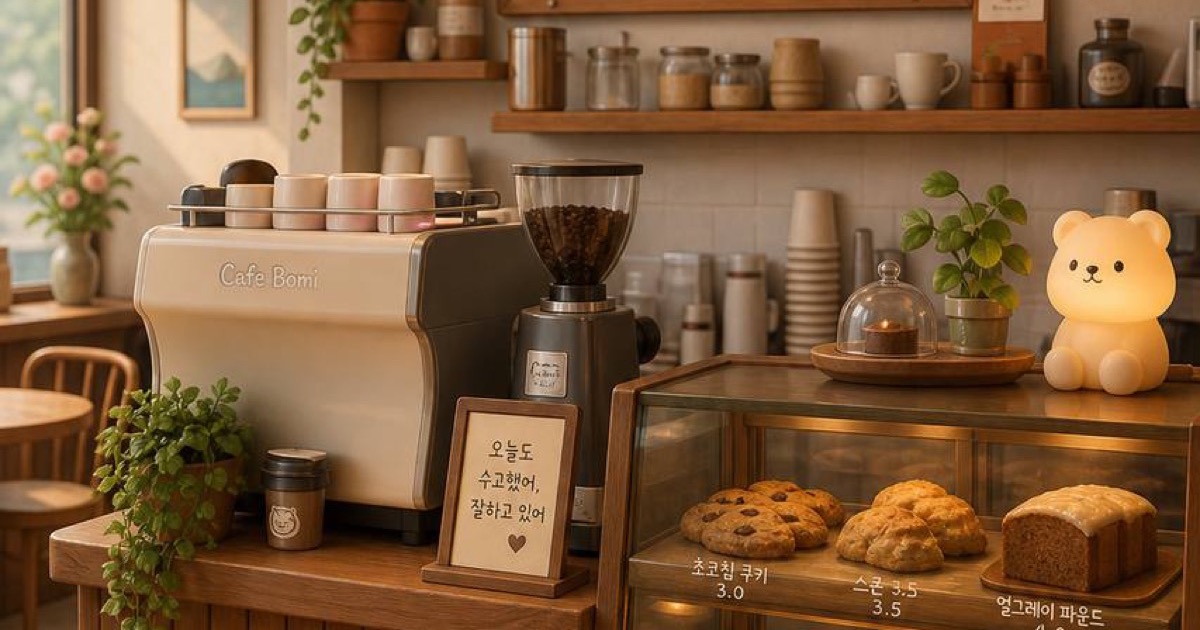
___ 주세요 — "Please give me ___." This is Pattern 01 in the SULSUL workbook, and for good reason. 물 주세요 (water, please). 이거 주세요 (this one, please). 아메리카노 한 잔 주세요 (one americano, please). Point at anything and add 주세요, and you've made a polite request. More examples are in how to say please give me in Korean.
___ 있어요? — "Do you have ___? / Is there ___?" (Pattern 03). 화장실 있어요? (Is there a restroom?) 작은 사이즈 있어요? (Do you have a small size?) 와이파이 있어요? (Is there Wi-Fi?) The answer will be 있어요 (yes, there is) or 없어요 (no, there isn't), two words you'll recognize instantly once you know the question.
___ 어디예요? — "Where is ___?" (Pattern 04). 지하철역 어디예요? (Where's the subway station?) 출구 어디예요? (Where's the exit?) You don't need "the" or "is" in Korean. Noun, then 어디예요, and you're done.
Notice that all three end in 요. That little syllable is what makes Korean polite to strangers. As long as your sentence ends in 요, you're in safe territory. The full reasoning is in how to be polite in Korean.
Group 3: The rescue lines for when you get lost
Here's the honest truth about your first real exchanges: you'll ask a perfect question and get an answer that's too fast, too long, or full of words you don't know. Beginners who only memorized questions end up nodding and leaving. Beginners who learned these three lines stay in the conversation.
잘 모르겠어요 (jal mo-reu-ge-sseo-yo) — "I'm not sure / I don't quite get it" (Pattern 21). It's softer than a flat "I don't know" and tells the other person to try again in a different way.
다시 말해 주세요 (da-si mal-hae ju-se-yo) — "Please say it again" (Pattern 22). Add 한 번만 to make it even gentler: 한 번만 다시 말해 주세요, "Just once more, please."
천천히 말해 주세요 (cheon-cheon-hi mal-hae ju-se-yo) — "Please speak slowly." People almost always slow down happily once they realize you're a learner. If you want more lines like these, see Korean phrases when someone speaks too fast.
A bonus line for when you're missing a word: 이거 한국어로 뭐예요? (i-geo han-gu-geo-ro mwo-ye-yo?), "What's this in Korean?" It turns every confused moment into a mini lesson. More in how to say it in Korean when you don't know the word.
A first conversation using only these 12 lines
Here's what a beginner's first trip to a convenience store can sound like:
You: 안녕하세요. 저기요, 우산 있어요? — an-nyeong-ha-se-yo. jeo-gi-yo, u-san i-sseo-yo? — "Hello. Excuse me, do you have umbrellas?"
Clerk: 네, 저쪽 음료수 옆에 있어요. — ne, jeo-jjok eum-nyo-su yeo-pe i-sseo-yo. — "Yes, they're over there next to the drinks."
You: 잘 모르겠어요. 천천히 말해 주세요. — jal mo-reu-ge-sseo-yo. cheon-cheon-hi mal-hae ju-se-yo. — "I didn't quite get that. Please speak slowly."
Clerk: 저기 있어요. (points) — jeo-gi i-sseo-yo. — "They're over there."
You: 아, 네! 이거 주세요. 감사합니다! — a, ne! i-geo ju-se-yo. gam-sa-ham-ni-da! — "Ah, yes! This one, please. Thank you!"
Nothing fancy, but every step worked: you opened politely, asked with a pattern, rescued yourself, and finished with a request and a thank-you.
What beginners can safely skip for now
You don't need everything at once. These can wait:
Casual speech (반말). Lines like 고마워 or 안녕 are for friends. Ending in 요 is safer until you know someone well.
The word for "you." Korean usually leaves it out. Dictionaries list 당신, but saying it to a stranger sounds odd or even rude. Just drop it.
"I" at the start of every sentence. 저는 (jeo-neun, "I") is correct, but Koreans drop it when it's obvious. 커피 좋아해요 already means "I like coffee."
Long grammar charts. The three patterns above will carry you further in your first month than any table of verb endings.
Mistakes beginners make with these phrases
Reading romanization instead of listening. "Gamsahamnida" on paper looks like five hard syllables. Out loud, it flows as gam-sa-ham-ni-da, with the h almost gone. Listen first, then read. The sound rules behind this are in basic Korean phrases for travel, with pronunciation.
Dropping the 요. 이거 줘 instead of 이거 주세요 turns a request into an order. Keep the ending even when you're nervous.
Using 저기요 to apologize. It calls someone over. For "sorry," use 죄송합니다.
Memorizing but never saying. A phrase you've only read stays stuck in your head when someone is waiting for your answer. Say it out loud until your mouth knows it.
How to practice your first 12 lines this week
Take one group per two days. On day one, say each line out loud ten times, slowly, then at normal speed. On day two, run the lines as a tiny scene, like the convenience store above, playing both parts. On the last day, mix all three groups: open, ask with a pattern, rescue yourself, close. When the 12 lines come out without thinking, you're ready to add more, and Korean small talk phrases for total beginners is a good next step.
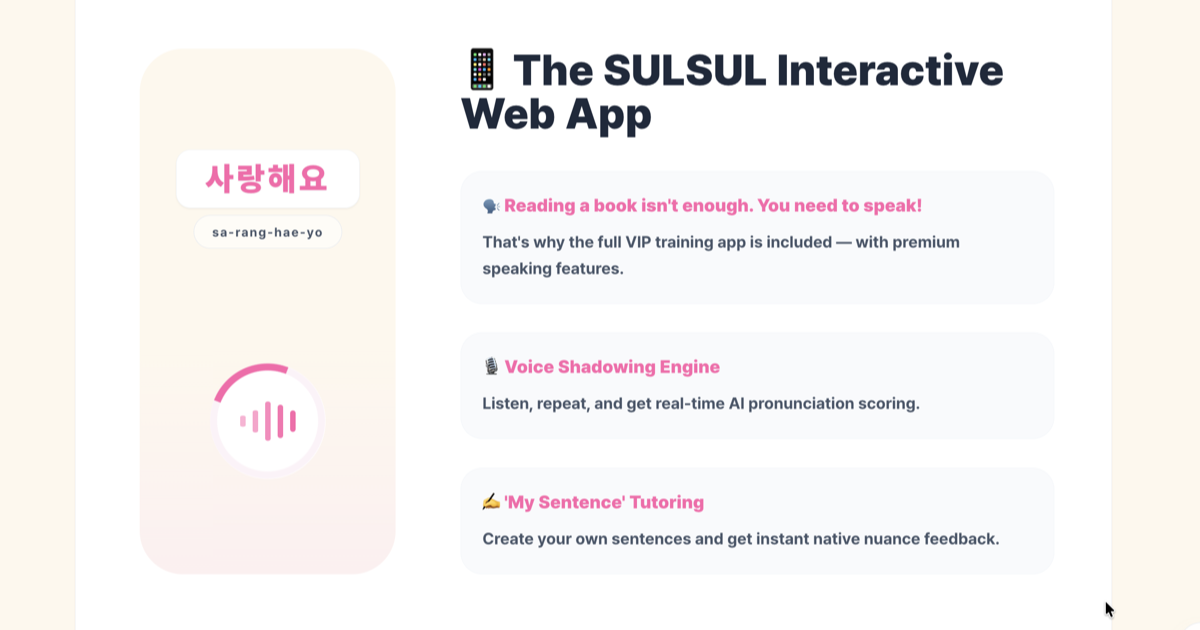
SULSUL is a speaking gym built for this: pick a pattern, say it out loud, get an instant fix from the AI pronunciation coach, then run the whole situation as a mission. The 100-pattern PDF workbook comes along as a bonus.
Now say it out loud
SULSUL says the phrase, you repeat it, and it tells you what came out wrong — 100 survival patterns for cafes, taxis and small talk in Seoul.
Start speaking Korean →