Korean Phrases for Opening a Bank Account in Korea
Opening a 계좌 (gyejwa, bank account) is the errand that turns a stay in Korea into a life in Korea — pay, rent, your phone bill and every refund you are owed all run through it. The conversation at the counter is short and packed with words nobody teaches you in class. Two patterns from the SULSUL workbook keep you inside it instead of nodding along. Pattern 20 — 무슨 뜻이에요? — is the life jacket for the moment a word goes past you: 그게 무슨 뜻이에요? (geuge museun tteusieyo?), "What does that mean?" Pattern 43 — -으면/면 — is how you ask what a condition actually buys you: 서류를 가져오면 한도가 풀려요? (seoryureul gajyeoomyeon handoga pullyeoyo?), "If I bring the documents, does the limit come off?"
- Say why you came: 계좌 만들러 왔어요 (gyejwa mandeulleo wasseoyo), "I came to open an account."
- Ask what a word means: 그게 무슨 뜻이에요? (geuge museun tteusieyo?), "What does that mean?"
- Ask what a document buys you: 서류를 가져오면 한도가 풀려요? (seoryureul gajyeoomyeon handoga pullyeoyo?), "If I bring the documents, does the limit come off?"
- Ask about the card: 카드도 같이 신청하면 언제 나와요? (kadeudo gati sincheonghamyeon eonje nawayo?), "If I apply for the card too, when is it ready?"
- Ask what to do if it goes wrong: 잘못 보내면 어떻게 해요? (jalmot bonaemyeon eotteoke haeyo?), "What do I do if I send it to the wrong person?"

How do you open an account at the counter?
A Korean 은행 (eunhaeng, bank) runs on the same rhythm as every other counter here: take a 번호표 (beonhopyo), the numbered ticket by the door, and have your first sentence ready when your number is called.
Them: 어떻게 오셨어요? — eotteoke osyeosseoyo? — "What brings you in?"
You: 계좌 만들러 왔어요. — gyejwa mandeulleo wasseoyo. — "I came to open an account."
Them: 신분증 주시겠어요? — sinbunjeung jusigesseoyo? — "Could I have your ID?"
You: 외국인등록증하고 여권 있어요. — oegugin deungnokjeunghago yeogwon isseoyo. — "I have my residence card and my passport."
통장 (tongjang) is the passbook, 계좌 is the account itself, and 체크카드 (chekeukadeu) is the debit card most people ask for in the same sitting. Bring your 외국인등록증 (oegugin deungnokjeung, residence card), your passport, and a Korean mobile number — the number is not paperwork, but nothing gets activated without it. Branches often want proof that you live and work here too, so ask about 재직증명서 (jaejik jeungmyeongseo, proof of employment) before you go.
From there the visit is a chain of conditions, and Pattern 43 tests them one at a time: 카드도 같이 신청하면 언제 나와요? (kadeudo gati sincheonghamyeon eonje nawayo?), "If I apply for the card too, when is it ready?" Attach -으면 after a stem with a batchim and -면 after one without, and any "what if" becomes a question you can say out loud. Ticket and window numbers are read with the Sino-Korean set in Korean numbers for paying and counting in Korea.
| Situation | Say this |
|---|---|
| Say why you came | 계좌 만들러 왔어요 (gyejwa mandeulleo wasseoyo) |
| Ask what a word means | 그게 무슨 뜻이에요? (geuge museun tteusieyo?) |
| Ask what a document buys you | 서류를 가져오면 한도가 풀려요? (seoryureul gajyeoomyeon handoga pullyeoyo?) |
| Ask about the card | 카드도 같이 신청하면 언제 나와요? (kadeudo gati sincheonghamyeon eonje nawayo?) |
| Ask what to do if it goes wrong | 잘못 보내면 어떻게 해요? (jalmot bonaemyeon eotteoke haeyo?) |
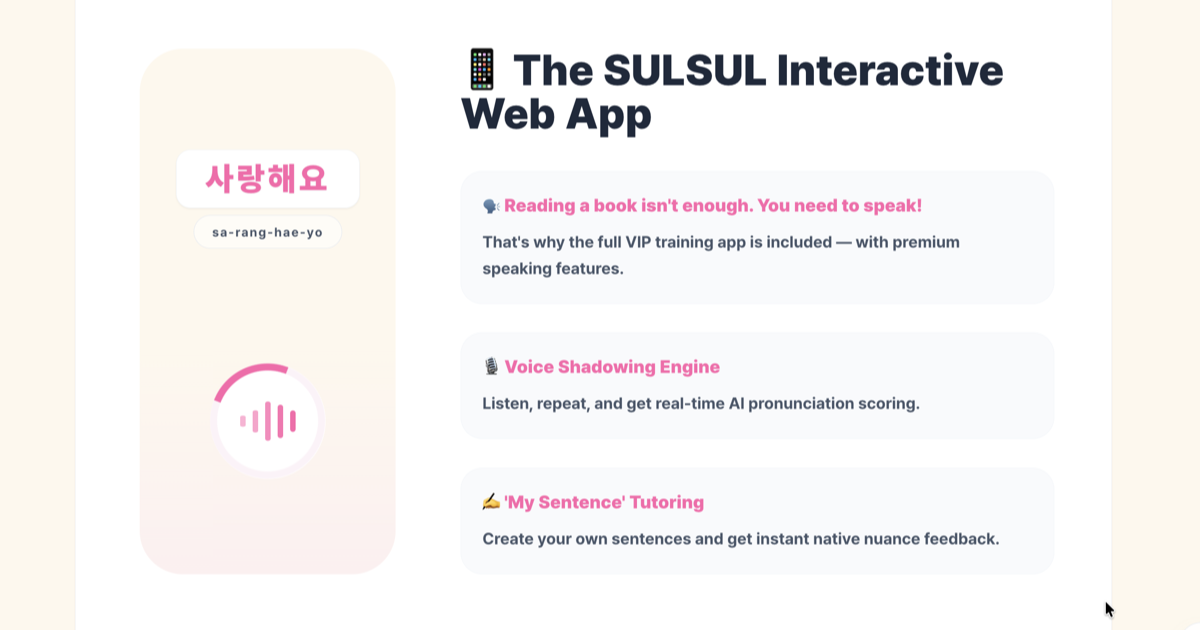
Practice this out loud with SULSUL — the app says it, you repeat it →
What do you say when a word goes past you?
Bank Korean is its own dialect — 한도계좌 (handogyejwa), 이체한도 (ichehando), 자동이체 (jadongiche), 예금주 (yegeumju) — and the polite silence after a word you did not catch is the expensive one, because you sign for whatever it meant. Pattern 20 costs a second and undoes all of it.
Them: 처음에는 한도계좌로 만들어 드릴게요. — cheoeumeneun handogyejwaro mandeureo deurilgeyo. — "We'll start you on a limited account."
You: 한도계좌가 무슨 뜻이에요? — handogyejwaga museun tteusieyo? — "What does 'handogyejwa' mean?"
Them: 이체 한도가 정해져 있는 계좌예요. — iche handoga jeonghaejyeo inneun gyejwayeyo. — "It's an account with a cap on transfers."
You: 한도는 어떻게 올려요? — handoneun eotteoke ollyeoyo? — "How do I raise the cap?"
The formula is just the unknown word plus 이/가 무슨 뜻이에요? — 이체한도가 무슨 뜻이에요?, 예금주가 무슨 뜻이에요? Carry the second version as well: 무슨 뜻이에요? asks about a word, while 무슨 말이에요? (museun marieyo?) asks what someone meant, for when the sentence made sense but the situation did not. And 잘 이해가 안 돼요 (jal ihaega an dwaeyo), "I don't quite understand," buys you the whole explanation again. When the answer comes back faster than you can hold on to, what to say when Korean is too fast is the toolkit for that half-second.
What usually goes wrong at a Korean bank?
The first thing is arriving without the document that branch happens to want, and a wasted trip is almost always one missing page. Ask twice — before you leave the house and before you leave the counter: 뭘 가져와야 해요? (mwol gajyeowaya haeyo?), "What do I have to bring?" and 오늘 안 되면 언제 다시 와야 해요? (oneul an doemyeon eonje dasi waya haeyo?), "If it can't be done today, when should I come back?" A registered address is usually part of it, so the errand in Korean phrases for the community service center in Korea comes first, with the lease from Korean phrases for talking to a real estate agent in Korea behind it.
The second is walking out with an account you cannot actually use. The card, the app and the transfer cap are three separate things, and the counter is the cheapest place to settle all three. 앱 설치 도와주시겠어요? (aep seolchi dowajusigesseoyo?), "Could you help me install the app?" is a normal request, and the app verifies against a Korean mobile number — so if you do not have one yet, Korean phrases for getting a SIM card in Korea is the errand to do first. Ask 카드는 언제 나와요? (kadeuneun eonje nawayo?) before you stand up, and the machines it opens are in Korean phrases for using an ATM in Korea.
The third is the panic later, which is why Pattern 43 is worth spending while a human is still in front of you. 잘못 보내면 어떻게 해요? (jalmot bonaemyeon eotteoke haeyo?), "What do I do if I send it to the wrong account?" and 비밀번호를 잊어버리면 어떻게 해요? (bimilbeonhoreul ijeobeorimyeon eotteoke haeyo?), "What if I forget the password?" are answers you want written down, not discovered. The same window sets up 자동이체 for rent and bills — 월세는 자동이체로 하고 싶어요 (wolseneun jadongichero hago sipeoyo) — which pairs with Korean phrases at the apartment management office in Korea. If any of it stalls, the openers in how to politely ask for help in Korean get someone to start over with you.
Say it out loud, not just in your head
그게 무슨 뜻이에요? is a sentence you cannot look up mid-sentence — a form is already turned toward you and a pen is being held out.
SULSUL is a speaking gym for exactly that moment: pick a survival pattern, say it out loud, get an instant fix from the AI pronunciation coach, then run the real situation as a mission. The 100-pattern PDF workbook comes along as a bonus.